Proper 5 / Ordinary Time 10
Preaching
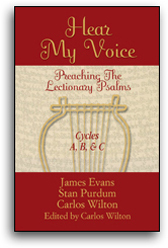
Hear My Voice
Preaching The Lectionary Psalms for Cycles A, B, C
Psalm 33 praises the God in whom the righteous trust. It was perhaps sung on the occasion of some national deliverance. Verses 1-3 are a call to praise and verses 4-5 provide the basis for the praise. The rest of the psalm details reasons for praising God and expresses confidence and trust in God.
The psalm contains the same number of poetic lines as there are letters in the Hebrew alphabet (22) probably signifying comprehensiveness of praise.
In preaching from this psalm, individual verses could be selected:

1. Verse 1 asserts that praise befits the upright. "Befits" is an acceptable word, but the KJV version of this verse could also be referenced: "Praise is comely for the upright." Though "comely" covers the meaning of "befits," it adds the sense of "beauty" and "attractiveness" that surely are qualities of praise. Is it not true that there is something beautiful about the personality that points away from itself to praise another? And by the way, praise is comely not only for the upright, but also for the reprobate and scoundrel, especially when it is part of an expression of repentance.
2. Verse 3 touts the value of singing a new song to God. Newness is not a virtue in and of itself, but old testimonies, repeated over and over, often lose their effectiveness as a witness to the goodness of God. Updated songs grow naturally out of thriving religious experiences.
3. Verses 7 and 9 both celebrate God as Creator. One of the first creative acts was bringing organization to the primeval sea, forcing it into boundaries (Genesis 1:6-7). Verse 9 says that God spoke the world into creation. Again and again, Genesis 1 describes creation happening because "God said." This verse connects also with John 1:1. What new things do we need to allow God to say in our lives, to recreate us?
-- S. P.
The psalm contains the same number of poetic lines as there are letters in the Hebrew alphabet (22) probably signifying comprehensiveness of praise.
In preaching from this psalm, individual verses could be selected:
1. Verse 1 asserts that praise befits the upright. "Befits" is an acceptable word, but the KJV version of this verse could also be referenced: "Praise is comely for the upright." Though "comely" covers the meaning of "befits," it adds the sense of "beauty" and "attractiveness" that surely are qualities of praise. Is it not true that there is something beautiful about the personality that points away from itself to praise another? And by the way, praise is comely not only for the upright, but also for the reprobate and scoundrel, especially when it is part of an expression of repentance.
2. Verse 3 touts the value of singing a new song to God. Newness is not a virtue in and of itself, but old testimonies, repeated over and over, often lose their effectiveness as a witness to the goodness of God. Updated songs grow naturally out of thriving religious experiences.
3. Verses 7 and 9 both celebrate God as Creator. One of the first creative acts was bringing organization to the primeval sea, forcing it into boundaries (Genesis 1:6-7). Verse 9 says that God spoke the world into creation. Again and again, Genesis 1 describes creation happening because "God said." This verse connects also with John 1:1. What new things do we need to allow God to say in our lives, to recreate us?
-- S. P.