The People And The Pope
Adult study
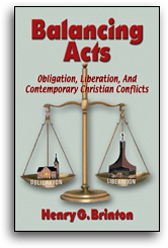
Balancing Acts
Obligation, Liberation, And Contemporary Christian Conflicts
It's October 1995. Pope John Paul II travels through the streets of Baltimore in a papal parade, celebrates Mass at the Camden Yards baseball stadium, and is cheered by a multitude of Roman Catholics. He is their leader, their role model, their Holy Father -- the one they believe to be God's deputy, the Vicar of Christ. They understand that he speaks for the Catholics of the world, and they appreciate his messages of moral clarity in a relativistic world.

Joining these Catholics, in spirit if not in person, are many Protestants who secretly wish they had a pope. Despite the fact that their churches were formed by Christians desperate to escape papal authority, these Protestants admire John Paul II and many dimensions of his leadership of the Catholic Church. If their own denominations could work out the organizational details, they would really like a pope of their own. Why is this?
For starters, the pope is a symbol of the unity of the Catholic Church. While it is said that Baptists "multiply by division," forming new congregations every time a church splits, Catholics remain united under the leadership of the Bishop of Rome. This is not to say that all Catholics agree with the pope's teachings -- in fact, a majority of American Catholics, according to a 2003 Washington Post-ABC News poll, dissent from the pope's teachings on birth control, premarital sex, and the death penalty. But all do have a connection to the same Holy Father, and eighty percent approve of the way the pope has done his job. Although they are not "one big happy family" -- especially in the wake of recent clergy sexual-abuse scandals -- Catholics are clearly a family, Baltimore to Bangkok.
"The Bishop of Rome does offer an important sign for the unity of the church," notes the Reverend Dr. L. Gregory Jones. This United Methodist minister was, at the time of the pope's visit, an associate professor of theology at Loyola College in Baltimore. "He reminds Protestants of the scandal of disunity. The pope seeks reconciliation among the churches, most recently in his encyclical titled, 'That All May Be One.' "
I am also impressed by the fact that the pope speaks with remarkable clarity. Whether you agree with him or not, you have to admit that John Paul II has a strong sense of covenant, and he is completely clear about where he stands. Pro-life. Pro-celibate-priesthood. Anti-contraception. Anti-ordination-of-women. Ninety percent of American Catholics feel that the pope has done a good-to-excellent job of setting a personal moral example, and even non-Christians admire him for holding on to strong beliefs in our morally wavering world.
Protestants tired of the diversity of stands in their own churches, where "individual conscience" rules, are drawn to the clarity of the pope's positions. They may not always like what he says, but at least they know what he is saying. "I think he has stood up for a lot of things," said Bob Maifarth, a Florida Presbyterian, to The Washington Post in October 2003, "saying that just because it's the year 2000-and-something, that doesn't mean what's in the Bible has to change."
Some Protestants "are looking for someone to speak with pastoral authority in our time," reflects the Reverend Dr. Edward W. Castner, former Associate General Presbyter of National Capital Presbytery. They are asking: "Where are the standards for today? Who is speaking out for them?" Instead of a pope, Presbyterians have a denominational headquarters that does not, according to Castner, "seem like a place of authority, tradition, and pastoral concern. It is more of an administrative functioning unit."
John Paul II is "remarkably thoughtful and profound," adds Jones, and the pope shows signs of being a fan of the exodus, working for the liberation of the oppressed. "This pope offers a sign of hope to a fragmented and despairing world. He has been critical of consumerism and materialism, and knows what the culture of death looks like. The pope's theological passion and exemplary witness shine through the darkness of disbelief, bureaucracy, and chaos."
In addition, the pope is a leader with a human touch. I was once given a humorous coffee mug which defines Protestantism in the following way: "It's the thought that counts." (The same mug's definition of Catholicism: "Stop thinking those thoughts.") Focus on "thought" is a problem for Protestantism, because Christianity has always been a very earthy religion. Jesus: God in human flesh. Communion: The body and the blood. Church: The body of Christ. While some may say, "The pope is only a man," others will say, "Exactly. That's the point." The pope is a human, representing God-in-human-form. There is power in his flesh-and-blood presence, in his ability to speak with visitors in their own languages, in his human touch.
For all of these reasons, I knew that there would be little protest from Protestants when the pope visited Baltimore in 1995. But just a few years later, parishioners in the Roman Catholic Church began to express intense dissatisfaction with the way in which their church hierarchy was handling cases of sexual abuse by Catholic clergy, culminating in a 2003 Washington Post-ABC News poll finding that 74 percent of American Catholics believed that the pope should have done more to address the problem of sexual abuse of children and teenagers by priests. One group in particular, "Voice of the Faithful," rose up from the grass roots in early 2002 and began to talk about making the Catholic Church more democratic, with the goal of gaining more governing rights for the laity. The faithful parishioners who had always looked up to the pope were now asking for the pope to become more accountable to the people.
When Voice of the Faithful gathered several thousand Catholics in Boston in July 2002, I understood both the depth of their concern and the direction they wanted to go. Rallying around the motto "Keep the Faith, Change the Church," they were riding a wave of outrage over the clergy sexual-abuse crisis, and they wanted to shift power downward from the top of their hierarchical church. In a little over six months, Voice of the Faithful had grown to 16,000 members from forty states and 21 countries, and was well on its way to becoming a force to be reckoned with in the governing bodies of the Roman Catholic Church.
As a Presbyterian pastor, committed to democratic church government, my initial reaction was simply to say, "Welcome to my world." I spend every day serving an institution that puts power in the hands of laypeople -- and I'm well aware of the assets and liabilities of such an approach. While having a voice and a vote certainly gives people more opportunities for institutional involvement and may even inspire greater commitment to the church's benevolent works, the process of democratization can also dilute the purity of the church's moral message and undermine its influence in larger political and social spheres. Furthermore, I am aware of no hard evidence that lay leadership provides protection against church scandals -- which is what many Voice of the Faithful members seem to be hoping. We Presbyterians know that there is no panacea to be found in shifting power from the pope to the people.
It is important to keep in mind that one of the great strengths of the Catholic Church has been the influence it derives from the unity of its message at every level of church life. From solid grass-roots support for its parochial school system to the commitment to Third World debt relief exemplified by Pope John Paul II's underwriting of the Jubilee 2000 debt-relief campaign, Catholicism has a social and political impact few other religions can imagine. Catholics have been able to do the work of Christian charity largely because they have practiced moral clarity.
In contrast are Protestant Christians such as the Presbyterians, a group with a very different history and philosophy. My current congregation, Fairfax Presbyterian, like any other Presbyterian church, is a representative democracy. As I explain to new members of my church, Presbyterians are ruled by "presbyters" -- the Greek word for "elders" -- and decisions about the life and ministry of the church are made primarily by laypeople elected and ordained to serve as those elders. The result is that on some issues -- and particularly politically charged ones such as abortion or the ordination of gays and lesbians -- the Presbyterian Church speaks with many voices, revising its policies over time and sometimes changing direction altogether.
That is contrary to traditional Catholic practice. "The idea that any board in a diocese could have independence from the authority of the bishop of the diocese is utterly non-Catholic," observes my friend Bill Parent, a priest in the Archdiocese of Washington, "something akin to disgruntled Presbyterians clamoring for a pope." While he's all in favor of laypeople serving on church boards, he reminds me that all such participation must relate to the role of the Catholic bishop as "chief shepherd" of the diocese.
But Voice of the Faithful -- and about a dozen other reform groups -- seems to be at the forefront of a more general change in the culture of the Catholic Church, at least in the United States. Dean Hoge, a sociologist at Catholic University, tells me that young Catholics see the teaching authority of the Vatican as much less important than do the older members of the church; in a 1999 survey, thirty percent of those born after Vatican II was introduced in the early '60s, said it is important, compared with 64 percent of the pre-Vatican II generation. And the 2003 Washington Post-ABC News poll revealed that 64 percent of American Catholics think that the next pope should change church policies to reflect the attitudes and lifestyles of Catholics today.
Changes are clearly underway, and while they may lead to more active involvement from people in the pews, they could also cause deterioration in church unity. Over the years, Catholics have enjoyed both institutional unity and remarkable moral clarity, and parishioners have been given a clear sense of which direction their moral guidepost points. Consider the way Catholic teaching about the sanctity of life has affected health care delivery, especially at the end of life -- Catholic hospitals have led the way in providing palliative care for dying patients. But today there is not necessarily more of a unified "Catholic vote" than a "Protestant vote" in this country. In the 2000 presidential election, more Catholics voted for pro-choice Al Gore than for pro-life George Bush, according to exit polls.
Catholics are becoming more like Presbyterians, a group of Christians that has trouble coming to a clear national consensus about some controversial issues because there are 2.5 million of us holding 2.5 million beliefs. With regard to abortion, for example, my denomination has been basically pro-choice, although pro-life Presbyterians have pushed to modify the policy over the years. We now oppose abortion as a means of birth control and gender selection, affirm adoption as preferable to the abortion of unwanted children, and consider the "intact dilation and extraction" procedure (also called "partial birth abortion") a "matter of grave moral concern."
Is this lack of moral clarity good or bad? It depends. Whether you consider this a weak, mixed message or a realistic one that parishioners will actually follow, it serves as an excellent illustration of our democratic church government in action. Sometimes politically charged issues split us down the middle, which is what has happened over the issue of ordaining gays and lesbians. Several years ago a desire for clarity led to the introduction of a "fidelity and chastity" clause which excludes sexually active gays and lesbians from ordination. Our national General Assembly voted to remove the requirement in 2001 (Christian charity); and our regional presbyteries voted to preserve it in 2002 (moral clarity).
That's just the kind of division -- healthy in some lights, destructive in others -- that could come to characterize a more democratic Catholic Church, because I doubt that 63 million American Catholics are going to behave very differently from 2.5 million American Presbyterians. And while the leaders of Voice of the Faithful have announced the ambitious goal of getting half of the nation's Catholics involved, and are actively courting the broad middle of the laity, I don't know how they'll avoid the hot-button issues that tend to divide church groups. One of the founders of Voice of the Faithful, Svea Fraser, tells me that they're not taking on those issues now, although they know that they'll eventually come up. "All we want now," she says, "is to find a place at the table, where all voices can be heard." But all those voices are sure to express a huge variety of opinions.
While I have concerns about democratic forms of church government, I'm not opposed to them -- I wouldn't be a Presbyterian pastor if I were. In fact, I believe that being liberated from hierarchical control frees us to be energetic followers of Moses, and to do the work of Christian charity with personal passion. In my experience, there is nothing more powerful than a group of people who feel called by God to perform a particular mission, whether it be serving on a church board, teaching a class, repairing the home of a low-income neighbor, or starting a new church. And in terms of Sunday offerings, which are one important measure of commitment, studies have shown that Protestants give higher portions of their income to the work of the church -- often two or three times greater -- than Catholics.
When my associate pastor and I meet with our elders for our monthly board meetings, I am often amazed by the skills and insights that these sixteen laypeople bring to the work of Fairfax Presbyterian Church. As a group of men and women, young and old, liberal and conservative, married and single, with careers ranging from academics to engineering to national security, we represent the broader congregation -- and whenever we face a challenging issue together, I have been consistently grateful for the clear guidance of these elders.
There are fewer places to hide in a church that depends on such lay leadership, and fewer ways to remain passive. In theory, if not always in practice, the unique set of insights, talents, and energy of every church member is needed to make a democratic congregation work. When functioning properly, such a church feels more like a religious movement than a religious institution, and it leans closer to the exodus of Moses than to the covenant of Abraham.
Some Catholics seem ready for this sort of democratic decision making. Lena Woltering, the coordinator of a lay group called FOSIL -- Fellowship of Southern Illinois Laity -- tells me that in their vision of church reform, "the model of shared authority and ownership is certainly something we are working toward." If this goal is achieved, it will transform the church no less profoundly than did the Protestant Reformation of the sixteenth century. Others, however, resist the notion of change. Susan Gibbs, spokeswoman for the Catholic Archdiocese of Washington, observes that most reform groups are small, recalling that in the late '90s, a group called "We Are Church" announced they would gather one million signatures from American Catholics in one year to support a number of reforms. "After extending their deadline an extra six months, they barely hit 30,000, if that," Gibbs told me in 2002.
Whatever the fate of the new reform movements, there will always be some who feel drawn to the clarity of Catholicism, and other Christians who seek the Protestant process of continual consensus building. The practical challenge for Catholics -- and other Christians with hierarchical forms of church government -- is to find ways to allow parishioners to take a role in shaping the mission and ministry of the church. The opposite challenge, for Presbyterians and others with democratic forms of church government, is to work on achieving consensus among church members, and speaking with moral clarity about issues of concern.
Still, within every community of faith, there will be not only a longing for an Abrahamic pope, but also a hunger to be liberated, Moses-style, from captivity to a church hierarchy. Both desires can be beneficial to society, but in widely divergent ways, with Catholic unity providing spiritual and social stability and Protestant diversity offering ever-changing religious and communal opportunities. It takes all sorts, I know, and I have to trust that God is present in not only the obligations and moral clarity being lifted up by Catholics, but also in the work of liberation and Christian charity being done by Protestants. The challenge for church leaders is to keep these qualities in a state of creative tension, never allowing one to completely dominate the life of the Christian community.
Joining these Catholics, in spirit if not in person, are many Protestants who secretly wish they had a pope. Despite the fact that their churches were formed by Christians desperate to escape papal authority, these Protestants admire John Paul II and many dimensions of his leadership of the Catholic Church. If their own denominations could work out the organizational details, they would really like a pope of their own. Why is this?
For starters, the pope is a symbol of the unity of the Catholic Church. While it is said that Baptists "multiply by division," forming new congregations every time a church splits, Catholics remain united under the leadership of the Bishop of Rome. This is not to say that all Catholics agree with the pope's teachings -- in fact, a majority of American Catholics, according to a 2003 Washington Post-ABC News poll, dissent from the pope's teachings on birth control, premarital sex, and the death penalty. But all do have a connection to the same Holy Father, and eighty percent approve of the way the pope has done his job. Although they are not "one big happy family" -- especially in the wake of recent clergy sexual-abuse scandals -- Catholics are clearly a family, Baltimore to Bangkok.
"The Bishop of Rome does offer an important sign for the unity of the church," notes the Reverend Dr. L. Gregory Jones. This United Methodist minister was, at the time of the pope's visit, an associate professor of theology at Loyola College in Baltimore. "He reminds Protestants of the scandal of disunity. The pope seeks reconciliation among the churches, most recently in his encyclical titled, 'That All May Be One.' "
I am also impressed by the fact that the pope speaks with remarkable clarity. Whether you agree with him or not, you have to admit that John Paul II has a strong sense of covenant, and he is completely clear about where he stands. Pro-life. Pro-celibate-priesthood. Anti-contraception. Anti-ordination-of-women. Ninety percent of American Catholics feel that the pope has done a good-to-excellent job of setting a personal moral example, and even non-Christians admire him for holding on to strong beliefs in our morally wavering world.
Protestants tired of the diversity of stands in their own churches, where "individual conscience" rules, are drawn to the clarity of the pope's positions. They may not always like what he says, but at least they know what he is saying. "I think he has stood up for a lot of things," said Bob Maifarth, a Florida Presbyterian, to The Washington Post in October 2003, "saying that just because it's the year 2000-and-something, that doesn't mean what's in the Bible has to change."
Some Protestants "are looking for someone to speak with pastoral authority in our time," reflects the Reverend Dr. Edward W. Castner, former Associate General Presbyter of National Capital Presbytery. They are asking: "Where are the standards for today? Who is speaking out for them?" Instead of a pope, Presbyterians have a denominational headquarters that does not, according to Castner, "seem like a place of authority, tradition, and pastoral concern. It is more of an administrative functioning unit."
John Paul II is "remarkably thoughtful and profound," adds Jones, and the pope shows signs of being a fan of the exodus, working for the liberation of the oppressed. "This pope offers a sign of hope to a fragmented and despairing world. He has been critical of consumerism and materialism, and knows what the culture of death looks like. The pope's theological passion and exemplary witness shine through the darkness of disbelief, bureaucracy, and chaos."
In addition, the pope is a leader with a human touch. I was once given a humorous coffee mug which defines Protestantism in the following way: "It's the thought that counts." (The same mug's definition of Catholicism: "Stop thinking those thoughts.") Focus on "thought" is a problem for Protestantism, because Christianity has always been a very earthy religion. Jesus: God in human flesh. Communion: The body and the blood. Church: The body of Christ. While some may say, "The pope is only a man," others will say, "Exactly. That's the point." The pope is a human, representing God-in-human-form. There is power in his flesh-and-blood presence, in his ability to speak with visitors in their own languages, in his human touch.
For all of these reasons, I knew that there would be little protest from Protestants when the pope visited Baltimore in 1995. But just a few years later, parishioners in the Roman Catholic Church began to express intense dissatisfaction with the way in which their church hierarchy was handling cases of sexual abuse by Catholic clergy, culminating in a 2003 Washington Post-ABC News poll finding that 74 percent of American Catholics believed that the pope should have done more to address the problem of sexual abuse of children and teenagers by priests. One group in particular, "Voice of the Faithful," rose up from the grass roots in early 2002 and began to talk about making the Catholic Church more democratic, with the goal of gaining more governing rights for the laity. The faithful parishioners who had always looked up to the pope were now asking for the pope to become more accountable to the people.
When Voice of the Faithful gathered several thousand Catholics in Boston in July 2002, I understood both the depth of their concern and the direction they wanted to go. Rallying around the motto "Keep the Faith, Change the Church," they were riding a wave of outrage over the clergy sexual-abuse crisis, and they wanted to shift power downward from the top of their hierarchical church. In a little over six months, Voice of the Faithful had grown to 16,000 members from forty states and 21 countries, and was well on its way to becoming a force to be reckoned with in the governing bodies of the Roman Catholic Church.
As a Presbyterian pastor, committed to democratic church government, my initial reaction was simply to say, "Welcome to my world." I spend every day serving an institution that puts power in the hands of laypeople -- and I'm well aware of the assets and liabilities of such an approach. While having a voice and a vote certainly gives people more opportunities for institutional involvement and may even inspire greater commitment to the church's benevolent works, the process of democratization can also dilute the purity of the church's moral message and undermine its influence in larger political and social spheres. Furthermore, I am aware of no hard evidence that lay leadership provides protection against church scandals -- which is what many Voice of the Faithful members seem to be hoping. We Presbyterians know that there is no panacea to be found in shifting power from the pope to the people.
It is important to keep in mind that one of the great strengths of the Catholic Church has been the influence it derives from the unity of its message at every level of church life. From solid grass-roots support for its parochial school system to the commitment to Third World debt relief exemplified by Pope John Paul II's underwriting of the Jubilee 2000 debt-relief campaign, Catholicism has a social and political impact few other religions can imagine. Catholics have been able to do the work of Christian charity largely because they have practiced moral clarity.
In contrast are Protestant Christians such as the Presbyterians, a group with a very different history and philosophy. My current congregation, Fairfax Presbyterian, like any other Presbyterian church, is a representative democracy. As I explain to new members of my church, Presbyterians are ruled by "presbyters" -- the Greek word for "elders" -- and decisions about the life and ministry of the church are made primarily by laypeople elected and ordained to serve as those elders. The result is that on some issues -- and particularly politically charged ones such as abortion or the ordination of gays and lesbians -- the Presbyterian Church speaks with many voices, revising its policies over time and sometimes changing direction altogether.
That is contrary to traditional Catholic practice. "The idea that any board in a diocese could have independence from the authority of the bishop of the diocese is utterly non-Catholic," observes my friend Bill Parent, a priest in the Archdiocese of Washington, "something akin to disgruntled Presbyterians clamoring for a pope." While he's all in favor of laypeople serving on church boards, he reminds me that all such participation must relate to the role of the Catholic bishop as "chief shepherd" of the diocese.
But Voice of the Faithful -- and about a dozen other reform groups -- seems to be at the forefront of a more general change in the culture of the Catholic Church, at least in the United States. Dean Hoge, a sociologist at Catholic University, tells me that young Catholics see the teaching authority of the Vatican as much less important than do the older members of the church; in a 1999 survey, thirty percent of those born after Vatican II was introduced in the early '60s, said it is important, compared with 64 percent of the pre-Vatican II generation. And the 2003 Washington Post-ABC News poll revealed that 64 percent of American Catholics think that the next pope should change church policies to reflect the attitudes and lifestyles of Catholics today.
Changes are clearly underway, and while they may lead to more active involvement from people in the pews, they could also cause deterioration in church unity. Over the years, Catholics have enjoyed both institutional unity and remarkable moral clarity, and parishioners have been given a clear sense of which direction their moral guidepost points. Consider the way Catholic teaching about the sanctity of life has affected health care delivery, especially at the end of life -- Catholic hospitals have led the way in providing palliative care for dying patients. But today there is not necessarily more of a unified "Catholic vote" than a "Protestant vote" in this country. In the 2000 presidential election, more Catholics voted for pro-choice Al Gore than for pro-life George Bush, according to exit polls.
Catholics are becoming more like Presbyterians, a group of Christians that has trouble coming to a clear national consensus about some controversial issues because there are 2.5 million of us holding 2.5 million beliefs. With regard to abortion, for example, my denomination has been basically pro-choice, although pro-life Presbyterians have pushed to modify the policy over the years. We now oppose abortion as a means of birth control and gender selection, affirm adoption as preferable to the abortion of unwanted children, and consider the "intact dilation and extraction" procedure (also called "partial birth abortion") a "matter of grave moral concern."
Is this lack of moral clarity good or bad? It depends. Whether you consider this a weak, mixed message or a realistic one that parishioners will actually follow, it serves as an excellent illustration of our democratic church government in action. Sometimes politically charged issues split us down the middle, which is what has happened over the issue of ordaining gays and lesbians. Several years ago a desire for clarity led to the introduction of a "fidelity and chastity" clause which excludes sexually active gays and lesbians from ordination. Our national General Assembly voted to remove the requirement in 2001 (Christian charity); and our regional presbyteries voted to preserve it in 2002 (moral clarity).
That's just the kind of division -- healthy in some lights, destructive in others -- that could come to characterize a more democratic Catholic Church, because I doubt that 63 million American Catholics are going to behave very differently from 2.5 million American Presbyterians. And while the leaders of Voice of the Faithful have announced the ambitious goal of getting half of the nation's Catholics involved, and are actively courting the broad middle of the laity, I don't know how they'll avoid the hot-button issues that tend to divide church groups. One of the founders of Voice of the Faithful, Svea Fraser, tells me that they're not taking on those issues now, although they know that they'll eventually come up. "All we want now," she says, "is to find a place at the table, where all voices can be heard." But all those voices are sure to express a huge variety of opinions.
While I have concerns about democratic forms of church government, I'm not opposed to them -- I wouldn't be a Presbyterian pastor if I were. In fact, I believe that being liberated from hierarchical control frees us to be energetic followers of Moses, and to do the work of Christian charity with personal passion. In my experience, there is nothing more powerful than a group of people who feel called by God to perform a particular mission, whether it be serving on a church board, teaching a class, repairing the home of a low-income neighbor, or starting a new church. And in terms of Sunday offerings, which are one important measure of commitment, studies have shown that Protestants give higher portions of their income to the work of the church -- often two or three times greater -- than Catholics.
When my associate pastor and I meet with our elders for our monthly board meetings, I am often amazed by the skills and insights that these sixteen laypeople bring to the work of Fairfax Presbyterian Church. As a group of men and women, young and old, liberal and conservative, married and single, with careers ranging from academics to engineering to national security, we represent the broader congregation -- and whenever we face a challenging issue together, I have been consistently grateful for the clear guidance of these elders.
There are fewer places to hide in a church that depends on such lay leadership, and fewer ways to remain passive. In theory, if not always in practice, the unique set of insights, talents, and energy of every church member is needed to make a democratic congregation work. When functioning properly, such a church feels more like a religious movement than a religious institution, and it leans closer to the exodus of Moses than to the covenant of Abraham.
Some Catholics seem ready for this sort of democratic decision making. Lena Woltering, the coordinator of a lay group called FOSIL -- Fellowship of Southern Illinois Laity -- tells me that in their vision of church reform, "the model of shared authority and ownership is certainly something we are working toward." If this goal is achieved, it will transform the church no less profoundly than did the Protestant Reformation of the sixteenth century. Others, however, resist the notion of change. Susan Gibbs, spokeswoman for the Catholic Archdiocese of Washington, observes that most reform groups are small, recalling that in the late '90s, a group called "We Are Church" announced they would gather one million signatures from American Catholics in one year to support a number of reforms. "After extending their deadline an extra six months, they barely hit 30,000, if that," Gibbs told me in 2002.
Whatever the fate of the new reform movements, there will always be some who feel drawn to the clarity of Catholicism, and other Christians who seek the Protestant process of continual consensus building. The practical challenge for Catholics -- and other Christians with hierarchical forms of church government -- is to find ways to allow parishioners to take a role in shaping the mission and ministry of the church. The opposite challenge, for Presbyterians and others with democratic forms of church government, is to work on achieving consensus among church members, and speaking with moral clarity about issues of concern.
Still, within every community of faith, there will be not only a longing for an Abrahamic pope, but also a hunger to be liberated, Moses-style, from captivity to a church hierarchy. Both desires can be beneficial to society, but in widely divergent ways, with Catholic unity providing spiritual and social stability and Protestant diversity offering ever-changing religious and communal opportunities. It takes all sorts, I know, and I have to trust that God is present in not only the obligations and moral clarity being lifted up by Catholics, but also in the work of liberation and Christian charity being done by Protestants. The challenge for church leaders is to keep these qualities in a state of creative tension, never allowing one to completely dominate the life of the Christian community.