One In Need Of Healing: Naaman's Story
Stories
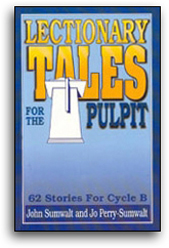
Lectionary Tales For The Pulpit
62 Stories For Cycle B
We would all be well advised to be careful where and how we tell this story.
I stand before you today as one in need of healing, as Naaman was, as we all are.
We come here in our brokenness, suffering as we all do from the diseases of racism, sexism, nationalism, denominationalism and homophobia. Some of us come bearing the scars of dysfunctional families: sexual, physical and emotional abuse - both abusers and abused - some of us hurting from wounds we have received from brothers and sisters sitting in these same pews.

We come with all of our pathologies: physical, emotional and spiritual, with all of our fears and griefs, into this community of recovering, forgiven sinners, this sinful and holy, dysfunctional and redeeming church - seeking healing.
And I, for one, am glad to be here in this community where I have been both abused and loved, where I have both sinned and been forgiven. And where I have been healed.
I cannot come into this place without thinking of my uncle, Donald Sumwalt, who, as some of you remember, was the registrar of this event for many years. He and I always sat together at the communion service on the last day. I will be thinking of him on Thursday as we come together in that service - and will remember, as I always do, what he did for me on my first ordination day in June of 1976. We were all together at the American Baptist Assembly in Green Lake. My wife Jo and I were tenting in the campground there. Uncle Don and Aunt Hazel were in a camper in a lot next to ours. I woke up on ordination Sunday with a knot in my back about the size of a grapefruit. It was all I could do to lift myself out of the sleeping bag. Every movement caused excruciating pain. I didn't know how I was going to get dressed, let alone walk up an aisle, kneel down and be ordained. Uncle Don came over and told me to lie down on my stomach. Then he laid hands on me and massaged my back muscles until I was able to walk. When Bishop Jesse DeWitt laid his hands on me later that morning, I knew I was being ordained into a healing community.
It was two years after that, in 1978, that Uncle Don was diagnosed with multiple myeloma, a cancer of the bone. The doctors did not expect him to live more than three months. He would not accept their prognosis. He prayed and we all prayed, and he felt assurance that he would be healed for ministry. He was. He served eight more years at Juda and at Chippewa Falls before his death in 1986. This is a community in which people are healed.
I gave thanks as I opened my travel kit this morning that two items were not there that I have had to bring with me in some years past - my Maalox bottle and my valium prescription. During the book controversy in Montello in 1981, and again during the building project in 1984, I suffered a stress-related stomach disorder. Lloyd Rediger helped me to give up some of my co-dependent and workaholic behavior - to "try smarter not harder" as he used to preach to all of us. I have learned to manage my stress by jogging and by taking regular days off. I am learning that I am not responsible for everything my church does or doesn't do - and to resist my obsession to try to control everything. I grow tomatoes now and I play softball (which is a different kind of disease). I understand myself to be in recovery. I experience healing and I give thanks for healing almost every day.
During those two dark years when I was sick, much sicker than I realized at the time (when I came here to this place, to this school for ministry, wondering if I would ever be completely well again and fearing that I would have to give up the work I loved), there were persons here who listened to me as I expressed my hurt and literally put their arms around me and loved me enough that I was able to go home and continue my work with hope. This is a healing community!
Those of us who are clergy tell our families and our congregations, as they watch us pack our golf clubs and our tennis rackets, that we come here for academic lectures and workshops (we are required to do it, you know - continuing education). But they know, and we know too, if we are honest with ourselves, that we really come here to be healed. There are other places we could go for lectures and workshops.
We come here to soak our weary souls in long, warm conversations with friends: to be immersed again in the restorative fellowship of kindred spirits and anointed with the healing oil of laughter. We come to break bread together, here in front of the altar, in the fellowship hall across the way, and in the cafes, restaurants and pizza joints downtown. Damrows over here on College Avenue serves the best oatmeal and the best toasted whole grain bread in the world. It is a holy place where one can savor an early morning cup of coffee and enjoy the companionship of good friends. Rabbi Jesus sometimes comes in and opens our eyes for us. And there is a bar over here on the northwest side which serves the hottest chili this side of Texas. All of this, our lectures and workshops, the exchange of new ideas, the sharing of hurts and joys, the prayers we pray, the songs we sing, pick-up basketball games, shopping sprees, late night outings to the movies, solitary walks, quiet discussions with superintendents: all of this is healing.
The young, captive girl who served in Naaman's household, were she alive today, could confidently send the Naamans of our time to this body of Christ. This is a healing community! And it will remain, long after this school for ministry is over, a community in need of healing. For we healers are also sinners, and we are continually wounding each other and being wounded by the sin-corrupted systems which plague our institutional life.
There is one corrupt system in particular which causes us more pain than anything else in our beloved church, and if it is not healed it will certainly be the death of United Methodism. That is the appointment system, our peculiar method of marrying pastors and congregations. It is more than a little ironic that we United Methodists, who are so much committed to egalitarian principles in government, in the market place, in education and the arts, and to democratic reform around the world, should cling so assiduously to such an autocratic method of choosing servant leaders. I think our late brother, John Wesley, who had no wish to leave the Church of England or to break its rules, who was repulsed by the thought of preaching in the fields and streets, who was most reluctant to allow lay persons to preach and to ordain lay preachers on his own authority, who resisted to his dying day the formation of a separate church - I think John Wesley would understand our reluctance to break with familiar traditions. But as he could not deny the spirit - the holy, healing spirit - neither can we.
We cannot be whole and healthy and joy-filled in this United Methodist movement until lay persons and pastors in our local churches share appointment power equally, and in a fully collegial way, with district superintendents and bishops. No, I am not suggesting that we adopt a call system. Connectionalism is our strength. Let bishops and district superintendents continue to be strong advocates for shared mission. The world is indeed our parish, now even more than it was for John Wesley. But we will not be able to minister effectively in the world of the twenty-first century if we perpetuate the eighteenth century hierarchical power structures that cause so much suffering among pastors and local congregations who are left out of the power loop.
How can we be healed?
Perhaps in the same way that Namaan was healed.
Naaman's Story
Naaman was a man like Norman Schwarzkopf of our own time, a hero of the nation, a commander of the army, held in high regard by the commander-in-chief because of his victories in battle. Imagine the reaction of the American public if it became known that such a man, though a mighty warrior, had AIDS. And can you imagine what the reaction would be if the President of the United States sent our Naaman off to visit the President of Cuba, let's say, carrying a letter like the one the King of Aram sent to the King of Israel. Do you think Mr. Castro might have reason to wonder about our President's intentions?
The general would arrive in Havana on Air Force One, carrying a trunkload of American dollars, a couple of Cadillacs and several tickets to next year's Super Bowl game. A limousine would whisk him off to the prophet's house, where he would be met by a secretary wearing latex gloves and bearing a message from the prophet telling him to go wash in the Bay of Pigs. We can understand why a general of the United States Army might be infuriated by such a suggestion. The Persian Gulf or the Panama Canal maybe, but not the Bay of Pigs!
Naaman would have been well aware that it was just east of the Jordan, in the time of the Israelite King Ahab, that his nation had suffered one of its most ignominious defeats. One hundred thousand Aramaean soldiers were slaughtered by the Israelites and the Aramaean king was captured. Wash in the Jordan indeed! But somehow his advisors were able to convince him to do it. And he was healed, as he had hoped, but not in the way he expected.
Naaman, whose power in Aram was second only to that of the king, could find no healing there. The Spirit, through the most unlikely voice of a young slave girl, sent him to another nation, to the prophet of a God he did not know.
Through whom will the spirit speak to us? In what dirty little river will God have us wash our leprous church?
Majid Tehranian, director of the Peace Institute in Honolulu, said in a speech recently:
All of us live with three kinds of lies: the lies we tell others, the lies we tell ourselves, and the lies we don't even know we are telling, or, more accurately, living.
Tehranian said,
We know the lies we tell to others; the lies we tell ourselves are a bit harder to discern, but the only way to really grasp the lies we don't even know we are living is to get outside our own cultural setting.
(The Christian Century, p. 635, July 1, 1992)
In this case it might help at least to get outside our own denomination.
There is a prophet in the Roman Catholic Church by the name of William Rademacher who has written about these issues in a book called Lay Ministry (Cross Roads Publishing Co., 1991).
Rademacher describes several institutional pathologies which plague his beloved Roman church:
Patriarchy, fear of women in ministry, obsession with secrecy, the preoccupation with sex, the compulsive need to control (especially the selection of bishops), and the fear of sharing real authority ...
"... a pathology," he says, "that is evident in the tight control and secrecy in the hierarchic system that selects only ultrasafe men as bishops." "Prophets," he adds, "are avoided like the plague" (p. 105).
Rademacher gives this qualified hope:
Since these pathologies have become part of its identity, the church is afraid to let them go ... Giving them up will require a wrenching emotional death ... True reform will require a miracle of grace, an intervention by the spirit, "like the rush of a mighty wind" coming from outside the church. (p. 106)
One of our own prophets, Don Ott, said upon his election as Bishop recently:
We are seen by many within the church and outside as an institution that has lost its way in our world. We need to throw the windows open and say to ourselves we must think in new ways and must be adaptable as we can in the rules established to govern our lives.
(The Milwaukee Sentinel, July, 1992)
"... throw open the windows ... and think in new ways ..."
Our United Methodist Church will be healed when we are able to heed that call. When, like Naaman, we are willing to go where the Spirit leads and do what the Spirit bids, our spirits will be restored like the spirit of a young child and we will be clean. We will be clean!
____________
Author's Note:
John preached this sermon at a healing service at The Wisconsin Conference of The United Methodist Church's School For Ministry at First United Methodist Church in Appleton, Wisconsin, August 18, 1992.
I stand before you today as one in need of healing, as Naaman was, as we all are.
We come here in our brokenness, suffering as we all do from the diseases of racism, sexism, nationalism, denominationalism and homophobia. Some of us come bearing the scars of dysfunctional families: sexual, physical and emotional abuse - both abusers and abused - some of us hurting from wounds we have received from brothers and sisters sitting in these same pews.
We come with all of our pathologies: physical, emotional and spiritual, with all of our fears and griefs, into this community of recovering, forgiven sinners, this sinful and holy, dysfunctional and redeeming church - seeking healing.
And I, for one, am glad to be here in this community where I have been both abused and loved, where I have both sinned and been forgiven. And where I have been healed.
I cannot come into this place without thinking of my uncle, Donald Sumwalt, who, as some of you remember, was the registrar of this event for many years. He and I always sat together at the communion service on the last day. I will be thinking of him on Thursday as we come together in that service - and will remember, as I always do, what he did for me on my first ordination day in June of 1976. We were all together at the American Baptist Assembly in Green Lake. My wife Jo and I were tenting in the campground there. Uncle Don and Aunt Hazel were in a camper in a lot next to ours. I woke up on ordination Sunday with a knot in my back about the size of a grapefruit. It was all I could do to lift myself out of the sleeping bag. Every movement caused excruciating pain. I didn't know how I was going to get dressed, let alone walk up an aisle, kneel down and be ordained. Uncle Don came over and told me to lie down on my stomach. Then he laid hands on me and massaged my back muscles until I was able to walk. When Bishop Jesse DeWitt laid his hands on me later that morning, I knew I was being ordained into a healing community.
It was two years after that, in 1978, that Uncle Don was diagnosed with multiple myeloma, a cancer of the bone. The doctors did not expect him to live more than three months. He would not accept their prognosis. He prayed and we all prayed, and he felt assurance that he would be healed for ministry. He was. He served eight more years at Juda and at Chippewa Falls before his death in 1986. This is a community in which people are healed.
I gave thanks as I opened my travel kit this morning that two items were not there that I have had to bring with me in some years past - my Maalox bottle and my valium prescription. During the book controversy in Montello in 1981, and again during the building project in 1984, I suffered a stress-related stomach disorder. Lloyd Rediger helped me to give up some of my co-dependent and workaholic behavior - to "try smarter not harder" as he used to preach to all of us. I have learned to manage my stress by jogging and by taking regular days off. I am learning that I am not responsible for everything my church does or doesn't do - and to resist my obsession to try to control everything. I grow tomatoes now and I play softball (which is a different kind of disease). I understand myself to be in recovery. I experience healing and I give thanks for healing almost every day.
During those two dark years when I was sick, much sicker than I realized at the time (when I came here to this place, to this school for ministry, wondering if I would ever be completely well again and fearing that I would have to give up the work I loved), there were persons here who listened to me as I expressed my hurt and literally put their arms around me and loved me enough that I was able to go home and continue my work with hope. This is a healing community!
Those of us who are clergy tell our families and our congregations, as they watch us pack our golf clubs and our tennis rackets, that we come here for academic lectures and workshops (we are required to do it, you know - continuing education). But they know, and we know too, if we are honest with ourselves, that we really come here to be healed. There are other places we could go for lectures and workshops.
We come here to soak our weary souls in long, warm conversations with friends: to be immersed again in the restorative fellowship of kindred spirits and anointed with the healing oil of laughter. We come to break bread together, here in front of the altar, in the fellowship hall across the way, and in the cafes, restaurants and pizza joints downtown. Damrows over here on College Avenue serves the best oatmeal and the best toasted whole grain bread in the world. It is a holy place where one can savor an early morning cup of coffee and enjoy the companionship of good friends. Rabbi Jesus sometimes comes in and opens our eyes for us. And there is a bar over here on the northwest side which serves the hottest chili this side of Texas. All of this, our lectures and workshops, the exchange of new ideas, the sharing of hurts and joys, the prayers we pray, the songs we sing, pick-up basketball games, shopping sprees, late night outings to the movies, solitary walks, quiet discussions with superintendents: all of this is healing.
The young, captive girl who served in Naaman's household, were she alive today, could confidently send the Naamans of our time to this body of Christ. This is a healing community! And it will remain, long after this school for ministry is over, a community in need of healing. For we healers are also sinners, and we are continually wounding each other and being wounded by the sin-corrupted systems which plague our institutional life.
There is one corrupt system in particular which causes us more pain than anything else in our beloved church, and if it is not healed it will certainly be the death of United Methodism. That is the appointment system, our peculiar method of marrying pastors and congregations. It is more than a little ironic that we United Methodists, who are so much committed to egalitarian principles in government, in the market place, in education and the arts, and to democratic reform around the world, should cling so assiduously to such an autocratic method of choosing servant leaders. I think our late brother, John Wesley, who had no wish to leave the Church of England or to break its rules, who was repulsed by the thought of preaching in the fields and streets, who was most reluctant to allow lay persons to preach and to ordain lay preachers on his own authority, who resisted to his dying day the formation of a separate church - I think John Wesley would understand our reluctance to break with familiar traditions. But as he could not deny the spirit - the holy, healing spirit - neither can we.
We cannot be whole and healthy and joy-filled in this United Methodist movement until lay persons and pastors in our local churches share appointment power equally, and in a fully collegial way, with district superintendents and bishops. No, I am not suggesting that we adopt a call system. Connectionalism is our strength. Let bishops and district superintendents continue to be strong advocates for shared mission. The world is indeed our parish, now even more than it was for John Wesley. But we will not be able to minister effectively in the world of the twenty-first century if we perpetuate the eighteenth century hierarchical power structures that cause so much suffering among pastors and local congregations who are left out of the power loop.
How can we be healed?
Perhaps in the same way that Namaan was healed.
Naaman's Story
Naaman was a man like Norman Schwarzkopf of our own time, a hero of the nation, a commander of the army, held in high regard by the commander-in-chief because of his victories in battle. Imagine the reaction of the American public if it became known that such a man, though a mighty warrior, had AIDS. And can you imagine what the reaction would be if the President of the United States sent our Naaman off to visit the President of Cuba, let's say, carrying a letter like the one the King of Aram sent to the King of Israel. Do you think Mr. Castro might have reason to wonder about our President's intentions?
The general would arrive in Havana on Air Force One, carrying a trunkload of American dollars, a couple of Cadillacs and several tickets to next year's Super Bowl game. A limousine would whisk him off to the prophet's house, where he would be met by a secretary wearing latex gloves and bearing a message from the prophet telling him to go wash in the Bay of Pigs. We can understand why a general of the United States Army might be infuriated by such a suggestion. The Persian Gulf or the Panama Canal maybe, but not the Bay of Pigs!
Naaman would have been well aware that it was just east of the Jordan, in the time of the Israelite King Ahab, that his nation had suffered one of its most ignominious defeats. One hundred thousand Aramaean soldiers were slaughtered by the Israelites and the Aramaean king was captured. Wash in the Jordan indeed! But somehow his advisors were able to convince him to do it. And he was healed, as he had hoped, but not in the way he expected.
Naaman, whose power in Aram was second only to that of the king, could find no healing there. The Spirit, through the most unlikely voice of a young slave girl, sent him to another nation, to the prophet of a God he did not know.
Through whom will the spirit speak to us? In what dirty little river will God have us wash our leprous church?
Majid Tehranian, director of the Peace Institute in Honolulu, said in a speech recently:
All of us live with three kinds of lies: the lies we tell others, the lies we tell ourselves, and the lies we don't even know we are telling, or, more accurately, living.
Tehranian said,
We know the lies we tell to others; the lies we tell ourselves are a bit harder to discern, but the only way to really grasp the lies we don't even know we are living is to get outside our own cultural setting.
(The Christian Century, p. 635, July 1, 1992)
In this case it might help at least to get outside our own denomination.
There is a prophet in the Roman Catholic Church by the name of William Rademacher who has written about these issues in a book called Lay Ministry (Cross Roads Publishing Co., 1991).
Rademacher describes several institutional pathologies which plague his beloved Roman church:
Patriarchy, fear of women in ministry, obsession with secrecy, the preoccupation with sex, the compulsive need to control (especially the selection of bishops), and the fear of sharing real authority ...
"... a pathology," he says, "that is evident in the tight control and secrecy in the hierarchic system that selects only ultrasafe men as bishops." "Prophets," he adds, "are avoided like the plague" (p. 105).
Rademacher gives this qualified hope:
Since these pathologies have become part of its identity, the church is afraid to let them go ... Giving them up will require a wrenching emotional death ... True reform will require a miracle of grace, an intervention by the spirit, "like the rush of a mighty wind" coming from outside the church. (p. 106)
One of our own prophets, Don Ott, said upon his election as Bishop recently:
We are seen by many within the church and outside as an institution that has lost its way in our world. We need to throw the windows open and say to ourselves we must think in new ways and must be adaptable as we can in the rules established to govern our lives.
(The Milwaukee Sentinel, July, 1992)
"... throw open the windows ... and think in new ways ..."
Our United Methodist Church will be healed when we are able to heed that call. When, like Naaman, we are willing to go where the Spirit leads and do what the Spirit bids, our spirits will be restored like the spirit of a young child and we will be clean. We will be clean!
____________
Author's Note:
John preached this sermon at a healing service at The Wisconsin Conference of The United Methodist Church's School For Ministry at First United Methodist Church in Appleton, Wisconsin, August 18, 1992.