The Marked Man
Sermon
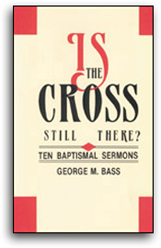
Is The Cross Still There?
Nine baptismal sermons
The beginning of Lent marks the start of a journey to Jerusalem. That's what it really is, although few of us will actually "go up to Jerusalem" to remember and "see" what happened there 2,000 years ago. In the environs of our congregations and communities, we will "go up" in our worship and the devotions of Lent and recall, as people who have a vital stake in a 2,000-year-old story, the events that Jesus predicted would cost him his life and, at the same time, would put the key to eternal life in the hands of all believers everywhere, in every age.

For one thing, we go up to remember that Jesus was a marked man, and to give thanks for his death. It was God's will that Jesus, his only-begotten Son, should die to save people from sin and death. When Jesus was transfigured on the mountain, God sent a specific message which made this very clear to Christ, as Luke reports the incident: "Suddenly there were two men there talking to him; they were Moses and Elijah appearing in glory, and they were speaking of his passing which he was to accomplish in Jerusalem (Luke 9:30-31)." God really does love the world so much that he gave Jesus Christ to the world -- and to death -- in order to do for people what they could never do for themselves. There is a cross always before us as we make this annual pilgrimage to Jerusalem. Jesus went up to Jerusalem not only to die as the prophets said he would, but to "pay the price of sin" by destroying death through his resurrection.
So he not only went up to Jerusalem to die; he went up to Jerusalem to die for us. That ought to stop us in our tracks, shouldn't it? Such knowledge should cause us to thank God for his goodness and grace, shouldn't it? Just the other day, there was a dangerous automobile accident not far from my home; a man in a pick-up truck rammed the rear of a van containing a family returning home from vacation. The collision drove the van off the highway down into a field where it overturned. The family -- parents and four children -- were trapped; those conscious could not free themselves. Gasoline was pouring from the fuel tank; it could explode at any moment. But a young man who works as a butcher only a mile from my home came along, stopped, investigated, and went into action. At the risk of his own life, he helped family members out of the vehicle -- except for the father, who was trapped and had to be cut out of the wrecked van by the special tools of the rescue squad, so that the paramedics, who were on the scene quickly, could take over. He saved their lives by putting his own life on the line. That family will be grateful forever for what he did.
That's pretty close to the gospel story, except that one ingredient is missing: Jesus actually died for the sake and salvation of humanity, whereas the butcher risked his life, almost sacrificed his life, but fortunately did not die in the selfless action of rescuing the victims of the accident. In that regard, the butcher is much like the confessors of the early Christian church, who with the martyrs, were ready to die for the faith. They actually gave their witness to the gospel of the Lord but, for various reasons, were not executed. But Jesus made the supreme sacrifice for us. The least we -- and all persons in common -- owe Jesus is gratitude for his good intentions and his self-sacrifice; his suffering and death -- for every one of us, believer and unbeliever alike -- demands respect and appreciation. But his crucifixion also raises perplexing questions for many people: Did he really save us from sin and death by dying on a cross? Are the "claims of the cross" -- forgiveness of our sins, reconciliation with God, and deliverance from death and the devil -- really valid? Or is all of this just a lovely but fanciful story about a man who had strange delusions of grandeur -- he claimed to be the Son of God -- created by a group of deceived people?
Jesus' death on the cross would mean nothing much to us or the world and certainly would not have saved us from anything, had it not been for the fact that everything he said about his fate at Jerusalem actually occurred. Historically, we know that his enemies had him put to death on a Roman cross; there's no question that he died. And there's no doubt that he went to the cross intentionally -- to save us from sin and reconcile us to God. But his death would not have been beneficial to us were it not for the fact that he rose from the dead on the third day -- as he, and the prophets before him, said that he would. Jesus' cross tells us that he died to save us -- and the empty tomb tries to tell us that the whole story is true, that we may believe in the cross because our Lord is alive -- forever!
Every time there is a baptism that empty tomb is filled with water, the water of Easter -- the water of life, as well as death. Easter tells us that the tomb has been flooded, and that every baptismal font, regardless of its size and shape, is really the vacated grave of Jesus. The font contains water which changes our lives; there is nothing accidental about this, as there was when coal mines were flooded in northeastern Pennsylvania during the Depression. My grandfather inherited a coal mine from his grandmother in the Scranton, Pennsylvania area. I remember that he was doing quite well financially when he came to live with us after my grandmother died during the early years of the Depression. He had a 1934 Ford V-8, was welldressed, helped his son buy a home, and gave regularly and liberally to his church. But when his coal mine was flooded, the flow of money, which could have gone on for years, dried up. That, plus some poor investments, saw him ruined financially. How different his life, and that of our family, would have been, if the coal mine had not been flooded. Floods usually bring tombs of one sort or another, but when, in baptism, the tomb of Christ is flooded with water and, in effect, becomes a baptismal font, it means life to those who sink beneath the water and surface again with the "Easter Christ."
So, we go up to Jerusalem because we have a stake in what happened there, and to look into that watery "grave of life" in the hope that we will find the blessed assurance of the gospel reminding us that we belong to God, forever. In baptism, he has marked us with the sign of the cross. "______________, child of God, you have been sealed by the Holy Spirit and marked with the cross of Christ forever."1 The water in that empty tomb has washed away the ashes of death with which we have been marked (today, in many congregations). The cross of Christ is planted in the waters of baptism, and we see reflections in the water of the font, and they are the reflections of people who have been cleansed and assured that they will live with Christ forever, and the mark of the marked man is there.
When Jennifer watched her baby brother Scott's baptism several years ago, she posed what might be the most crucial question that we should be asking at the beginning, and during Lent. Four years earlier she had been baptized at the same font, and now she stood up close, was vitally interested in everything that went on. She listened intently to the words of the baptismal liturgy; she watched the actions, especially when the water was poured on her brother's head, and as the pastor -- I -- traced the sign of the cross on Scott's forehead and said, "Scott, child of God, you have been sealed with the Holy Spirit and marked with the cross of Christ forever," Jennifer seemed almost mesmerized by what went on. But as soon as the liturgy was concluded, she ran over to one of her grandmothers, lifted up the bangs on her forehead, and asked her grandmother, "Is it still there?" She meant the "mark of the cross," of course.
Lent puts that important question on our lips, "Is the cross still there?" And God's word gives us an answer, which the Holy Spirit burns into our hearts, minds, and souls once again. But to hear God's "the cross is still there" and the gospel's reply, we have to go all the way to Jesus' empty, water-filled, tomb and see our reflections in it on Easter morning. That empty tomb tells us that death has been overcome by Jesus Christ, and that we don't have to worry about death anymore. Decades before people began to be concerned about "death and dying," and started to discuss death, write books and articles about the process, and teach courses on the subject in colleges, seminaries and hospitals, Dietrich Bonhoeffer wrote, in his Letters and Papers From Prison: "Do we not attach more importance nowadays to the act of dying than to death itself? We are much more concerned with getting over the act of dying than with being victorious over death. Socrates mastered the art of dying; Christ overcame death."
Isn't it interesting that our time has looked to Socrates' submission to a death sentence by poison for one answer to pain and hopelessness today? Death, by committing suicide, which is a procedure that the Hemlock Society supports, is becoming acceptable as a way out of this life, as a final answer to the human dilemma of pain and suffering, of life and death. God gives us different information in the cross and empty tomb of Jesus Christ! Jesus has conquered death, for everyone who believes, for every age, for all time! He has opened the way into the kingdom of heaven for each of us, as Browning declared, "A hand like this hand shall throw open the gates of new life to thee! See the Christ (the risen Christ) stand!"
So we go up to Jerusalem in the gospel story and our worship during Lent. And at the cross and tomb, we will find God's answer. Paul starts us on our way, and we declare with him: "I want to know Christ, and the power of his resurrection, and the fellowship of sharing in his suffering, becoming like him in his death so, somehow, to attain the resurrection of the dead." Jesus' "baptism" -- that's what it really was -- into death on that terrible tree and his glorious resurrection on the third day assure us that "The cross is still there" for each of us.
For one thing, we go up to remember that Jesus was a marked man, and to give thanks for his death. It was God's will that Jesus, his only-begotten Son, should die to save people from sin and death. When Jesus was transfigured on the mountain, God sent a specific message which made this very clear to Christ, as Luke reports the incident: "Suddenly there were two men there talking to him; they were Moses and Elijah appearing in glory, and they were speaking of his passing which he was to accomplish in Jerusalem (Luke 9:30-31)." God really does love the world so much that he gave Jesus Christ to the world -- and to death -- in order to do for people what they could never do for themselves. There is a cross always before us as we make this annual pilgrimage to Jerusalem. Jesus went up to Jerusalem not only to die as the prophets said he would, but to "pay the price of sin" by destroying death through his resurrection.
So he not only went up to Jerusalem to die; he went up to Jerusalem to die for us. That ought to stop us in our tracks, shouldn't it? Such knowledge should cause us to thank God for his goodness and grace, shouldn't it? Just the other day, there was a dangerous automobile accident not far from my home; a man in a pick-up truck rammed the rear of a van containing a family returning home from vacation. The collision drove the van off the highway down into a field where it overturned. The family -- parents and four children -- were trapped; those conscious could not free themselves. Gasoline was pouring from the fuel tank; it could explode at any moment. But a young man who works as a butcher only a mile from my home came along, stopped, investigated, and went into action. At the risk of his own life, he helped family members out of the vehicle -- except for the father, who was trapped and had to be cut out of the wrecked van by the special tools of the rescue squad, so that the paramedics, who were on the scene quickly, could take over. He saved their lives by putting his own life on the line. That family will be grateful forever for what he did.
That's pretty close to the gospel story, except that one ingredient is missing: Jesus actually died for the sake and salvation of humanity, whereas the butcher risked his life, almost sacrificed his life, but fortunately did not die in the selfless action of rescuing the victims of the accident. In that regard, the butcher is much like the confessors of the early Christian church, who with the martyrs, were ready to die for the faith. They actually gave their witness to the gospel of the Lord but, for various reasons, were not executed. But Jesus made the supreme sacrifice for us. The least we -- and all persons in common -- owe Jesus is gratitude for his good intentions and his self-sacrifice; his suffering and death -- for every one of us, believer and unbeliever alike -- demands respect and appreciation. But his crucifixion also raises perplexing questions for many people: Did he really save us from sin and death by dying on a cross? Are the "claims of the cross" -- forgiveness of our sins, reconciliation with God, and deliverance from death and the devil -- really valid? Or is all of this just a lovely but fanciful story about a man who had strange delusions of grandeur -- he claimed to be the Son of God -- created by a group of deceived people?
Jesus' death on the cross would mean nothing much to us or the world and certainly would not have saved us from anything, had it not been for the fact that everything he said about his fate at Jerusalem actually occurred. Historically, we know that his enemies had him put to death on a Roman cross; there's no question that he died. And there's no doubt that he went to the cross intentionally -- to save us from sin and reconcile us to God. But his death would not have been beneficial to us were it not for the fact that he rose from the dead on the third day -- as he, and the prophets before him, said that he would. Jesus' cross tells us that he died to save us -- and the empty tomb tries to tell us that the whole story is true, that we may believe in the cross because our Lord is alive -- forever!
Every time there is a baptism that empty tomb is filled with water, the water of Easter -- the water of life, as well as death. Easter tells us that the tomb has been flooded, and that every baptismal font, regardless of its size and shape, is really the vacated grave of Jesus. The font contains water which changes our lives; there is nothing accidental about this, as there was when coal mines were flooded in northeastern Pennsylvania during the Depression. My grandfather inherited a coal mine from his grandmother in the Scranton, Pennsylvania area. I remember that he was doing quite well financially when he came to live with us after my grandmother died during the early years of the Depression. He had a 1934 Ford V-8, was welldressed, helped his son buy a home, and gave regularly and liberally to his church. But when his coal mine was flooded, the flow of money, which could have gone on for years, dried up. That, plus some poor investments, saw him ruined financially. How different his life, and that of our family, would have been, if the coal mine had not been flooded. Floods usually bring tombs of one sort or another, but when, in baptism, the tomb of Christ is flooded with water and, in effect, becomes a baptismal font, it means life to those who sink beneath the water and surface again with the "Easter Christ."
So, we go up to Jerusalem because we have a stake in what happened there, and to look into that watery "grave of life" in the hope that we will find the blessed assurance of the gospel reminding us that we belong to God, forever. In baptism, he has marked us with the sign of the cross. "______________, child of God, you have been sealed by the Holy Spirit and marked with the cross of Christ forever."1 The water in that empty tomb has washed away the ashes of death with which we have been marked (today, in many congregations). The cross of Christ is planted in the waters of baptism, and we see reflections in the water of the font, and they are the reflections of people who have been cleansed and assured that they will live with Christ forever, and the mark of the marked man is there.
When Jennifer watched her baby brother Scott's baptism several years ago, she posed what might be the most crucial question that we should be asking at the beginning, and during Lent. Four years earlier she had been baptized at the same font, and now she stood up close, was vitally interested in everything that went on. She listened intently to the words of the baptismal liturgy; she watched the actions, especially when the water was poured on her brother's head, and as the pastor -- I -- traced the sign of the cross on Scott's forehead and said, "Scott, child of God, you have been sealed with the Holy Spirit and marked with the cross of Christ forever," Jennifer seemed almost mesmerized by what went on. But as soon as the liturgy was concluded, she ran over to one of her grandmothers, lifted up the bangs on her forehead, and asked her grandmother, "Is it still there?" She meant the "mark of the cross," of course.
Lent puts that important question on our lips, "Is the cross still there?" And God's word gives us an answer, which the Holy Spirit burns into our hearts, minds, and souls once again. But to hear God's "the cross is still there" and the gospel's reply, we have to go all the way to Jesus' empty, water-filled, tomb and see our reflections in it on Easter morning. That empty tomb tells us that death has been overcome by Jesus Christ, and that we don't have to worry about death anymore. Decades before people began to be concerned about "death and dying," and started to discuss death, write books and articles about the process, and teach courses on the subject in colleges, seminaries and hospitals, Dietrich Bonhoeffer wrote, in his Letters and Papers From Prison: "Do we not attach more importance nowadays to the act of dying than to death itself? We are much more concerned with getting over the act of dying than with being victorious over death. Socrates mastered the art of dying; Christ overcame death."
Isn't it interesting that our time has looked to Socrates' submission to a death sentence by poison for one answer to pain and hopelessness today? Death, by committing suicide, which is a procedure that the Hemlock Society supports, is becoming acceptable as a way out of this life, as a final answer to the human dilemma of pain and suffering, of life and death. God gives us different information in the cross and empty tomb of Jesus Christ! Jesus has conquered death, for everyone who believes, for every age, for all time! He has opened the way into the kingdom of heaven for each of us, as Browning declared, "A hand like this hand shall throw open the gates of new life to thee! See the Christ (the risen Christ) stand!"
So we go up to Jerusalem in the gospel story and our worship during Lent. And at the cross and tomb, we will find God's answer. Paul starts us on our way, and we declare with him: "I want to know Christ, and the power of his resurrection, and the fellowship of sharing in his suffering, becoming like him in his death so, somehow, to attain the resurrection of the dead." Jesus' "baptism" -- that's what it really was -- into death on that terrible tree and his glorious resurrection on the third day assure us that "The cross is still there" for each of us.