
Lessons In Virtue That Books Can't Teach
Adult study
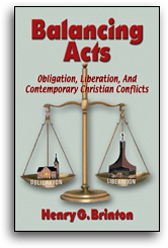
Balancing Acts
Obligation, Liberation, And Contemporary Christian Conflicts
There's no question, virtue is a hot topic these days. Walk around a bookstore or sign onto one of the online book services, and you'll see that over the past decade or two virtue has been the inspiration for literally hundreds of books. The most familiar is William J. Bennett's Book of Virtues, of course, and the former secretary of education has had another fifteen titles on the market, including tapes and children's books based on his bestseller.

Virtue's thrall goes well beyond annual book lists. Character education has become a popular component of many school curriculums; at least twelve states have passed policy statements on character education; the actor, Tom Selleck, perhaps better known as Magnum, P.I., has hosted a video program on character education for elementary schools.
I suppose we should be thankful. After all we hear and read about violence and vice, it's refreshing to see virtue become an industry all of its own, but I can't help thinking that most of these endeavors, no matter how well-intentioned, are lacking an essential element. The books and classes miss what I believe to be a central truth about virtue: It is learned from life, not lessons. Although we may think of virtue as being an obligation -- with its links to purity, moral clarity, and personal responsibility -- virtue also requires a certain type of liberation.
This is not to say that covenant-keeping can't be helpful in crafting good character. When I think of my own work as a minister, I realize how much I rely on the Old and New Testaments -- also called the Old Covenant and the New Covenant -- as a guide to virtuous behavior. But one of the greatest strengths of the Bible is that it is so much more than "A Treasury of Great Moral Stories" (Bennett's subtitle). It teaches by example, by involving us in tales of individual lives and of people's evolving relationship with God. In fact, it's more like a book of role models. Think of Moses or King David or the Apostle Peter, whose stories reveal both their strengths and their all-too-human failings. They cannot be reduced to simple morality tales. But they clearly challenge us to embrace virtue and avoid vice.
People often look to their ministers for guidance about questions of character, and I've often wished I had easy answers -- but I don't. In recent years, though, I've begun to realize that the answers are all around us, if we allow ourselves to be liberated from the lessons of good-vs.-evil morality tales. As we remembered the deaths of some active members of Calvary Presbyterian Church, I became more and more convinced that good character comes from observing and copying virtuous people, that it is developed through relationships in communities.
Among the members we lost was John Middlecoff, an usher who used to be a fixture at the church entrance. I thought of John as the "Cal Ripken" of Calvary, not only because he was proud of his Baltimore birthplace, but because he played his position at the door, week in and week out, rarely missing a day. He welcomed all comers to services, a living example of dependability and diligence. I don't mean to suggest that John was a perfect man. He wasn't. Nor did he set out to teach anyone good character. But his ways rubbed off on many of us whom he greeted with a sly smile -- and a characteristic snapping of his suspenders for small children. Nobody could replace John -- or quite pull off his suspender trick -- but I saw several people try to fill the gap he left at the door. We miss our teachers when they are gone.
I'm hardly the first to wrestle with what virtue is all about. Aristotle thought of virtue as a state of character gained by repeatedly performing good actions. Thomas Hibbs, a contemporary philosopher who has taught at Boston College, calls virtue "an acquired excellence of character that renders a person capable over the long haul of behaving in certain reliable ways."
I think both Aristotle and Hibbs are onto something. Hibbs likens the acquisition of virtue to athletic training; both require repetition and hard work; both are most easily learned by following examples. Books and programs and covenants can be helpful, of course, but in the end, virtue is best learned by practice, not through abstract thought. As Hibbs points out, if you want to learn to shoot hoops, playing basketball beats reading a book about basketball.
Virtuous living is a team sport, not an individual activity. By that I mean it requires a community of accountability and support. That's why I think the Eagle's Wings Tutoring Program at Calvary succeeded in making a small difference in some local children's lives. The program matched volunteer tutors with neighborhood schoolchildren, many of whom came from chaotic homes. Meeting for an hour each week in the church basement, the children absorbed virtues of kindness, perseverance, and diligence from their tutors. Character is not so much taught as it is "caught," in a setting like that.
The St. Peter's School in Waldorf has adopted a rather different approach, one that is growing in popularity in public and private schools. This Catholic elementary school's character-formation program features a particular virtue -- such as "self-control" -- as the focus for each month. The children engage in projects and activities that help them to understand and live by virtue, and every subject is oriented to touch on the featured trait. Is it working? I asked the Reverend Bill Parent, who was associate pastor at St. Peter's Church. "The initial effect is that it gives the children language to talk about issues," he told me. Perhaps the program's greatest strength is that it involves sessions for the parents, and makes character development a priority for the school, church, and community.
I once visited an elderly woman84 recovering from a stroke in the hospital. I asked about her husband, and she lamented that he was "no good," that he never wanted their children to learn more than how to write their names. But she had stressed education for them, and now all four have made a success in careers ranging from business to academics. They imitated their mother, a virtuous woman, not their father. William Willimon, dean of the Chapel at Duke University, puts it succinctly: "Virtue is not following rules, but rather virtue begins by being good. Luther said you don't get apples from a thorn bush and I agree, so far as people are concerned."
At its heart, virtue is not following rules -- it is not a legalistic obsession with obligation, purity, moral clarity, and personal responsibility. Instead, virtue begins by being good, by putting one foot in front of the other and following a role model like Moses. It may require some wandering in the wilderness, but the final destination is a new and better land.
At Calvary, we had a practice of marking fiftieth wedding anniversaries in our services, and I learned from many members of the congregation that younger married couples saw these services as more than celebrations of a long marriage. "I think it's incredible that people can stay together this long," one member of the congregation told me. Debbie Noel had been married for eight years at the time, and had two children. "It gives me strength," she said. "If others can do it, then I hope I can, too." Senior teachers who have made it far down the road of married life (a road that invariably has its share of potholes) inspire young learners who will later become teachers themselves. "We become virtuous over a lifelong period of trial and error, self-knowledge, self-criticism, observation, correction, example," Willimon has told me. "The young need more opportunity to be with and to observe the old."
That's why the process of teaching and learning virtue is done best in families, churches, and businesses. Any community -- whether it be small as a family or large as a school -- can contain both teachers and learners who help each other to strive for excellence. Contrast that with the sort of initiatives several states have adopted -- such as the act passed in Alabama in 1995 that requires students to receive ten minutes of instruction per day in character traits ranging from citizenship to sportsmanship, as well as to recite the Pledge of Allegiance. "You can't simply have virtue with a smiley face," Hibbs has told his students in Boston.
But what if people are reluctant to exchange a book of virtues for a community of flesh-and-blood human beings? The clarity of a book can be very attractive, especially when compared to the chaos of a congregation. Certainly not everyone wants to follow fallible human beings -- people as flawed as Moses, who had the murder of an Egyptian on his criminal record (Exodus 2:11-12) -- on a journey to an uncertain future. Some people understandably prefer the clear obligations of Abraham over the vague liberation promised by Moses.
In my experience, the life of the church has brought into focus a conflict that has become familiar in our multicultural society -- a conflict between the virtue of tolerance and accepting differences, on the one hand (liberation), and the need to be true to particular beliefs and customs on the other (obligation). The examples in our society are many, some more profound than others. Should police officers be allowed to wear dreadlocks? Should homosexuals be allowed to be Boy Scout leaders? Should school testing take place on the sabbath? In each case, individual differences clash with institutional expectations, and different types of character formation occur depending on the path that is chosen.
The prevailing ethos these days is to accept, accommodate, and adapt to differences. The virtue in that liberating approach is evident in the vibrancy of our culture, from the range of foods at the sidewalk cafes to the varied traditions our children learn to appreciate -- and the languages they hear -- in class. There's no doubt in my mind that we all profit from learning about and adapting to such cultural differences. But each time we adapt, we also give something up. And, in the church, which is founded on a set of obligations and beliefs, figuring out what we should give up and what we should stick to can be particularly perplexing.
I struggle with these issues every day, and there is no book that can give me clear guidance. A friend once asked me to help him plan a memorial service for an acquaintance, with the understanding that most of the people attending would not be religious. I hardly knew where to begin. The secular world doesn't accept the ideas of resurrection inherent in Christian theology. Without a common language grounded in the Bible or religious practice, which words should I choose? Even though I was not going to take part in the service, I was struck by the tension in myself between exodus-style inclusiveness and covenant-oriented exclusiveness -- between wanting to help plan an event that would welcome nonreligious participants and allow them to feel comfortable with the service, while preserving the essence of the Christian faith.
On another occasion, when I was asked by a Jewish bride to take down all the crosses in my sanctuary for her marriage to a Christian, I refused. She wasn't pleased, but she was asking me to be more flexible -- more inclusive -- than my faith would allow.
I am hardly alone in these balancing acts. Most religious leaders claim they want to be hospitable to all people in their programs, but they balk if they are asked to abandon a distinctive tradition or modify a long-standing belief. They have good reason: If they dump their distinctiveness, they lose the identity that gives them meaning in the first place. So they live with the tension of guarding their valuables while they throw open their doors.
Signs of this strain pop up constantly. The 1964 Civil Rights Act recognized the peculiar role of religious organizations and gave them the right to discriminate in their hiring -- to employ only people who share their beliefs. Abraham would be proud. But should those organizations be allowed to continue such practices if they receive federal funds to carry out public programs? That issue sparked debate in relation to President Bush's "faith-based" initiative. Should the Salvation Army, which holds the belief that homosexual activity is a sin, be allowed to discriminate against gays in its hiring? While I am certainly not in favor of discrimination, I have to admit that a question is nagging me: If the effectiveness of the Salvation Army comes from uniformity of belief, isn't it logical that Salvation Army staff members be required to share the same convictions?
In this case, the argument should be for the virtue of inclusiveness, since the Salvation Army receives federal dollars and performs ministry for a broad cross section of the population. But think about it: Exclusiveness is a cherished characteristic of all religious groups. Orthodox Jews don't want to be required to give up their dietary laws; Quakers don't want to be forced to serve in the military; fundamentalist Christians don't want evolution to be taught to their children. If you want to teach evolution, don't expect fundamentalists to accept you as a Sunday school teacher. Likewise, don't eat non-kosher food and expect to be counted an Orthodox Jew. Since the time of Abraham, adhering to a belief system is what religion is all about. "When in Rome ..." as the saying goes.
In the church, we often expect people to do what the Romans do, but we also recognize that Rome can change -- and that brings controversies anew. My own denomination, the Presbyterian Church (USA), lost congregations a generation ago when it decided to break with tradition and insist on the ordination of women. This was a Moses-style exodus from a long history of women being barred from ordained leadership. While some Presbyterians argued for excluding women from leadership on the grounds of traditional understandings of scripture, others pushed for acceptance based on a modern belief in divine inclusiveness -- the notion that God desires the inclusion of all people, which is suggested by scripture such as the passage displayed in the sanctuary of Fairfax Presbyterian Church: "A House of Prayer for All Peoples." Given the gifts of ministry that my female colleagues clearly have, I am glad that the inclusive forces won that debate.
The drive toward inclusiveness is motivating the National Cathedral in Washington -- long associated with the Episcopal Church -- to increase its outreach to the community and make its ministry more interdenominational. "We acknowledge who we are -- an Episcopal cathedral," says Robert Becker of the Office of Program and Pastoral Ministries. "But we also stress the fact that this cathedral is indeed a house of prayer for all people. Often, that translates into special interfaith services that are held here." In 2001, there was a dedication of the final stained glass window in the cathedral, one that recalls the hope of the Hebrew people to return to Jerusalem after exile in Babylon. Invited participants included notable Jewish figures such as Supreme Court Justice Ruth Bader Ginsberg and Rabbi Irving Greenberg, chairman of the United States Holocaust Memorial Council.
But how "interfaith" can an Episcopal cathedral be, given the centrality of Jesus in the building's liturgy, art, and architecture? That's a question that no book can answer; it must be worked out in the experience of the community. Michael Wyatt, director of religious education, told me that " 'A house of prayer for all people' does not mean to me that all individuals would find here -- or are even entitled to find here -- a service that they would have designed on their own. The ownership of ritual prayer is not individualistic." While the cathedral offers a genuine welcome to every guest, its hospitality is grounded in a distinctively Christian tradition. Liberation and obligation have to remain in a kind of creative tension, as the virtue of inclusiveness is balanced with the virtue of exclusiveness.
Indeed, my friend, Timothy Merrill, senior editor of the preaching journal Homiletics, doesn't think that it is possible to provide a worship style that appeals to everyone. "What you find in the middle of the road is usually dead, road-kill worship that leaves a bad taste in the mouth for everyone." He argues that there is "a strong movement that leaps back ... to medieval expressions of piety, such as chants, prayers, and plainsong" -- traditions that he senses provide more opportunities for theological reflection than contemporary worship styles.
But what if people are uncomfortable with medieval chants, and are looking for a more "user-friendly," contemporary worship experience? "We live in an 'experience' economy," observes Phil Beauchene, an elder at Fairfax Presbyterian Church, reminding me that "Disney doesn't sell you a ride, it sells you an experience." He is convinced that we could use drama and multimedia to better advantage in worship, and I think he's right -- we should be liberated from traditional styles of preaching and praying. What he's talking about, of course, is changing the way we deliver the message, not changing the message itself.
But sometimes our effort to reach people runs the risk of diluting or altering that message. That's a key issue for Phil and his wife, Carolyn Klein, who is heavily involved in ministries of music and Christian education at Fairfax: Should Fairfax have different types of services to appeal to specific groups? Should the church offer a contemporary service on Saturday evening for those who are on the periphery of organized religion -- a kind of "lite church" that could draw people in? Carolyn and Phil worry that if the church works too hard at being acceptable to everyone, it will end up not standing for anything in particular. There is no virtue in throwing out our core beliefs and obligations in the quest for complete inclusiveness.
So, how did I resolve the issue of the memorial service involving church outsiders? My friend and I settled on a passage of scripture in which Elisha asks his departing mentor Elijah for "a double share of your spirit" (2 Kings 2:9) -- a passage that is well-grounded in the Bible, but also accessible to a gathering of nonreligious people. In other words, I invited them to Rome, without expecting them to speak Italian immediately.
Such attempts to transmit the tradition, and to train a new generation of Christians in virtuous behavior, will become increasingly important in our multicultural and religiously pluralistic world. In the end, the challenge that religious communities face is not to be relevant, but to be clear -- about their beliefs, their practices, their scriptures, their morals, their outreach projects, their organizational structures. "From the beginning, Christians have said that what is relevant is the tradition," observes Wyatt of the National Cathedral. If the church does not have a distinctive message to offer society, then it has ceased to be a true religious voice. It has become just another cultural phenomenon, one that will quickly be replaced by the next spiritual fad.
That sort of focus on tradition will inevitably lead to the kind of conflict represented by the Salvation Army's response to homosexual activity. Sometimes the church will embark on an exodus and change, as my denomination did over the ordination of women; sometimes it will keep the covenant and stick with tradition, as the Salvation Army is insisting it will. That may lead the organization to back away from federal funding and concentrate on its own community of faith -- which is not a bad thing.
Such an approach serves as a reminder that most people come to church in search of a distinctive and recognizable "house of prayer" -- an organization that is open to all, but not one that is trying to be all things to all people. That means that pastors like me have to be prepared to make a stand once in a while for things that will be unacceptable to others. We will do this not because moral clarity is always superior to Christian charity, but because both clarity and charity are interlocking virtues in our practice of the faith. On a practical level, this means that we have to focus on being clear, not relevant -- clear about our beliefs, our scriptures, our morals, and our mission projects.
As we live out the faith in community -- remembering that virtuous living is a team sport, not an individual activity -- we discover that the perspectives of Abraham and Moses both have important roles to play, and that their contributions of obligation, liberation, exclusiveness, and inclusiveness can all be used for the good, if kept in the proper balance. In the ongoing life of the church, this can be done by making an effort to match young people with adult role models, in tutoring programs, confirmation classes, fellowship events, and mission projects. It can be accomplished by taking the time in worship to celebrate personal milestones, such as fiftieth wedding anniversaries, moments that capture important images of moral clarity and Christian charity. Together, Moses and Abraham can guide us as we attempt to develop true Christian character -- not only for our own benefit, but for the good of the next generation of Christians, and all who enter our houses of prayer.
Virtue's thrall goes well beyond annual book lists. Character education has become a popular component of many school curriculums; at least twelve states have passed policy statements on character education; the actor, Tom Selleck, perhaps better known as Magnum, P.I., has hosted a video program on character education for elementary schools.
I suppose we should be thankful. After all we hear and read about violence and vice, it's refreshing to see virtue become an industry all of its own, but I can't help thinking that most of these endeavors, no matter how well-intentioned, are lacking an essential element. The books and classes miss what I believe to be a central truth about virtue: It is learned from life, not lessons. Although we may think of virtue as being an obligation -- with its links to purity, moral clarity, and personal responsibility -- virtue also requires a certain type of liberation.
This is not to say that covenant-keeping can't be helpful in crafting good character. When I think of my own work as a minister, I realize how much I rely on the Old and New Testaments -- also called the Old Covenant and the New Covenant -- as a guide to virtuous behavior. But one of the greatest strengths of the Bible is that it is so much more than "A Treasury of Great Moral Stories" (Bennett's subtitle). It teaches by example, by involving us in tales of individual lives and of people's evolving relationship with God. In fact, it's more like a book of role models. Think of Moses or King David or the Apostle Peter, whose stories reveal both their strengths and their all-too-human failings. They cannot be reduced to simple morality tales. But they clearly challenge us to embrace virtue and avoid vice.
People often look to their ministers for guidance about questions of character, and I've often wished I had easy answers -- but I don't. In recent years, though, I've begun to realize that the answers are all around us, if we allow ourselves to be liberated from the lessons of good-vs.-evil morality tales. As we remembered the deaths of some active members of Calvary Presbyterian Church, I became more and more convinced that good character comes from observing and copying virtuous people, that it is developed through relationships in communities.
Among the members we lost was John Middlecoff, an usher who used to be a fixture at the church entrance. I thought of John as the "Cal Ripken" of Calvary, not only because he was proud of his Baltimore birthplace, but because he played his position at the door, week in and week out, rarely missing a day. He welcomed all comers to services, a living example of dependability and diligence. I don't mean to suggest that John was a perfect man. He wasn't. Nor did he set out to teach anyone good character. But his ways rubbed off on many of us whom he greeted with a sly smile -- and a characteristic snapping of his suspenders for small children. Nobody could replace John -- or quite pull off his suspender trick -- but I saw several people try to fill the gap he left at the door. We miss our teachers when they are gone.
I'm hardly the first to wrestle with what virtue is all about. Aristotle thought of virtue as a state of character gained by repeatedly performing good actions. Thomas Hibbs, a contemporary philosopher who has taught at Boston College, calls virtue "an acquired excellence of character that renders a person capable over the long haul of behaving in certain reliable ways."
I think both Aristotle and Hibbs are onto something. Hibbs likens the acquisition of virtue to athletic training; both require repetition and hard work; both are most easily learned by following examples. Books and programs and covenants can be helpful, of course, but in the end, virtue is best learned by practice, not through abstract thought. As Hibbs points out, if you want to learn to shoot hoops, playing basketball beats reading a book about basketball.
Virtuous living is a team sport, not an individual activity. By that I mean it requires a community of accountability and support. That's why I think the Eagle's Wings Tutoring Program at Calvary succeeded in making a small difference in some local children's lives. The program matched volunteer tutors with neighborhood schoolchildren, many of whom came from chaotic homes. Meeting for an hour each week in the church basement, the children absorbed virtues of kindness, perseverance, and diligence from their tutors. Character is not so much taught as it is "caught," in a setting like that.
The St. Peter's School in Waldorf has adopted a rather different approach, one that is growing in popularity in public and private schools. This Catholic elementary school's character-formation program features a particular virtue -- such as "self-control" -- as the focus for each month. The children engage in projects and activities that help them to understand and live by virtue, and every subject is oriented to touch on the featured trait. Is it working? I asked the Reverend Bill Parent, who was associate pastor at St. Peter's Church. "The initial effect is that it gives the children language to talk about issues," he told me. Perhaps the program's greatest strength is that it involves sessions for the parents, and makes character development a priority for the school, church, and community.
I once visited an elderly woman84 recovering from a stroke in the hospital. I asked about her husband, and she lamented that he was "no good," that he never wanted their children to learn more than how to write their names. But she had stressed education for them, and now all four have made a success in careers ranging from business to academics. They imitated their mother, a virtuous woman, not their father. William Willimon, dean of the Chapel at Duke University, puts it succinctly: "Virtue is not following rules, but rather virtue begins by being good. Luther said you don't get apples from a thorn bush and I agree, so far as people are concerned."
At its heart, virtue is not following rules -- it is not a legalistic obsession with obligation, purity, moral clarity, and personal responsibility. Instead, virtue begins by being good, by putting one foot in front of the other and following a role model like Moses. It may require some wandering in the wilderness, but the final destination is a new and better land.
At Calvary, we had a practice of marking fiftieth wedding anniversaries in our services, and I learned from many members of the congregation that younger married couples saw these services as more than celebrations of a long marriage. "I think it's incredible that people can stay together this long," one member of the congregation told me. Debbie Noel had been married for eight years at the time, and had two children. "It gives me strength," she said. "If others can do it, then I hope I can, too." Senior teachers who have made it far down the road of married life (a road that invariably has its share of potholes) inspire young learners who will later become teachers themselves. "We become virtuous over a lifelong period of trial and error, self-knowledge, self-criticism, observation, correction, example," Willimon has told me. "The young need more opportunity to be with and to observe the old."
That's why the process of teaching and learning virtue is done best in families, churches, and businesses. Any community -- whether it be small as a family or large as a school -- can contain both teachers and learners who help each other to strive for excellence. Contrast that with the sort of initiatives several states have adopted -- such as the act passed in Alabama in 1995 that requires students to receive ten minutes of instruction per day in character traits ranging from citizenship to sportsmanship, as well as to recite the Pledge of Allegiance. "You can't simply have virtue with a smiley face," Hibbs has told his students in Boston.
But what if people are reluctant to exchange a book of virtues for a community of flesh-and-blood human beings? The clarity of a book can be very attractive, especially when compared to the chaos of a congregation. Certainly not everyone wants to follow fallible human beings -- people as flawed as Moses, who had the murder of an Egyptian on his criminal record (Exodus 2:11-12) -- on a journey to an uncertain future. Some people understandably prefer the clear obligations of Abraham over the vague liberation promised by Moses.
In my experience, the life of the church has brought into focus a conflict that has become familiar in our multicultural society -- a conflict between the virtue of tolerance and accepting differences, on the one hand (liberation), and the need to be true to particular beliefs and customs on the other (obligation). The examples in our society are many, some more profound than others. Should police officers be allowed to wear dreadlocks? Should homosexuals be allowed to be Boy Scout leaders? Should school testing take place on the sabbath? In each case, individual differences clash with institutional expectations, and different types of character formation occur depending on the path that is chosen.
The prevailing ethos these days is to accept, accommodate, and adapt to differences. The virtue in that liberating approach is evident in the vibrancy of our culture, from the range of foods at the sidewalk cafes to the varied traditions our children learn to appreciate -- and the languages they hear -- in class. There's no doubt in my mind that we all profit from learning about and adapting to such cultural differences. But each time we adapt, we also give something up. And, in the church, which is founded on a set of obligations and beliefs, figuring out what we should give up and what we should stick to can be particularly perplexing.
I struggle with these issues every day, and there is no book that can give me clear guidance. A friend once asked me to help him plan a memorial service for an acquaintance, with the understanding that most of the people attending would not be religious. I hardly knew where to begin. The secular world doesn't accept the ideas of resurrection inherent in Christian theology. Without a common language grounded in the Bible or religious practice, which words should I choose? Even though I was not going to take part in the service, I was struck by the tension in myself between exodus-style inclusiveness and covenant-oriented exclusiveness -- between wanting to help plan an event that would welcome nonreligious participants and allow them to feel comfortable with the service, while preserving the essence of the Christian faith.
On another occasion, when I was asked by a Jewish bride to take down all the crosses in my sanctuary for her marriage to a Christian, I refused. She wasn't pleased, but she was asking me to be more flexible -- more inclusive -- than my faith would allow.
I am hardly alone in these balancing acts. Most religious leaders claim they want to be hospitable to all people in their programs, but they balk if they are asked to abandon a distinctive tradition or modify a long-standing belief. They have good reason: If they dump their distinctiveness, they lose the identity that gives them meaning in the first place. So they live with the tension of guarding their valuables while they throw open their doors.
Signs of this strain pop up constantly. The 1964 Civil Rights Act recognized the peculiar role of religious organizations and gave them the right to discriminate in their hiring -- to employ only people who share their beliefs. Abraham would be proud. But should those organizations be allowed to continue such practices if they receive federal funds to carry out public programs? That issue sparked debate in relation to President Bush's "faith-based" initiative. Should the Salvation Army, which holds the belief that homosexual activity is a sin, be allowed to discriminate against gays in its hiring? While I am certainly not in favor of discrimination, I have to admit that a question is nagging me: If the effectiveness of the Salvation Army comes from uniformity of belief, isn't it logical that Salvation Army staff members be required to share the same convictions?
In this case, the argument should be for the virtue of inclusiveness, since the Salvation Army receives federal dollars and performs ministry for a broad cross section of the population. But think about it: Exclusiveness is a cherished characteristic of all religious groups. Orthodox Jews don't want to be required to give up their dietary laws; Quakers don't want to be forced to serve in the military; fundamentalist Christians don't want evolution to be taught to their children. If you want to teach evolution, don't expect fundamentalists to accept you as a Sunday school teacher. Likewise, don't eat non-kosher food and expect to be counted an Orthodox Jew. Since the time of Abraham, adhering to a belief system is what religion is all about. "When in Rome ..." as the saying goes.
In the church, we often expect people to do what the Romans do, but we also recognize that Rome can change -- and that brings controversies anew. My own denomination, the Presbyterian Church (USA), lost congregations a generation ago when it decided to break with tradition and insist on the ordination of women. This was a Moses-style exodus from a long history of women being barred from ordained leadership. While some Presbyterians argued for excluding women from leadership on the grounds of traditional understandings of scripture, others pushed for acceptance based on a modern belief in divine inclusiveness -- the notion that God desires the inclusion of all people, which is suggested by scripture such as the passage displayed in the sanctuary of Fairfax Presbyterian Church: "A House of Prayer for All Peoples." Given the gifts of ministry that my female colleagues clearly have, I am glad that the inclusive forces won that debate.
The drive toward inclusiveness is motivating the National Cathedral in Washington -- long associated with the Episcopal Church -- to increase its outreach to the community and make its ministry more interdenominational. "We acknowledge who we are -- an Episcopal cathedral," says Robert Becker of the Office of Program and Pastoral Ministries. "But we also stress the fact that this cathedral is indeed a house of prayer for all people. Often, that translates into special interfaith services that are held here." In 2001, there was a dedication of the final stained glass window in the cathedral, one that recalls the hope of the Hebrew people to return to Jerusalem after exile in Babylon. Invited participants included notable Jewish figures such as Supreme Court Justice Ruth Bader Ginsberg and Rabbi Irving Greenberg, chairman of the United States Holocaust Memorial Council.
But how "interfaith" can an Episcopal cathedral be, given the centrality of Jesus in the building's liturgy, art, and architecture? That's a question that no book can answer; it must be worked out in the experience of the community. Michael Wyatt, director of religious education, told me that " 'A house of prayer for all people' does not mean to me that all individuals would find here -- or are even entitled to find here -- a service that they would have designed on their own. The ownership of ritual prayer is not individualistic." While the cathedral offers a genuine welcome to every guest, its hospitality is grounded in a distinctively Christian tradition. Liberation and obligation have to remain in a kind of creative tension, as the virtue of inclusiveness is balanced with the virtue of exclusiveness.
Indeed, my friend, Timothy Merrill, senior editor of the preaching journal Homiletics, doesn't think that it is possible to provide a worship style that appeals to everyone. "What you find in the middle of the road is usually dead, road-kill worship that leaves a bad taste in the mouth for everyone." He argues that there is "a strong movement that leaps back ... to medieval expressions of piety, such as chants, prayers, and plainsong" -- traditions that he senses provide more opportunities for theological reflection than contemporary worship styles.
But what if people are uncomfortable with medieval chants, and are looking for a more "user-friendly," contemporary worship experience? "We live in an 'experience' economy," observes Phil Beauchene, an elder at Fairfax Presbyterian Church, reminding me that "Disney doesn't sell you a ride, it sells you an experience." He is convinced that we could use drama and multimedia to better advantage in worship, and I think he's right -- we should be liberated from traditional styles of preaching and praying. What he's talking about, of course, is changing the way we deliver the message, not changing the message itself.
But sometimes our effort to reach people runs the risk of diluting or altering that message. That's a key issue for Phil and his wife, Carolyn Klein, who is heavily involved in ministries of music and Christian education at Fairfax: Should Fairfax have different types of services to appeal to specific groups? Should the church offer a contemporary service on Saturday evening for those who are on the periphery of organized religion -- a kind of "lite church" that could draw people in? Carolyn and Phil worry that if the church works too hard at being acceptable to everyone, it will end up not standing for anything in particular. There is no virtue in throwing out our core beliefs and obligations in the quest for complete inclusiveness.
So, how did I resolve the issue of the memorial service involving church outsiders? My friend and I settled on a passage of scripture in which Elisha asks his departing mentor Elijah for "a double share of your spirit" (2 Kings 2:9) -- a passage that is well-grounded in the Bible, but also accessible to a gathering of nonreligious people. In other words, I invited them to Rome, without expecting them to speak Italian immediately.
Such attempts to transmit the tradition, and to train a new generation of Christians in virtuous behavior, will become increasingly important in our multicultural and religiously pluralistic world. In the end, the challenge that religious communities face is not to be relevant, but to be clear -- about their beliefs, their practices, their scriptures, their morals, their outreach projects, their organizational structures. "From the beginning, Christians have said that what is relevant is the tradition," observes Wyatt of the National Cathedral. If the church does not have a distinctive message to offer society, then it has ceased to be a true religious voice. It has become just another cultural phenomenon, one that will quickly be replaced by the next spiritual fad.
That sort of focus on tradition will inevitably lead to the kind of conflict represented by the Salvation Army's response to homosexual activity. Sometimes the church will embark on an exodus and change, as my denomination did over the ordination of women; sometimes it will keep the covenant and stick with tradition, as the Salvation Army is insisting it will. That may lead the organization to back away from federal funding and concentrate on its own community of faith -- which is not a bad thing.
Such an approach serves as a reminder that most people come to church in search of a distinctive and recognizable "house of prayer" -- an organization that is open to all, but not one that is trying to be all things to all people. That means that pastors like me have to be prepared to make a stand once in a while for things that will be unacceptable to others. We will do this not because moral clarity is always superior to Christian charity, but because both clarity and charity are interlocking virtues in our practice of the faith. On a practical level, this means that we have to focus on being clear, not relevant -- clear about our beliefs, our scriptures, our morals, and our mission projects.
As we live out the faith in community -- remembering that virtuous living is a team sport, not an individual activity -- we discover that the perspectives of Abraham and Moses both have important roles to play, and that their contributions of obligation, liberation, exclusiveness, and inclusiveness can all be used for the good, if kept in the proper balance. In the ongoing life of the church, this can be done by making an effort to match young people with adult role models, in tutoring programs, confirmation classes, fellowship events, and mission projects. It can be accomplished by taking the time in worship to celebrate personal milestones, such as fiftieth wedding anniversaries, moments that capture important images of moral clarity and Christian charity. Together, Moses and Abraham can guide us as we attempt to develop true Christian character -- not only for our own benefit, but for the good of the next generation of Christians, and all who enter our houses of prayer.

