The Lenten Season
Preaching
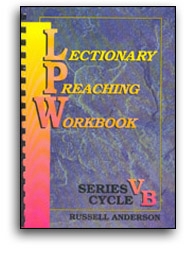
Lectionary Preaching Workbook
Series V, Cycle B
Historical Development
Lent is rooted in the historical practices of the first century church. Originally Lent lasted only forty hours, representing the forty hours Jesus' body lay in the tomb. In the third century the church in Jerusalem extended the season to six days and dubbed it Holy Week. Each day of Holy Week worship services would be conducted in the proper geographic location - Pilate's Hall, the Upper Room and so forth. When the western church celebrated Holy Week, they substituted the stations of the cross for the geographic locations. Special emphasis was accorded to the so--called tritium - Good Friday, Holy Saturday and Easter.
Next the six days of Holy Week were extended to 36 days, a tithe of the 365 day calendar. Charlemagne rounded this period off to forty days in 731 A.D. The number "40" had biblical precedent. Jesus fasted for forty days in the wilderness at the onset of his public ministry. Moses communed with God for forty days atop Mount Sinai in order to receive the Ten Commandments. The Israelites wandered for forty years in the wilderness. Thus, forty is a nice round number indicating a long time.
Lent is actually 46, not forty, days since Sundays are not considered as a part of Lent. That's why we speak of Sundays "in" Lent, not Sundays "of" Lent. Nevertheless, observance of the season has spilled over into the Sunday observance. We see indications of this with the liturgical color of purple in the paraments and the absence of the "Alleluia" and the "Glory To God."
Determining The Date Of Lent
The beginning of Lent is based on the timing of Easter. The date of Easter derives from the Jewish lunar calendar. Easter occurs on the first Sunday following the first full moon in Spring. The starting date for Lent traces back 46 days from the Easter Feast. For the first millennium of the Christian Church, the first day of Lent was called the "Beginning Of The Fast." In 1099, Pope Urban changed the name to "Ash Wednesday." Ashes are a traditional symbol of penitence and remorse. The practice of imposing ashes on the first day of Lent continues to this day in the church of Rome as well as in many Lutheran and Episcopalian quarters. As the ashes are imposed in the shape of a cross on the forehead of the worshipper, the priest or pastor intones "Remember that you are dust and to dust you shall return." This solemn reminder of our mortality spurs us to get right with God, who alone holds the key to eternal life. Many Protestant churches abandoned the imposition of ashes as being too Romanist or perhaps out of deference to the teachings of Jesus in Matthew 6:16--18, which state that when we fast we should not look dismal like the hypocrites.
The Significance Of Lent For The Believer
In the fourth century, Lent was a six--week period of catechesis for those who were preparing to become members of the church through Holy Baptism. It was an intense period of examination, prayer, repentance, and education to prepare the candidate for initiation into the mysteries of the faith, the sacraments. The candidate took on a new identity and became a new person in Christ. Those deemed ready to be admitted into the mysteries were baptized very early Easter morning to demonstrate that they were dying and rising with Christ. After Christianity became legalized in 325 A.D., Lent gradually became a general period of penitence for all believers. It remains a time when the church holds high the sufferings of Christ and his death on the cross. This observance should not be a macabre attempt to inflict personal suffering on ourselves. Rather, grasping the enormity of Christ's sacrifice and sufferings on our behalf, we are to respond with renewed repentance and faith.
Theological Themes Of Lent
Sacrifice - The First Lesson for The First Sunday In Lent is the story of God's testing of Abraham by asking him to sacrifice his son Isaac. Of course, the sacrifice of Christ on the cross permeates every aspect of our Lenten observance.
Repentance - The church opens Lent with a call to repentance on Ash Wednesday. Joel 2:12 dramatically introduces this theme in these words: "Yet even now," says the Lord, "return to me with fasting, with weeping, and with mourning; and rend your hearts and not your garments."
Suffering and death - Lent addresses the most troubling issue of mankind since the fall: What is the meaning of suffering and death? No philosophical answers are forthcoming. Rather, the Lenten texts confront us with the bold assertion that God himself suffers with us, redeeming our suffering and death.
The disciplines of Lent - These are prayer, fasting and almsgiving. These disciplines are held up for us in the Ash Wednesday Gospel (Matthew 6). These are the tools with which we can draw closer to Christ and experience a renewal of our spiritual center. Jesus prayed and fasted for forty days in the wilderness at the beginning of his public ministry. When Lent draws to a close, we find Jesus praying passionately in the Garden of Gethsemane. Abundant opportunities and encouragements to pray should be offered during the Lenten season. Fasting remains a solidly biblical practice that is largely ignored by Protestants. The Roman Church has also lessened the requirements for fasting. From the earliest times of the church, fasting was practiced on Fridays and on the Friday and Saturday of Holy Week. Fasting is a means of subordinating our physical needs to the spiritual. Also, fasting has been employed as a means of identifying with the sufferings of Christ. Unfortunately, self--denial has little appeal to the western mind. Lent provides us with a wonderful rationale for engaging in the third discipline of Lent, almsgiving. God has given himself to us in Christ; we show our appreciation by giving to God and others. Many congregations have special projects to which they contribute during Lent and provide special offering envelopes, folders and the like. Church members respond more favorably to giving more during Lent than they do to an appeal for increased prayer and fasting. It's easier to open our pocketbooks than it is to rend our hearts.
Worship Suggestions For Lenten Mid--Week Services And Holy Week
Many churches hold special services during the Lenten season that center around the passion of our Lord. Often these services are held on Wednesdays. These services should be knit together by a theme. Some churches prefer alternatives to preaching for the proclamation, employing drama, music and so forth. This can be effective if it deals with passion themes because such productions can involve a number of people. To make these services more practical, why not ask different lay people to give short witness talks as to how their faith has enabled them to surmount various human struggles? For instance, "How My Faith Helped Me Cope With Cancer." Topical series are popular and there are many such on the market. However, if you buy one of these series, be sure to adapt it to your situation. Another possibility is to take the passion story which is featured on Passion Sunday, the Sixth Sunday In Lent, and have a teaching series based on it. Ask people to bring their Bibles or have preprinted sheets for participants to fill in at various points. If it's a small group, give opportunity for discussion.
Some churches have services of devotion each day in Holy Week but they are not well attended. A majority of congregations focus on Maundy Thursday and Good Friday. Maundy Thursday seems to be the best attended. "Maundy" derives from the Latin word mandatum, meaning command. This harks from the story where Jesus washes his disciples' feet (John 13) and gives his disciples a new commandment, "That you love one another as I have loved you" (v. 34). Some congregations hold symbolic foot washing ceremonies as a part of the liturgy, which dramatically illustrate Christ's call for us to be servants. This account is not featured in the "B" series of the lectionary. Rather, it is Mark's account of the institution of the Lord's Supper.
Good Friday is the most solemn of the Lenten services, as we remember our Lord's suffering and death on the cross. Many churches and communities hold services around the seven last words of Jesus from the cross, which are pulled from all four gospels. These services are not recommended because they are a rather artificial construct which destroys the integrity of the individual gospel accounts. This year's lectionary series features the passion according to John. Why not read this account in a dramatic fashion, giving the various roles to different people in the congregation and reserving some parts for men, women and the congregation as a whole? Lights and shadows, sights and sounds should be employed at strategic points for greater impact. Tenebrae, a service of shadows, comes in many creative forms and is still used in many churches.
Holy Week opens on Passion Sunday, formerly Palm Sunday, which features Mark's account of the passion. Since most of the members of the church probably did not attend the Good Friday service, it would be good to feature a dramatic reading of Mark's passion account, assigning roles to various people. Involve men, women, children, choirs and so forth. Such accounts can be purchased at various ecclesiastical book stores. The Palm Sunday portion of passion story can be featured at the very beginning of the liturgy. This liturgy should begin in a place large enough to accommodate the worshipping congregation but outside the worship center of the church. After the Palm Sunday reading, the congregation processes into the nave (worship area) of the church with palms raised. The subordination of the Palm Sunday emphasis to the Passion story was instituted through the Revised Common Lectionary. It was felt that the church needed to provide an opportunity for most Christians to hear the passion story as a whole. This is something of a concession to the reality of modern life, which recognizes that most members will not attend all of the special Lenten liturgies during the week.
Roman Catholic and a few Protestant churches observe the Easter vigil on Holy Saturday evening. This would be a good time to baptize adult converts to the faith. This liturgy harks back to the early centuries of the church but it is very difficult to attract very many to this service.
A Suggested Sermon Series For Sundays In Lent
With all the emphasis in contemporary society on physical fitness, why not emphasize Lent as a time for increased spiritual fitness? Our spirit as well as our body must be toned up and strengthened for the spiritual battles that lie ahead. Each chapter contains sermon outlines for the following themes and titles.
Title for series: "Forty Days To Spiritual Fitness"
Ash Wednesday: Three Exercises You Can Do In Private
Theme: The right way to practice prayer, fasting and almsgiving.
Text: Matthew 6:1--6, 16--21
First Sunday In Lent: Repentance - Begin Your Spiritual Fitness Program With This Exercise
Theme: The call to regular and ongoing repentance.
Text: Mark 1:12--15
Second Sunday In Lent: Cross Bearing - The Essential Exercise For Christian Discipleship
Theme: Cross bearing. Suffering for the sake of the gospel.
Text: Mark 8:31--38
Third Sunday In Lent: Cleansing - An Exercise You Must Do At Church
Theme: Root out the leaven of corruption in the church.
Text: John 2:13--22
Fourth Sunday In Lent: Lift Up Christ - An Exercise That Will Strengthen The Entire Body
Theme: God lifted up Jesus on the cross. We must lift up Jesus through faith and witness.
Text: John 3:14--21
Fifth Sunday In Lent: Follow Christ - An Exercise That Leads Through Pain To Glory
Theme: Following Christ all the way to the cross.
Text: John 12:20--33
Passion Sunday: Be Loyal - Don't Give Up The Exercise Of Your Faith
Theme: The women stayed by Jesus all the way to the end and were the first to see the risen Christ. Like them, we must follow Jesus even when things look the darkest.
Text: Mark 15:40--47
Suggestion: Think about having a Lenten fitness program that combines both physical and spiritual exercises.
Lent is rooted in the historical practices of the first century church. Originally Lent lasted only forty hours, representing the forty hours Jesus' body lay in the tomb. In the third century the church in Jerusalem extended the season to six days and dubbed it Holy Week. Each day of Holy Week worship services would be conducted in the proper geographic location - Pilate's Hall, the Upper Room and so forth. When the western church celebrated Holy Week, they substituted the stations of the cross for the geographic locations. Special emphasis was accorded to the so--called tritium - Good Friday, Holy Saturday and Easter.
Next the six days of Holy Week were extended to 36 days, a tithe of the 365 day calendar. Charlemagne rounded this period off to forty days in 731 A.D. The number "40" had biblical precedent. Jesus fasted for forty days in the wilderness at the onset of his public ministry. Moses communed with God for forty days atop Mount Sinai in order to receive the Ten Commandments. The Israelites wandered for forty years in the wilderness. Thus, forty is a nice round number indicating a long time.
Lent is actually 46, not forty, days since Sundays are not considered as a part of Lent. That's why we speak of Sundays "in" Lent, not Sundays "of" Lent. Nevertheless, observance of the season has spilled over into the Sunday observance. We see indications of this with the liturgical color of purple in the paraments and the absence of the "Alleluia" and the "Glory To God."
Determining The Date Of Lent
The beginning of Lent is based on the timing of Easter. The date of Easter derives from the Jewish lunar calendar. Easter occurs on the first Sunday following the first full moon in Spring. The starting date for Lent traces back 46 days from the Easter Feast. For the first millennium of the Christian Church, the first day of Lent was called the "Beginning Of The Fast." In 1099, Pope Urban changed the name to "Ash Wednesday." Ashes are a traditional symbol of penitence and remorse. The practice of imposing ashes on the first day of Lent continues to this day in the church of Rome as well as in many Lutheran and Episcopalian quarters. As the ashes are imposed in the shape of a cross on the forehead of the worshipper, the priest or pastor intones "Remember that you are dust and to dust you shall return." This solemn reminder of our mortality spurs us to get right with God, who alone holds the key to eternal life. Many Protestant churches abandoned the imposition of ashes as being too Romanist or perhaps out of deference to the teachings of Jesus in Matthew 6:16--18, which state that when we fast we should not look dismal like the hypocrites.
The Significance Of Lent For The Believer
In the fourth century, Lent was a six--week period of catechesis for those who were preparing to become members of the church through Holy Baptism. It was an intense period of examination, prayer, repentance, and education to prepare the candidate for initiation into the mysteries of the faith, the sacraments. The candidate took on a new identity and became a new person in Christ. Those deemed ready to be admitted into the mysteries were baptized very early Easter morning to demonstrate that they were dying and rising with Christ. After Christianity became legalized in 325 A.D., Lent gradually became a general period of penitence for all believers. It remains a time when the church holds high the sufferings of Christ and his death on the cross. This observance should not be a macabre attempt to inflict personal suffering on ourselves. Rather, grasping the enormity of Christ's sacrifice and sufferings on our behalf, we are to respond with renewed repentance and faith.
Theological Themes Of Lent
Sacrifice - The First Lesson for The First Sunday In Lent is the story of God's testing of Abraham by asking him to sacrifice his son Isaac. Of course, the sacrifice of Christ on the cross permeates every aspect of our Lenten observance.
Repentance - The church opens Lent with a call to repentance on Ash Wednesday. Joel 2:12 dramatically introduces this theme in these words: "Yet even now," says the Lord, "return to me with fasting, with weeping, and with mourning; and rend your hearts and not your garments."
Suffering and death - Lent addresses the most troubling issue of mankind since the fall: What is the meaning of suffering and death? No philosophical answers are forthcoming. Rather, the Lenten texts confront us with the bold assertion that God himself suffers with us, redeeming our suffering and death.
The disciplines of Lent - These are prayer, fasting and almsgiving. These disciplines are held up for us in the Ash Wednesday Gospel (Matthew 6). These are the tools with which we can draw closer to Christ and experience a renewal of our spiritual center. Jesus prayed and fasted for forty days in the wilderness at the beginning of his public ministry. When Lent draws to a close, we find Jesus praying passionately in the Garden of Gethsemane. Abundant opportunities and encouragements to pray should be offered during the Lenten season. Fasting remains a solidly biblical practice that is largely ignored by Protestants. The Roman Church has also lessened the requirements for fasting. From the earliest times of the church, fasting was practiced on Fridays and on the Friday and Saturday of Holy Week. Fasting is a means of subordinating our physical needs to the spiritual. Also, fasting has been employed as a means of identifying with the sufferings of Christ. Unfortunately, self--denial has little appeal to the western mind. Lent provides us with a wonderful rationale for engaging in the third discipline of Lent, almsgiving. God has given himself to us in Christ; we show our appreciation by giving to God and others. Many congregations have special projects to which they contribute during Lent and provide special offering envelopes, folders and the like. Church members respond more favorably to giving more during Lent than they do to an appeal for increased prayer and fasting. It's easier to open our pocketbooks than it is to rend our hearts.
Worship Suggestions For Lenten Mid--Week Services And Holy Week
Many churches hold special services during the Lenten season that center around the passion of our Lord. Often these services are held on Wednesdays. These services should be knit together by a theme. Some churches prefer alternatives to preaching for the proclamation, employing drama, music and so forth. This can be effective if it deals with passion themes because such productions can involve a number of people. To make these services more practical, why not ask different lay people to give short witness talks as to how their faith has enabled them to surmount various human struggles? For instance, "How My Faith Helped Me Cope With Cancer." Topical series are popular and there are many such on the market. However, if you buy one of these series, be sure to adapt it to your situation. Another possibility is to take the passion story which is featured on Passion Sunday, the Sixth Sunday In Lent, and have a teaching series based on it. Ask people to bring their Bibles or have preprinted sheets for participants to fill in at various points. If it's a small group, give opportunity for discussion.
Some churches have services of devotion each day in Holy Week but they are not well attended. A majority of congregations focus on Maundy Thursday and Good Friday. Maundy Thursday seems to be the best attended. "Maundy" derives from the Latin word mandatum, meaning command. This harks from the story where Jesus washes his disciples' feet (John 13) and gives his disciples a new commandment, "That you love one another as I have loved you" (v. 34). Some congregations hold symbolic foot washing ceremonies as a part of the liturgy, which dramatically illustrate Christ's call for us to be servants. This account is not featured in the "B" series of the lectionary. Rather, it is Mark's account of the institution of the Lord's Supper.
Good Friday is the most solemn of the Lenten services, as we remember our Lord's suffering and death on the cross. Many churches and communities hold services around the seven last words of Jesus from the cross, which are pulled from all four gospels. These services are not recommended because they are a rather artificial construct which destroys the integrity of the individual gospel accounts. This year's lectionary series features the passion according to John. Why not read this account in a dramatic fashion, giving the various roles to different people in the congregation and reserving some parts for men, women and the congregation as a whole? Lights and shadows, sights and sounds should be employed at strategic points for greater impact. Tenebrae, a service of shadows, comes in many creative forms and is still used in many churches.
Holy Week opens on Passion Sunday, formerly Palm Sunday, which features Mark's account of the passion. Since most of the members of the church probably did not attend the Good Friday service, it would be good to feature a dramatic reading of Mark's passion account, assigning roles to various people. Involve men, women, children, choirs and so forth. Such accounts can be purchased at various ecclesiastical book stores. The Palm Sunday portion of passion story can be featured at the very beginning of the liturgy. This liturgy should begin in a place large enough to accommodate the worshipping congregation but outside the worship center of the church. After the Palm Sunday reading, the congregation processes into the nave (worship area) of the church with palms raised. The subordination of the Palm Sunday emphasis to the Passion story was instituted through the Revised Common Lectionary. It was felt that the church needed to provide an opportunity for most Christians to hear the passion story as a whole. This is something of a concession to the reality of modern life, which recognizes that most members will not attend all of the special Lenten liturgies during the week.
Roman Catholic and a few Protestant churches observe the Easter vigil on Holy Saturday evening. This would be a good time to baptize adult converts to the faith. This liturgy harks back to the early centuries of the church but it is very difficult to attract very many to this service.
A Suggested Sermon Series For Sundays In Lent
With all the emphasis in contemporary society on physical fitness, why not emphasize Lent as a time for increased spiritual fitness? Our spirit as well as our body must be toned up and strengthened for the spiritual battles that lie ahead. Each chapter contains sermon outlines for the following themes and titles.
Title for series: "Forty Days To Spiritual Fitness"
Ash Wednesday: Three Exercises You Can Do In Private
Theme: The right way to practice prayer, fasting and almsgiving.
Text: Matthew 6:1--6, 16--21
First Sunday In Lent: Repentance - Begin Your Spiritual Fitness Program With This Exercise
Theme: The call to regular and ongoing repentance.
Text: Mark 1:12--15
Second Sunday In Lent: Cross Bearing - The Essential Exercise For Christian Discipleship
Theme: Cross bearing. Suffering for the sake of the gospel.
Text: Mark 8:31--38
Third Sunday In Lent: Cleansing - An Exercise You Must Do At Church
Theme: Root out the leaven of corruption in the church.
Text: John 2:13--22
Fourth Sunday In Lent: Lift Up Christ - An Exercise That Will Strengthen The Entire Body
Theme: God lifted up Jesus on the cross. We must lift up Jesus through faith and witness.
Text: John 3:14--21
Fifth Sunday In Lent: Follow Christ - An Exercise That Leads Through Pain To Glory
Theme: Following Christ all the way to the cross.
Text: John 12:20--33
Passion Sunday: Be Loyal - Don't Give Up The Exercise Of Your Faith
Theme: The women stayed by Jesus all the way to the end and were the first to see the risen Christ. Like them, we must follow Jesus even when things look the darkest.
Text: Mark 15:40--47
Suggestion: Think about having a Lenten fitness program that combines both physical and spiritual exercises.