Journey Into Faith
Worship
Worship Innovations Volume Two
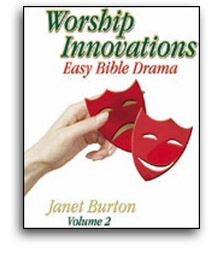
Worship Innovations: Easy Bible Drama
Isaac's Test On Mount Moriah
Synopsis: On his return from the test on Mount Moriah, Isaac talks with his mother about the ordeal and together they wonder, "What if God had really required Isaac's life -- could we now still love him?" At issue: Putting God ahead of all we love in life.
Preparation
Characters Needed:
Sarah: Now 100 years old, dressed in a simple, dark tunic with shawl around her shoulders. She wears a dark headpiece/veil and sandals.

Isaac: A boy between ten and fourteen years old, dressed in a neutral, knee-length tunic with leather belt and sandals on bare feet.
Setting: Create a portion of the tent of Abraham and Sarah by swagging a twelve-foot length of natural burlap between two sturdy poles. A small bench for Sarah should be covered with a tapestry or animal skin. Lay a woven rug or sheepskin as a floor mat for Isaac. Lower the house lights and place a lighted oil lamp or candle beside Sarah on the bench. Set a bowl of ripe grapes on the floor mat. A couple of plants could be added.
As the play opens, Sarah and Isaac are deep in conversation about the day's events. She sits on the bench, and he on the floor near her.
Dialogue
Sarah: Your father did what? (Her tone is one of unbelief. She reaches out to touch her son's hand.) My Lord Abraham actually put you on the altar, Isaac? (Shakes her head.) Whatever was he thinking?
Isaac: (Pats her hand.) Yes, Mother. I was so afraid. I couldn't believe what was happening. Father tied my hands and feet (places his wrists together in a bound position to show her) and lifted me onto the altar of rocks and wood. (Rises onto his knees and mimics Abraham's lifting him up.)
Sarah: (Shakes her head again.) He would have sacrificed you? Our only son? The son of promise? (Stands and walks to the edge of the tent, looking outward.) What ever could he have been thinking? Surely God did not ask such a terrible thing of him!
(Returns to the bench and looks at Isaac.) What did Lord Abraham say, Isaac? How did he explain this terrible mistake?
Isaac: But it wasn't a mistake, Mother. (Pats her knee, consoling her.) All the way to Mount Moriah Father was quiet. We thought he was preparing himself for the worship of Jehovah. But after we got there, and we had left Eliezer and the Hittite servant with the donkeys, and it was just Father and me, he was quieter still.
Sarah: (Rushes him with an impatient wave of her hand.) And so? And so? What happened next?
Isaac: And so, I began to ask him, "Father, we have the fire and the wood. But where is the lamb for the sacrifice?"
Sarah: And how did he answer you?
Isaac: He just kept saying, "God himself will provide the lamb, Son." And he did, Mother!
Sarah: Yes! You! You, my precious, only son! What a pagan, awful thing to do. (Reaches out to gently hug Isaac, but he pulls away to respond.)
Isaac: No, Mother -- not me. Just as Father laid me on the altar, and reached for his big knife (mimics his father, raising his hand as if holding a dagger) a voice called to him and stopped him.
Sarah: (Interrupts) A voice? What voice, Isaac? I thought you two were alone up there.
Isaac: I didn't know the voice, Mother, but Father seemed to recognize it. Maybe it was an angel from God. It said, (mimics a deep voice), "Do not lay a hand on the boy. Now I know you truly love God, because you have not refused to give your son to me."
Sarah: And did he let you go then?
Isaac: Father was so relieved. The voice kept talking, but Father was busy untying my hands and feet (gestures to mimic Abraham) and hugging me and crying. (Points outside the tent to the desert.) And then we saw the lamb.
Sarah: A real lamb, Son? Up there on the mountain?
Isaac: Yes, Mother. A ram actually. Perfect for sacrificing. He was caught in a tamarisk tree by his horns. And Father sacrificed the ram in my place. (Pauses, and reaches for a bunch of grapes.) And then we started for home. (Stuffs several grapes in his mouth.)
Sarah: Don't stuff your mouth so, Son. What could Lord Abraham have been thinking? You -- our only promise for God's fulfilling his covenant. How can God keep his promises if we have no heir?
Isaac: (Sits up on his knees, still munching grapes.) I asked Father that on the way down the mountain. And he just said, "God can raise the dead, you know."
Sarah: (Repeats his answer slowly.) God can raise the dead? (Nods.) Yes, my son, I guess he can. If he could bring life from my body at the age of ninety, and cause you to be born a perfect son, I guess he could raise the dead. (Leans over to hug Isaac.)
Isaac: Our Jehovah God is more awesome than the Canaanite gods, isn't he, Mother? They could never raise people from the dead. They aren't even alive themselves.
Sarah: More awesome -- and more mysterious.
Isaac: (Stands and looks at his mother.) Father says our God has promised that our family will become a great and wealthy nation one day. Greater than the Babylonians -- or the Hittites. (Swings his arm in an arc over the desert landscape.) Maybe as great as Egypt. And he will give us this whole country -- some day.
Sarah: (Stands to put her arm around his shoulders.) And you, my son, are the one through whom God will make it all come to pass.
Isaac: Well, I hope there are no more Mount Moriahs on the way. That was scary!
Sarah: If there are Mount Moriahs, there will be rams in the tamarisk, Isaac. I guess that is what we must remember from all this. We must learn to trust Jehovah God to provide. (Hugs him, he kisses her cheek and exits. Sarah watches him go, then talks to herself.)
Whatever would we have done if Jehovah had really asked for our son? The most precious thing in our lives -- more precious than life itself. (Blows out the lamp and turns to go, but looks back toward the tent.) Could we have loved him even then? (Exits.)
Follow Up
Some Issues: The test on Mount Moriah is one of the Bible's many difficult stories from which we must learn, partly because it is so far removed from life as we live it today. Were Abraham to repeat that incident in today's world, he would be jailed for child abuse. Sarah would likely divorce him and have her son in counseling by Monday morning. We simply cannot identify with all that happened here.
Not to mention the theological struggle caused by God's seeming to ask Abraham to do something that would harm another human -- most especially his son. Our understanding of God is that he does not initiate evil, but rather acts toward us out of love and compassion. By the time of Moses and Joshua, God's people understood that he forbid child sacrifice -- a practice common in the pagan peoples who lived about them. (See Psalm 106:37-39.)
So, what are we to make of this story? The heart of it is Genesis 22:12. God illustrated by the test on Mount Moriah that he requires us to put nothing before him, but to love him totally, with "all our heart, soul, mind and strength." And the proof of that love is seen in our unquestioning submission to his will. We do not have to like this disturbing story, but we must learn from it. Whether or not God requires a drastic sacrifice from us, he must have first place in our lives. (See 1 Samuel 15:22.)
Questions For Thought:
About Isaac: One of the omissions of the Bible account is how Isaac responded to being the object of this lesson. What did he say or do? What did he feel? Do you agree with how he is depicted in this drama? When it was over, do you think he shared his father's total commitment to Jehovah's will?
About Sarah: In the drama, Sarah raises a tough question. If Jehovah had really asked Abraham to go through with the sacrifice, could they have loved God still? In times of severe grief, some people turn toward God, others turn against him. What makes the difference?
About Abraham: Abraham is rightfully known for his faith. Hebrews 11:17-19 gives us an important clue. How could Abraham have trusted God to the extent he did in this story? Compare Abraham's faith with Paul's declaration in Romans 8:37-39.
About Ourselves: The probing light of this dramatic event forces us to ask, "Is there anything -- any person, quest, object or endeavor -- in my life that I could not trust to God, should he ask for it?" We are eager to answer, "No," but only when the test comes -- when we must climb the mountain, build the altar, and raise the dagger -- will we truly know how difficult that question can be. Has a time like that ever happened for you?
Synopsis: On his return from the test on Mount Moriah, Isaac talks with his mother about the ordeal and together they wonder, "What if God had really required Isaac's life -- could we now still love him?" At issue: Putting God ahead of all we love in life.
Preparation
Characters Needed:
Sarah: Now 100 years old, dressed in a simple, dark tunic with shawl around her shoulders. She wears a dark headpiece/veil and sandals.
Isaac: A boy between ten and fourteen years old, dressed in a neutral, knee-length tunic with leather belt and sandals on bare feet.
Setting: Create a portion of the tent of Abraham and Sarah by swagging a twelve-foot length of natural burlap between two sturdy poles. A small bench for Sarah should be covered with a tapestry or animal skin. Lay a woven rug or sheepskin as a floor mat for Isaac. Lower the house lights and place a lighted oil lamp or candle beside Sarah on the bench. Set a bowl of ripe grapes on the floor mat. A couple of plants could be added.
As the play opens, Sarah and Isaac are deep in conversation about the day's events. She sits on the bench, and he on the floor near her.
Dialogue
Sarah: Your father did what? (Her tone is one of unbelief. She reaches out to touch her son's hand.) My Lord Abraham actually put you on the altar, Isaac? (Shakes her head.) Whatever was he thinking?
Isaac: (Pats her hand.) Yes, Mother. I was so afraid. I couldn't believe what was happening. Father tied my hands and feet (places his wrists together in a bound position to show her) and lifted me onto the altar of rocks and wood. (Rises onto his knees and mimics Abraham's lifting him up.)
Sarah: (Shakes her head again.) He would have sacrificed you? Our only son? The son of promise? (Stands and walks to the edge of the tent, looking outward.) What ever could he have been thinking? Surely God did not ask such a terrible thing of him!
(Returns to the bench and looks at Isaac.) What did Lord Abraham say, Isaac? How did he explain this terrible mistake?
Isaac: But it wasn't a mistake, Mother. (Pats her knee, consoling her.) All the way to Mount Moriah Father was quiet. We thought he was preparing himself for the worship of Jehovah. But after we got there, and we had left Eliezer and the Hittite servant with the donkeys, and it was just Father and me, he was quieter still.
Sarah: (Rushes him with an impatient wave of her hand.) And so? And so? What happened next?
Isaac: And so, I began to ask him, "Father, we have the fire and the wood. But where is the lamb for the sacrifice?"
Sarah: And how did he answer you?
Isaac: He just kept saying, "God himself will provide the lamb, Son." And he did, Mother!
Sarah: Yes! You! You, my precious, only son! What a pagan, awful thing to do. (Reaches out to gently hug Isaac, but he pulls away to respond.)
Isaac: No, Mother -- not me. Just as Father laid me on the altar, and reached for his big knife (mimics his father, raising his hand as if holding a dagger) a voice called to him and stopped him.
Sarah: (Interrupts) A voice? What voice, Isaac? I thought you two were alone up there.
Isaac: I didn't know the voice, Mother, but Father seemed to recognize it. Maybe it was an angel from God. It said, (mimics a deep voice), "Do not lay a hand on the boy. Now I know you truly love God, because you have not refused to give your son to me."
Sarah: And did he let you go then?
Isaac: Father was so relieved. The voice kept talking, but Father was busy untying my hands and feet (gestures to mimic Abraham) and hugging me and crying. (Points outside the tent to the desert.) And then we saw the lamb.
Sarah: A real lamb, Son? Up there on the mountain?
Isaac: Yes, Mother. A ram actually. Perfect for sacrificing. He was caught in a tamarisk tree by his horns. And Father sacrificed the ram in my place. (Pauses, and reaches for a bunch of grapes.) And then we started for home. (Stuffs several grapes in his mouth.)
Sarah: Don't stuff your mouth so, Son. What could Lord Abraham have been thinking? You -- our only promise for God's fulfilling his covenant. How can God keep his promises if we have no heir?
Isaac: (Sits up on his knees, still munching grapes.) I asked Father that on the way down the mountain. And he just said, "God can raise the dead, you know."
Sarah: (Repeats his answer slowly.) God can raise the dead? (Nods.) Yes, my son, I guess he can. If he could bring life from my body at the age of ninety, and cause you to be born a perfect son, I guess he could raise the dead. (Leans over to hug Isaac.)
Isaac: Our Jehovah God is more awesome than the Canaanite gods, isn't he, Mother? They could never raise people from the dead. They aren't even alive themselves.
Sarah: More awesome -- and more mysterious.
Isaac: (Stands and looks at his mother.) Father says our God has promised that our family will become a great and wealthy nation one day. Greater than the Babylonians -- or the Hittites. (Swings his arm in an arc over the desert landscape.) Maybe as great as Egypt. And he will give us this whole country -- some day.
Sarah: (Stands to put her arm around his shoulders.) And you, my son, are the one through whom God will make it all come to pass.
Isaac: Well, I hope there are no more Mount Moriahs on the way. That was scary!
Sarah: If there are Mount Moriahs, there will be rams in the tamarisk, Isaac. I guess that is what we must remember from all this. We must learn to trust Jehovah God to provide. (Hugs him, he kisses her cheek and exits. Sarah watches him go, then talks to herself.)
Whatever would we have done if Jehovah had really asked for our son? The most precious thing in our lives -- more precious than life itself. (Blows out the lamp and turns to go, but looks back toward the tent.) Could we have loved him even then? (Exits.)
Follow Up
Some Issues: The test on Mount Moriah is one of the Bible's many difficult stories from which we must learn, partly because it is so far removed from life as we live it today. Were Abraham to repeat that incident in today's world, he would be jailed for child abuse. Sarah would likely divorce him and have her son in counseling by Monday morning. We simply cannot identify with all that happened here.
Not to mention the theological struggle caused by God's seeming to ask Abraham to do something that would harm another human -- most especially his son. Our understanding of God is that he does not initiate evil, but rather acts toward us out of love and compassion. By the time of Moses and Joshua, God's people understood that he forbid child sacrifice -- a practice common in the pagan peoples who lived about them. (See Psalm 106:37-39.)
So, what are we to make of this story? The heart of it is Genesis 22:12. God illustrated by the test on Mount Moriah that he requires us to put nothing before him, but to love him totally, with "all our heart, soul, mind and strength." And the proof of that love is seen in our unquestioning submission to his will. We do not have to like this disturbing story, but we must learn from it. Whether or not God requires a drastic sacrifice from us, he must have first place in our lives. (See 1 Samuel 15:22.)
Questions For Thought:
About Isaac: One of the omissions of the Bible account is how Isaac responded to being the object of this lesson. What did he say or do? What did he feel? Do you agree with how he is depicted in this drama? When it was over, do you think he shared his father's total commitment to Jehovah's will?
About Sarah: In the drama, Sarah raises a tough question. If Jehovah had really asked Abraham to go through with the sacrifice, could they have loved God still? In times of severe grief, some people turn toward God, others turn against him. What makes the difference?
About Abraham: Abraham is rightfully known for his faith. Hebrews 11:17-19 gives us an important clue. How could Abraham have trusted God to the extent he did in this story? Compare Abraham's faith with Paul's declaration in Romans 8:37-39.
About Ourselves: The probing light of this dramatic event forces us to ask, "Is there anything -- any person, quest, object or endeavor -- in my life that I could not trust to God, should he ask for it?" We are eager to answer, "No," but only when the test comes -- when we must climb the mountain, build the altar, and raise the dagger -- will we truly know how difficult that question can be. Has a time like that ever happened for you?