Hold On! Your Life Is At Stake!
Sermon
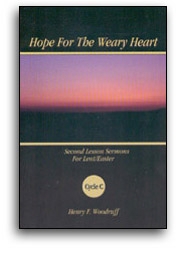
Hope For The Weary Heart
Second Lesson Sermons For Lent/Easter Cycle C
The names of the places -- Treblinka, Auschwitz, Buchenwald, and all the rest -- remain seared into our memory, even as those who knew the struggle in those places still carry their numbers on their arms. The struggle was the monumental battle between the desire to obliterate life and the will to survive; in the struggle it seemed that all the power was on one side. Those in control of the places called Treblinka, Auschwitz, Buchenwald, and the rest seemed to have had every bit of the power. They strung the barbed wire and manned the machine guns; they ran the showers that weren't and the ovens that were; they seemingly controlled every aspect of the miserable lives of the men, women, and children put there -- people whose only crime was that they were Jewish, or homosexual, or disabled, or suffered from some other "defect" as the Nazis defined it. They seemed totally impotent in the face of it all.

But the most amazing thing transpired: while some passively succumbed, others would simply not give up. They were dehumanized; they were stripped of their clothes and their dignity; they were stripped from their families and brutalized. They were treated far worse than the animals in whose cattle cars they were brought to the camps, but still they held on. Why was that?
Eric Fromm, himself a survivor of the Nazi Holocaust, discovered the truth of it: what you decide to hold on to makes a difference in how long you can hold on! Fromm witnessed it every single day in the death camp where he was incarcerated; he tells some of the story in his book The Art of Loving. What made the difference, Fromm observed, was the will to hold on to the capacity to love, and the refusal to let go all reason to the contrary! And there was every reason to let go: they knew their situation was hopeless; they witnessed their own husbands and wives and children brutalized and murdered in front of them. If there was ever a time, like Job's, "to curse God and die" (Job 2:9), this one was it!
Yes, but those who didn't -- those who held on because they knew their very life -- in every sense of the word -- was at stake -- they -- survived! In the most profound sense, they held on to life even when it was crushed out of them. They discovered the truth of it, the truth which came to them in the crucible of unspeakable human hurt: what you hold on to -- and where you stake your very life -- really does make a difference: in the living, and the dying, and in everything between and beyond.
It can and will make a difference for us; it is the truth for us. No barbed wire surrounds us; we are only hemmed in by the circumstances of our lives. No death camp guard threatens us; it is simply boredom, emptiness, lost possibilities, and vanished dreams, our own miserable failures; this is what would strip life from us. This is the "in between time" for us, and in this in between time -- between now and death -- it really does make a difference where we stake our lives. It is the truth for us where we are: It makes a difference what we hold on to.
There are lots of possibilities, and some are easier to hold on to than others. We can hold on to the stuff around us. This is easy; it is nearby and we can see it. Lord knows, we've got enough of it around us! So when our lives are at stake we can reach out and grab the things we've accumulated, hold on to them, and try to keep life from slipping away. But we all know its true: whatever things we have, even the rags that covered the emaciated bodies of the Holocaust victims, can be stripped from us. Nothing is permanent; stuff will not enable us to hold on to life.
Sometimes we try to hold on to ourselves. You know what this is like: we just suck it up and tell ourselves, "We can do this! We're bright enough, good enough, capable enough in ourselves to do it. We don't need anything, nor anyone else; we can do it ourselves." This, too, can work for awhile -- but only for awhile. And then the crushing reality of it all falls down on us, crushing the life out of us, and we are forced to face the truth of it: We are not sufficient in our own puny selves to hold on to life when it is disintegrating underneath us; we need something more to grasp than ourselves.
Like the survivors Eric Fromm observed, the "something more" can be each other. There is strength here; there is strength from living in community, in reaching out, giving and receiving love, and forging bonds of support. And yet, all communities also disintegrate; they, too, are impermanent. Eventually whatever community of which we are a part will disappear, and again we are left reaching, grasping, trying, to hold on for dear life.
One choice remains, the one that lies at both the beginning and the ending of life itself. It is the choice of reaching out to Christ and holding on to him. Only here can we really stake our lives, and when our lives are at stake, this is Good News to know. Few knew it better than Paul, and it was because of his own lived experience that he could lift himself up as an example and write the words of hope he penned to his close friends at Philippi. Earlier in his life Paul had centered his life elsewhere, and it had all slipped through his grasp. He was a person of piercing intellect and as well educated as anyone could be in his time; but he discovered that neither education nor sheer intelligence could sustain him when he lay blinded and helpless on the Damascus road. Paul was fiercely proud of his family's religion -- his religion -- even as he was proud of his ethnic heritage. None of it, however, mattered when he faced his own profound failure before God, writing those words in the seventh chapter of Romans that tear at our heart: "I don't even understand myself. The things I want to do, I cannot; and the very things I find abhorrent are the very things I do. Wretched man that I am, who will deliver me from this body of death?"(Romans 7:19ff). He had powerful friends in powerful places, but they couldn't save him either.
In his life Paul had tried it all, until he finally made the discovery that gave him life -- both in the days he had, as well as in the time beyond. It was the discovery that only Christ will not fail you, and it is only by holding on to him that you can make it. I think this is why there is such passion in his words as we read them: Paul knew that all who were enemies of the Cross were enemies of life; all who would tell you to hold on to something else and stake your life on something else -- whether it was tradition, or dogma, or ritual, or status, or whatever -- all who pointed you elsewhere were pointing you toward destruction. This is why Paul urged his friends to "stand firm in the Lord," for it is only the hand of the Lord Jesus that will preserve your life when life -- and its meaning, its purpose -- are all at stake.
Where you and I are standing today, this is not easy. It is not easy for any of us; I know, for I've been there, been where all of us have been: watching any hope in our lives slip through our fingers, feeling the very ground on which we are standing slide out from under our feet. Oh, we're trying to hold on; we are trying it almost every challenging day of our fragile lives. Moreover, deep down inside we know Paul is right -- that only by holding on to Jesus can we hold on to life. The problem -- and it's a big one -- is that to hold on to Jesus, you've first got to find the hand of Christ, and then find the courage not to let go. How do we do this?
I know the answer, even as Paul knew it, but you know it, too. Every Christian knows the answer about how to find the hand of Jesus and not let go, even though we often forget or think we don't know how. Jog your memory with me: When you were slipping and sliding, grasping at anything that would save your miserable life, wasn't it Christ who grasped you? You see, we don't have to search for the One who is the foundation of our life; Christ is searching for us! It is the scandal of the Gospel: God has seen fit never to give up on us, and when others were sent to reach to us, and we turned away, God sent Jesus who never turns away. Christ is always reaching, with hand outstretched, ready to grasp ours and lift us to new life. We can count on it. Christ is reaching to us, always, because this is what Christ is always about: reaching to hold and walk with us, reaching to sustain and give strength, reaching even when life is ebbing away, reaching, always reaching. All we have to do is reach out, and we will be found!
Then it will be easy to hold on and not let go -- because we really do know the truth of it: If we're going to get anywhere in this life -- or beyond it -- it is the hand of Christ that will lead us. Grasping that hand we will celebrate the truth and power of it, whether it be an unknown and threatening future we face, or even the specter of death itself staring us in the face. Our heart and spirit will sing with Thomas Dorsey's immortal words, "Precious Lord, take my hand, lead me on, let me stand, I am tired, I am weak, I am worn; through the storm, through the night, lead me on to the light: Take my hand, precious Lord, lead me home" (United Methodist Hymnal, No. 474).
But the most amazing thing transpired: while some passively succumbed, others would simply not give up. They were dehumanized; they were stripped of their clothes and their dignity; they were stripped from their families and brutalized. They were treated far worse than the animals in whose cattle cars they were brought to the camps, but still they held on. Why was that?
Eric Fromm, himself a survivor of the Nazi Holocaust, discovered the truth of it: what you decide to hold on to makes a difference in how long you can hold on! Fromm witnessed it every single day in the death camp where he was incarcerated; he tells some of the story in his book The Art of Loving. What made the difference, Fromm observed, was the will to hold on to the capacity to love, and the refusal to let go all reason to the contrary! And there was every reason to let go: they knew their situation was hopeless; they witnessed their own husbands and wives and children brutalized and murdered in front of them. If there was ever a time, like Job's, "to curse God and die" (Job 2:9), this one was it!
Yes, but those who didn't -- those who held on because they knew their very life -- in every sense of the word -- was at stake -- they -- survived! In the most profound sense, they held on to life even when it was crushed out of them. They discovered the truth of it, the truth which came to them in the crucible of unspeakable human hurt: what you hold on to -- and where you stake your very life -- really does make a difference: in the living, and the dying, and in everything between and beyond.
It can and will make a difference for us; it is the truth for us. No barbed wire surrounds us; we are only hemmed in by the circumstances of our lives. No death camp guard threatens us; it is simply boredom, emptiness, lost possibilities, and vanished dreams, our own miserable failures; this is what would strip life from us. This is the "in between time" for us, and in this in between time -- between now and death -- it really does make a difference where we stake our lives. It is the truth for us where we are: It makes a difference what we hold on to.
There are lots of possibilities, and some are easier to hold on to than others. We can hold on to the stuff around us. This is easy; it is nearby and we can see it. Lord knows, we've got enough of it around us! So when our lives are at stake we can reach out and grab the things we've accumulated, hold on to them, and try to keep life from slipping away. But we all know its true: whatever things we have, even the rags that covered the emaciated bodies of the Holocaust victims, can be stripped from us. Nothing is permanent; stuff will not enable us to hold on to life.
Sometimes we try to hold on to ourselves. You know what this is like: we just suck it up and tell ourselves, "We can do this! We're bright enough, good enough, capable enough in ourselves to do it. We don't need anything, nor anyone else; we can do it ourselves." This, too, can work for awhile -- but only for awhile. And then the crushing reality of it all falls down on us, crushing the life out of us, and we are forced to face the truth of it: We are not sufficient in our own puny selves to hold on to life when it is disintegrating underneath us; we need something more to grasp than ourselves.
Like the survivors Eric Fromm observed, the "something more" can be each other. There is strength here; there is strength from living in community, in reaching out, giving and receiving love, and forging bonds of support. And yet, all communities also disintegrate; they, too, are impermanent. Eventually whatever community of which we are a part will disappear, and again we are left reaching, grasping, trying, to hold on for dear life.
One choice remains, the one that lies at both the beginning and the ending of life itself. It is the choice of reaching out to Christ and holding on to him. Only here can we really stake our lives, and when our lives are at stake, this is Good News to know. Few knew it better than Paul, and it was because of his own lived experience that he could lift himself up as an example and write the words of hope he penned to his close friends at Philippi. Earlier in his life Paul had centered his life elsewhere, and it had all slipped through his grasp. He was a person of piercing intellect and as well educated as anyone could be in his time; but he discovered that neither education nor sheer intelligence could sustain him when he lay blinded and helpless on the Damascus road. Paul was fiercely proud of his family's religion -- his religion -- even as he was proud of his ethnic heritage. None of it, however, mattered when he faced his own profound failure before God, writing those words in the seventh chapter of Romans that tear at our heart: "I don't even understand myself. The things I want to do, I cannot; and the very things I find abhorrent are the very things I do. Wretched man that I am, who will deliver me from this body of death?"(Romans 7:19ff). He had powerful friends in powerful places, but they couldn't save him either.
In his life Paul had tried it all, until he finally made the discovery that gave him life -- both in the days he had, as well as in the time beyond. It was the discovery that only Christ will not fail you, and it is only by holding on to him that you can make it. I think this is why there is such passion in his words as we read them: Paul knew that all who were enemies of the Cross were enemies of life; all who would tell you to hold on to something else and stake your life on something else -- whether it was tradition, or dogma, or ritual, or status, or whatever -- all who pointed you elsewhere were pointing you toward destruction. This is why Paul urged his friends to "stand firm in the Lord," for it is only the hand of the Lord Jesus that will preserve your life when life -- and its meaning, its purpose -- are all at stake.
Where you and I are standing today, this is not easy. It is not easy for any of us; I know, for I've been there, been where all of us have been: watching any hope in our lives slip through our fingers, feeling the very ground on which we are standing slide out from under our feet. Oh, we're trying to hold on; we are trying it almost every challenging day of our fragile lives. Moreover, deep down inside we know Paul is right -- that only by holding on to Jesus can we hold on to life. The problem -- and it's a big one -- is that to hold on to Jesus, you've first got to find the hand of Christ, and then find the courage not to let go. How do we do this?
I know the answer, even as Paul knew it, but you know it, too. Every Christian knows the answer about how to find the hand of Jesus and not let go, even though we often forget or think we don't know how. Jog your memory with me: When you were slipping and sliding, grasping at anything that would save your miserable life, wasn't it Christ who grasped you? You see, we don't have to search for the One who is the foundation of our life; Christ is searching for us! It is the scandal of the Gospel: God has seen fit never to give up on us, and when others were sent to reach to us, and we turned away, God sent Jesus who never turns away. Christ is always reaching, with hand outstretched, ready to grasp ours and lift us to new life. We can count on it. Christ is reaching to us, always, because this is what Christ is always about: reaching to hold and walk with us, reaching to sustain and give strength, reaching even when life is ebbing away, reaching, always reaching. All we have to do is reach out, and we will be found!
Then it will be easy to hold on and not let go -- because we really do know the truth of it: If we're going to get anywhere in this life -- or beyond it -- it is the hand of Christ that will lead us. Grasping that hand we will celebrate the truth and power of it, whether it be an unknown and threatening future we face, or even the specter of death itself staring us in the face. Our heart and spirit will sing with Thomas Dorsey's immortal words, "Precious Lord, take my hand, lead me on, let me stand, I am tired, I am weak, I am worn; through the storm, through the night, lead me on to the light: Take my hand, precious Lord, lead me home" (United Methodist Hymnal, No. 474).