He Was A Good Man
Sermon
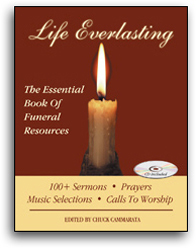
Life Everlasting
The Essential Book of Funeral Resources
Object:
For a gifted and blessed man
He Was A Good Man
Mark 5:1-9; Revelation 7:15-17
The story of the Gerasene demoniac reminds us of two truths which we need to hold before us as we begin this time of remembering and reflection.

Each of us has our own demons which torment us and can rule us. Not personified other-worldly beings as Mark describes in his gospel from the first century, but the forces which push us and drive us and can consume us in this century. We all have our own demons; the differences between us are whether we will admit them or hide them.
Second, if we can name the demon (shine the light of Jesus Christ on the demon), the demon loses its power. Demons live and work in darkness. They live in the half-light of denial.
We have a demon in the room with us. We are going to name it, and take away its power. Paul took his own life. We do not know why. We may never know why. "Why?" is the question which envelops the room.
Let us call for the light of Jesus Christ to shine into this room and on this question.
I did not know Paul. I think that I may have met him at one of the high and holy moments which I have been privileged to share with this family. Yesterday afternoon, I met with his wife and his daughter and his mother and his brother and a few other members of the family to learn from them those things which they would want me to remember to you this day about Paul.
I say to you that time with the family was "bookended" by a brief conversation which I had with Paul's brother-in-law, and one of his long-time business associates. Let me bookend what the family remembered with those conversations, for I found the whole of the experience to follow certain themes.
Paul's brother-in-law, Harold, attended church yesterday. It was our annual youth Sunday. He remained after worship until I was free so that he could speak to me. Harold and Joannie were members of this church until they moved to Lano. They have always expressed a great interest in the church and attend when they are in town.
Harold wanted me to know how much he enjoyed the service, how happy he was with what we are doing in the life of this church, then he got to the point. He said to me with tears in his eyes, "Pastor, Paul was a good man. He was good to his wife, Betty, he was good to his sister, Joannie, and he was good to me. He worked too hard, he was a workaholic, but he was a good man."
Then, when I met with the family, Joannie remembered that when she brought Harold to meet Paul, though Paul did not say anything, she could tell from his expression that he did not approve. Paul was protective and simply did not know about this tall, lanky stranger.
As Paul grew to know Harold, he grew to trust him, respect him, and love him as a brother. That new relationship brought about great, good times for the whole family.
Family was important to Paul, the whole family. He was concerned, and protective of them.
Betty said that you always knew where you stood with Paul. He was a man who dealt directly with people. He respected people for who they were. If someone presented themselves to be something they were not, whether that was a member of the family or in a business relationship: it did not matter, that person was going to be held accountable.
Betty said that he had a mind which did not work as our minds work, he was a genius. Perhaps because his mind worked differently, he was distant, maybe even aloof with people until he came to know them. Once he knew them, he was loving and caring. They were married 37 years. She describes their relationship as "fantastic."
His mother remembers that he was a special son. She laughed as she remembered that her generation thought he was "born forty years old." Evidence of his special gifts surfaced early in his life. He was the only student in his high school with a pilot's license. She said that he was a loving, kind, and compassionate son; always there when she needed him. But he was also a complex man with a reserved personality.
His daughter remembers that he had high expectations of himself and her. She remembers that he loved the outdoors, loved the hill country, and loved to read. She and her dad shared a love of books.
A complex man with a brilliant mind; a reserved personality until you proved your merit.
As I sat and listened, a picture emerged of a man of enormous gifts, a man devoted to his family but who could be consumed by his work; a man who demanded respect and received it, and respected others when they earned it. His brother said that he had "big shoes to live up to."
Then, in a brief conversation, his long-time corporate attorney, business associate, and friend, said that Paul "was a man of unquestioned integrity."
That was Paul.
As this picture emerged of a man gifted and blessed, the question began to emerge, too. Why? Why would a man who had so much do such a thing? Paul was gifted and blessed. Why?
We may never know. The answer may never be revealed. We may speculate, but we may never know. Paul's life ended with a great unanswered question, "Why?"
In that situation there are two issues which we must confront, two issues which will torment us until we shine the light of Jesus Christ on them.
"What now for the family?" and "Where is God?"
I am going to share with you what I have shared with the family, for we will struggle with Paul's death.
Today we are in shock. The enormity of his loss has yet to hit us with its full weight. Shock is the mental and emotional state God gives us to let us move through these first days. Betty and the rest of the family will not remember many of the details of these days. As time passes and they begin to ask questions, gently help them remember.
Our shock will give away to anger. There is always some anger in any death. My own father passed away as a fairly young man. After his death, my mother would curse him for "dying on her" when the garbage disposal backed up, or when the license needed to be renewed on the car. Dad always took care of those things. When he was not there to do it, she became angry.
You will become angry. You will become angry at Paul for what he did to himself, and what he has done to you. Your anger will be enhanced by guilt. "What could I have done?" "How could we not have seen this coming?" Those thoughts will torment you.
Anger is part of the process to heal. When you do become angry, take it to God. Tell God how angry you are in words that leave no misunderstanding of the depth of your anger! Shout at God, "Take this! Oh, God, just take this and return to me a measure of grace and peace."
God has broad shoulders, God can take it. Just remember that when you take your anger to God, leave it there! Ask God for "grace and peace" and God will grant grace and peace.
After our anger subsides, there will be grief; mind-numbing grief. The kind of grief where all the senses are lost; no taste, no smell, no touch, we may not even know what day it is. Our sides will ache. Mind-numbing grief will give way to mourning.
We mourn as long as we will. Do not let anyone deny you of your mourning because it is not over as quickly as they think it should be. Mourning takes as long as it takes. Be present to each other. Be family and friends and struggle together. Let the presence of God in Christ Jesus be among you as you mourn together.
Now, where is God?
There is an affirmation of faith which we use in this church which allows us to confess: "In life, in death, in life beyond death; God is with us. We are not alone."
I have shared with this church my own journey to develop a "theology of death." I have learned that a suicide is a terminal illness, as many illnesses are terminal. Paul was a victim of a terminal illness.
We have been taught most of our lives that to take one's own life is an unforgivable act. That is not scriptural. A number of people take their own lives in the Bible, most notably Saul and Jonathan. David laments their death, "Your glory, O Israel, lies slain upon your high places! How the mighty have fallen."
There is an unforgivable sin in scripture, it is blasphemy against the Holy Spirit. The unforgivable sin would be to deny Paul the power of the Holy Spirit in the time which he most needed it. In life, in death, in life beyond death; God is with us. We are not alone. God was with Paul as he struggled.
We believe in the "journey of faith." We believe God walks with us all the days of our lives. Sometimes God seems very close. Sometimes God seems distant. We believe that God is never distant, but that we have lost our direction. To be "lost" is a concept which is unfamiliar to us. We are never lost, God always knows where we are.
We also believe that in God's abounding love, we are allowed to be free people. God does not control us, or control our actions. When tragedy strikes, when people die because of their illnesses, God weeps with us. God weeps at the loss, and the sorrow. Scripture does say that God does not wish for anyone to die. God is with us this moment, weeping with us in our loss. "In life, in death, in life beyond death; God is with us. We are not alone."
As to the life beyond, the presbyter, John, writing to his small churches in Asia Minor, reports a vision of wonderful hope. In speaking of those who have gone "through the great ordeal" (which does seem to fit this moment, doesn't it?), John writes,
... they are before the throne of God, and worship him day and night within his temple, and the one who is seated on the throne will shelter them. They will hunger no more, and thirst no more; the sun will not strike them, nor any scorching heat; for the Lamb at the center of the throne will be their shepherd, and he will guide them to springs of the water of life, and God will wipe away every tear from their eyes.
-- Revelation 7:15-17
It is a vision of grace and peace, a vision which we believe God grants to all his children. We may never know the "why" which has led us to this moment. But we know right now that our God has wrapped his loving arms around each of us, and around Paul. He is safe. He is loved. His illness is over. "In life, in death, in life beyond death; God is with us. We are not alone." Amen.
He Was A Good Man
Mark 5:1-9; Revelation 7:15-17
The story of the Gerasene demoniac reminds us of two truths which we need to hold before us as we begin this time of remembering and reflection.
Each of us has our own demons which torment us and can rule us. Not personified other-worldly beings as Mark describes in his gospel from the first century, but the forces which push us and drive us and can consume us in this century. We all have our own demons; the differences between us are whether we will admit them or hide them.
Second, if we can name the demon (shine the light of Jesus Christ on the demon), the demon loses its power. Demons live and work in darkness. They live in the half-light of denial.
We have a demon in the room with us. We are going to name it, and take away its power. Paul took his own life. We do not know why. We may never know why. "Why?" is the question which envelops the room.
Let us call for the light of Jesus Christ to shine into this room and on this question.
I did not know Paul. I think that I may have met him at one of the high and holy moments which I have been privileged to share with this family. Yesterday afternoon, I met with his wife and his daughter and his mother and his brother and a few other members of the family to learn from them those things which they would want me to remember to you this day about Paul.
I say to you that time with the family was "bookended" by a brief conversation which I had with Paul's brother-in-law, and one of his long-time business associates. Let me bookend what the family remembered with those conversations, for I found the whole of the experience to follow certain themes.
Paul's brother-in-law, Harold, attended church yesterday. It was our annual youth Sunday. He remained after worship until I was free so that he could speak to me. Harold and Joannie were members of this church until they moved to Lano. They have always expressed a great interest in the church and attend when they are in town.
Harold wanted me to know how much he enjoyed the service, how happy he was with what we are doing in the life of this church, then he got to the point. He said to me with tears in his eyes, "Pastor, Paul was a good man. He was good to his wife, Betty, he was good to his sister, Joannie, and he was good to me. He worked too hard, he was a workaholic, but he was a good man."
Then, when I met with the family, Joannie remembered that when she brought Harold to meet Paul, though Paul did not say anything, she could tell from his expression that he did not approve. Paul was protective and simply did not know about this tall, lanky stranger.
As Paul grew to know Harold, he grew to trust him, respect him, and love him as a brother. That new relationship brought about great, good times for the whole family.
Family was important to Paul, the whole family. He was concerned, and protective of them.
Betty said that you always knew where you stood with Paul. He was a man who dealt directly with people. He respected people for who they were. If someone presented themselves to be something they were not, whether that was a member of the family or in a business relationship: it did not matter, that person was going to be held accountable.
Betty said that he had a mind which did not work as our minds work, he was a genius. Perhaps because his mind worked differently, he was distant, maybe even aloof with people until he came to know them. Once he knew them, he was loving and caring. They were married 37 years. She describes their relationship as "fantastic."
His mother remembers that he was a special son. She laughed as she remembered that her generation thought he was "born forty years old." Evidence of his special gifts surfaced early in his life. He was the only student in his high school with a pilot's license. She said that he was a loving, kind, and compassionate son; always there when she needed him. But he was also a complex man with a reserved personality.
His daughter remembers that he had high expectations of himself and her. She remembers that he loved the outdoors, loved the hill country, and loved to read. She and her dad shared a love of books.
A complex man with a brilliant mind; a reserved personality until you proved your merit.
As I sat and listened, a picture emerged of a man of enormous gifts, a man devoted to his family but who could be consumed by his work; a man who demanded respect and received it, and respected others when they earned it. His brother said that he had "big shoes to live up to."
Then, in a brief conversation, his long-time corporate attorney, business associate, and friend, said that Paul "was a man of unquestioned integrity."
That was Paul.
As this picture emerged of a man gifted and blessed, the question began to emerge, too. Why? Why would a man who had so much do such a thing? Paul was gifted and blessed. Why?
We may never know. The answer may never be revealed. We may speculate, but we may never know. Paul's life ended with a great unanswered question, "Why?"
In that situation there are two issues which we must confront, two issues which will torment us until we shine the light of Jesus Christ on them.
"What now for the family?" and "Where is God?"
I am going to share with you what I have shared with the family, for we will struggle with Paul's death.
Today we are in shock. The enormity of his loss has yet to hit us with its full weight. Shock is the mental and emotional state God gives us to let us move through these first days. Betty and the rest of the family will not remember many of the details of these days. As time passes and they begin to ask questions, gently help them remember.
Our shock will give away to anger. There is always some anger in any death. My own father passed away as a fairly young man. After his death, my mother would curse him for "dying on her" when the garbage disposal backed up, or when the license needed to be renewed on the car. Dad always took care of those things. When he was not there to do it, she became angry.
You will become angry. You will become angry at Paul for what he did to himself, and what he has done to you. Your anger will be enhanced by guilt. "What could I have done?" "How could we not have seen this coming?" Those thoughts will torment you.
Anger is part of the process to heal. When you do become angry, take it to God. Tell God how angry you are in words that leave no misunderstanding of the depth of your anger! Shout at God, "Take this! Oh, God, just take this and return to me a measure of grace and peace."
God has broad shoulders, God can take it. Just remember that when you take your anger to God, leave it there! Ask God for "grace and peace" and God will grant grace and peace.
After our anger subsides, there will be grief; mind-numbing grief. The kind of grief where all the senses are lost; no taste, no smell, no touch, we may not even know what day it is. Our sides will ache. Mind-numbing grief will give way to mourning.
We mourn as long as we will. Do not let anyone deny you of your mourning because it is not over as quickly as they think it should be. Mourning takes as long as it takes. Be present to each other. Be family and friends and struggle together. Let the presence of God in Christ Jesus be among you as you mourn together.
Now, where is God?
There is an affirmation of faith which we use in this church which allows us to confess: "In life, in death, in life beyond death; God is with us. We are not alone."
I have shared with this church my own journey to develop a "theology of death." I have learned that a suicide is a terminal illness, as many illnesses are terminal. Paul was a victim of a terminal illness.
We have been taught most of our lives that to take one's own life is an unforgivable act. That is not scriptural. A number of people take their own lives in the Bible, most notably Saul and Jonathan. David laments their death, "Your glory, O Israel, lies slain upon your high places! How the mighty have fallen."
There is an unforgivable sin in scripture, it is blasphemy against the Holy Spirit. The unforgivable sin would be to deny Paul the power of the Holy Spirit in the time which he most needed it. In life, in death, in life beyond death; God is with us. We are not alone. God was with Paul as he struggled.
We believe in the "journey of faith." We believe God walks with us all the days of our lives. Sometimes God seems very close. Sometimes God seems distant. We believe that God is never distant, but that we have lost our direction. To be "lost" is a concept which is unfamiliar to us. We are never lost, God always knows where we are.
We also believe that in God's abounding love, we are allowed to be free people. God does not control us, or control our actions. When tragedy strikes, when people die because of their illnesses, God weeps with us. God weeps at the loss, and the sorrow. Scripture does say that God does not wish for anyone to die. God is with us this moment, weeping with us in our loss. "In life, in death, in life beyond death; God is with us. We are not alone."
As to the life beyond, the presbyter, John, writing to his small churches in Asia Minor, reports a vision of wonderful hope. In speaking of those who have gone "through the great ordeal" (which does seem to fit this moment, doesn't it?), John writes,
... they are before the throne of God, and worship him day and night within his temple, and the one who is seated on the throne will shelter them. They will hunger no more, and thirst no more; the sun will not strike them, nor any scorching heat; for the Lamb at the center of the throne will be their shepherd, and he will guide them to springs of the water of life, and God will wipe away every tear from their eyes.
-- Revelation 7:15-17
It is a vision of grace and peace, a vision which we believe God grants to all his children. We may never know the "why" which has led us to this moment. But we know right now that our God has wrapped his loving arms around each of us, and around Paul. He is safe. He is loved. His illness is over. "In life, in death, in life beyond death; God is with us. We are not alone." Amen.