The Gift that Matters!
Sermon
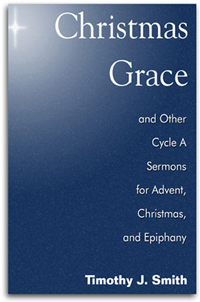
Christmas Grace
Cycle A Second Lesson Sermons for Advent, Christmas, Epiphany
As we gather on the Sunday after Christmas we do so with a sigh of relief. The gifts have been opened; our family has come and returned home. The past month typically holds the busiest days and weeks of the year for many of us. It is little wonder why we might feel tired today. It has been a hectic couple of weeks but slowly our lives are returning back to normal, as we settle back into our regular routines.

We have celebrated Jesus' birth. We are reminded that Jesus came to bring salvation to all people. Jesus is God's present to each one of us. We must respond to that gift as well by allowing Jesus to enter and change our lives.
Our focus for the days following Christmas and before the start of the New Year is to reflect on the events of the past year. News magazines have special year end reports highlighting the good and the bad from the previous twelve months. Television news programs will also review what has taken place this year by asking and answering the question of whether or not this has been a good year.
In the same way we reflect on our faith. Has the past year been one of growth or stagnation in our walk with Jesus? For the last month we have focused on the Baby Jesus. We've sung the Christmas carol asking the question, "What Child is This?" We've answered that the baby was none other than our Lord Jesus Christ. Our question this morning is what do we do with Jesus now that we've celebrated Christmas? Do we pack him away with our nativity set only to bring him out next December? Or do we claim or reclaim Jesus as our Lord? A question worthy of our reflection today is how has God's gift -- Jesus changed our lives?
Columnist Maureen Dowd recalls the Christmas that she received "one of those wooden horses that bounced on springs." She named her horse "Trigger" and rode him every day.
Much to her dismay one morning she discovered that her beloved horse was gone. Her mother explained that a poor woman and her son spotted Trigger as they walked past their house. The young boy "stared longingly at the horse." Maureen recalls how her mother's world had been turned upside down when she lost her own father at age twelve. As a result her mother always had a soft spot for children who were hurt and in need. On a modest pension her mother would send a few dollars to children who she had read about who were hungry or in need of an operation.
Maureen did not want to accept the news that her horse was given to another child, a stranger. "I was crushed," she writes. Whenever she and her mother disagreed over the next sixteen years Maureen would always bring up her beloved horse that her mother had given away.
Then on her 21st birthday, Maureen came home to find her bouncing horse with a handwritten note in its mouth, "I'm back!" signed "Trigger." Many years have passed and Maureen is thankful for the lesson her mother taught her at a young age, "materialism and narcissism can only smother life -- and Christmas -- if you let them."1
The author of the book of Hebrews gives us a different perspective on Jesus' life. Hebrews was addressed to people who had gone through a tough time, a time of suffering, persecution, imprisonment, and confiscation of property. The author wrote hoping to instill a fresh sense of hope, desiring people to turn to Jesus.
We discover that the author claims that Jesus is the pioneer of our salvation. A pioneer goes ahead to clear a path for others to follow. There is a sense of adventure associated with the pioneer going where no one has gone before. Along with adventure it takes courage. The pioneer blazes a trail for others to follow. The pioneer is motivated by the conviction that there is a better place out there somewhere and will stop at nothing until it is found.
The author of Hebrews portrays Jesus as the pioneer who opens the way to God. In a sense, Jesus broke down the wall separating people from their God. People had been searching for a way to God. Through his life, death, and new life, Jesus clears the way for us to enter into a relationship with God. Jesus has truly gone where no one has gone before leading the way to God the Father. We discover through Jesus that God desires to be in relationship with us, "in bringing many children to glory."
It is through Jesus' life, death, and resurrection that he achieved the goal God set before him, making "the pioneer of their salvation perfect through sufferings." Perfection signifies completeness. Through his suffering and death Jesus Christ gained "glory" not for only himself but for "many children," in fact all people. Thanks to Jesus we can count ourselves as God's own children.
Through Jesus' life he has made a new future available for us. We may from time to time endure setbacks and suffering here on earth but thanks to Jesus we can look forward to a future where God has the last word for each one of us.
Another image the author of Hebrews employs is that Jesus is our brother. While Jesus is the Son of God he was also human, and he experienced everything we have growing up. As an infant he experienced his mother's love as she held him and cared for his every need. There was a close bond between Mary and Jesus built upon the foundation of love. As a young man Jesus would learn carpentry skills from Joseph. Jesus would work crafting wooden items for other people. Jesus experienced every emotion that we do. He knew what it felt like to be loved and also to fall out of favor with people. He must have felt disappointment, especially when his chosen disciples did not grasp his objective. Like us, he might even have felt discouraged from time to time. Jesus understands us because he shared all these experiences.
We can identify with someone who knows and understands what we experience. Jesus is not "ashamed" to call us his brothers and sisters. The author of Hebrews claims, "For the one who sanctifies and those who are sanctified all have one Father. For this reason Jesus is not ashamed to call them brothers and sisters." It is an act of grace to be included in God's family. Jesus blazed a path for us to follow that led to God. We follow Jesus down that path knowing that he experienced the wide range of emotions that we do. We identify closely with Jesus because he became one of us. That is the definition of incarnation.
Another image to consider is that Jesus is our liberator who came to set us free, "and free those who all their lives were held in slavery by the fear of death." Sometimes we find ourselves drawn into situations we would rather avoid. Many people struggle through various addictions and vices. People caught up in destructive addictions need the help and intervention of another to pull them through. Jesus our liberator set us free to start over again. Only Jesus has the power to break the hold of sin in our lives.
Through the crucified and risen Christ, God confronts evil with love. Jesus sets us free. "Therefore he had to become like his brothers and sisters in every respect, so that he might be a merciful and faithful high priest in the service of God, to make a sacrifice of atonement for the sins of the people."
Jesus as the high priest is a theme that the author of Hebrews develops further in his epistle. "Since, then, we have a great high priest who has passed through the heavens, Jesus, the Son of God, let us hold fast to our confession" (4:14). Jesus offers himself to us in love so that our relationship with God can be restored.
Kay was in the seventh grade when her father died. One week later Kay was back in school even though her life had been filled with the grief of losing her dad. That first day back Kay was called to the principal's office, "for a chat." Mr. Cook told her he knew how hard it was to lose a father, however, "the best way to work through grief is to reach out to others," he told her.
He invited her to join what he called; the "Subs for Santa" drive that collected food and toys for needy families within the school district. Kay joined six other students in mid-December to deliver presents and foods to area families. This was a wonderful experience for her and the other students. "Even though there were still plenty of presents and food in the van, the other students were dropped off at their homes," she remembers.
"We came to my house," Kay recalls, "and I wished Mr. Cook a Merry Christmas and ran inside." A few minutes later there was a knock on the door -- it was Mr. Cook with food, toys, and other presents. The entire school had been collecting presents for Kay's family. Kay was so touched that she sat on the stair and cried.
Kay remembers that Christmas of being thankful to her school, "for showing my family the true meaning of Christmas." Years later she fondly retells this story to her own children. "Christmas is to remember first Jesus, second others, and last yourself," she says.2
We do not know what the future holds but thanks to Jesus, we know the one who holds the future. We might not have received everything that we wanted or maybe we feel that post-Christmas let down. However, we have the one thing we really need -- Jesus Christ. Jesus is the one present that we do not need to return but can keep forever. Amen.
__________
1. Maureen Dowd, "ATale of Trigger," New York Times, December 26, 2007.
2. Kay Lynn, "The Gift," Love Matters, Delilah (Ontario Canada: Harlequin, 2008), pp. 48-49.
We have celebrated Jesus' birth. We are reminded that Jesus came to bring salvation to all people. Jesus is God's present to each one of us. We must respond to that gift as well by allowing Jesus to enter and change our lives.
Our focus for the days following Christmas and before the start of the New Year is to reflect on the events of the past year. News magazines have special year end reports highlighting the good and the bad from the previous twelve months. Television news programs will also review what has taken place this year by asking and answering the question of whether or not this has been a good year.
In the same way we reflect on our faith. Has the past year been one of growth or stagnation in our walk with Jesus? For the last month we have focused on the Baby Jesus. We've sung the Christmas carol asking the question, "What Child is This?" We've answered that the baby was none other than our Lord Jesus Christ. Our question this morning is what do we do with Jesus now that we've celebrated Christmas? Do we pack him away with our nativity set only to bring him out next December? Or do we claim or reclaim Jesus as our Lord? A question worthy of our reflection today is how has God's gift -- Jesus changed our lives?
Columnist Maureen Dowd recalls the Christmas that she received "one of those wooden horses that bounced on springs." She named her horse "Trigger" and rode him every day.
Much to her dismay one morning she discovered that her beloved horse was gone. Her mother explained that a poor woman and her son spotted Trigger as they walked past their house. The young boy "stared longingly at the horse." Maureen recalls how her mother's world had been turned upside down when she lost her own father at age twelve. As a result her mother always had a soft spot for children who were hurt and in need. On a modest pension her mother would send a few dollars to children who she had read about who were hungry or in need of an operation.
Maureen did not want to accept the news that her horse was given to another child, a stranger. "I was crushed," she writes. Whenever she and her mother disagreed over the next sixteen years Maureen would always bring up her beloved horse that her mother had given away.
Then on her 21st birthday, Maureen came home to find her bouncing horse with a handwritten note in its mouth, "I'm back!" signed "Trigger." Many years have passed and Maureen is thankful for the lesson her mother taught her at a young age, "materialism and narcissism can only smother life -- and Christmas -- if you let them."1
The author of the book of Hebrews gives us a different perspective on Jesus' life. Hebrews was addressed to people who had gone through a tough time, a time of suffering, persecution, imprisonment, and confiscation of property. The author wrote hoping to instill a fresh sense of hope, desiring people to turn to Jesus.
We discover that the author claims that Jesus is the pioneer of our salvation. A pioneer goes ahead to clear a path for others to follow. There is a sense of adventure associated with the pioneer going where no one has gone before. Along with adventure it takes courage. The pioneer blazes a trail for others to follow. The pioneer is motivated by the conviction that there is a better place out there somewhere and will stop at nothing until it is found.
The author of Hebrews portrays Jesus as the pioneer who opens the way to God. In a sense, Jesus broke down the wall separating people from their God. People had been searching for a way to God. Through his life, death, and new life, Jesus clears the way for us to enter into a relationship with God. Jesus has truly gone where no one has gone before leading the way to God the Father. We discover through Jesus that God desires to be in relationship with us, "in bringing many children to glory."
It is through Jesus' life, death, and resurrection that he achieved the goal God set before him, making "the pioneer of their salvation perfect through sufferings." Perfection signifies completeness. Through his suffering and death Jesus Christ gained "glory" not for only himself but for "many children," in fact all people. Thanks to Jesus we can count ourselves as God's own children.
Through Jesus' life he has made a new future available for us. We may from time to time endure setbacks and suffering here on earth but thanks to Jesus we can look forward to a future where God has the last word for each one of us.
Another image the author of Hebrews employs is that Jesus is our brother. While Jesus is the Son of God he was also human, and he experienced everything we have growing up. As an infant he experienced his mother's love as she held him and cared for his every need. There was a close bond between Mary and Jesus built upon the foundation of love. As a young man Jesus would learn carpentry skills from Joseph. Jesus would work crafting wooden items for other people. Jesus experienced every emotion that we do. He knew what it felt like to be loved and also to fall out of favor with people. He must have felt disappointment, especially when his chosen disciples did not grasp his objective. Like us, he might even have felt discouraged from time to time. Jesus understands us because he shared all these experiences.
We can identify with someone who knows and understands what we experience. Jesus is not "ashamed" to call us his brothers and sisters. The author of Hebrews claims, "For the one who sanctifies and those who are sanctified all have one Father. For this reason Jesus is not ashamed to call them brothers and sisters." It is an act of grace to be included in God's family. Jesus blazed a path for us to follow that led to God. We follow Jesus down that path knowing that he experienced the wide range of emotions that we do. We identify closely with Jesus because he became one of us. That is the definition of incarnation.
Another image to consider is that Jesus is our liberator who came to set us free, "and free those who all their lives were held in slavery by the fear of death." Sometimes we find ourselves drawn into situations we would rather avoid. Many people struggle through various addictions and vices. People caught up in destructive addictions need the help and intervention of another to pull them through. Jesus our liberator set us free to start over again. Only Jesus has the power to break the hold of sin in our lives.
Through the crucified and risen Christ, God confronts evil with love. Jesus sets us free. "Therefore he had to become like his brothers and sisters in every respect, so that he might be a merciful and faithful high priest in the service of God, to make a sacrifice of atonement for the sins of the people."
Jesus as the high priest is a theme that the author of Hebrews develops further in his epistle. "Since, then, we have a great high priest who has passed through the heavens, Jesus, the Son of God, let us hold fast to our confession" (4:14). Jesus offers himself to us in love so that our relationship with God can be restored.
Kay was in the seventh grade when her father died. One week later Kay was back in school even though her life had been filled with the grief of losing her dad. That first day back Kay was called to the principal's office, "for a chat." Mr. Cook told her he knew how hard it was to lose a father, however, "the best way to work through grief is to reach out to others," he told her.
He invited her to join what he called; the "Subs for Santa" drive that collected food and toys for needy families within the school district. Kay joined six other students in mid-December to deliver presents and foods to area families. This was a wonderful experience for her and the other students. "Even though there were still plenty of presents and food in the van, the other students were dropped off at their homes," she remembers.
"We came to my house," Kay recalls, "and I wished Mr. Cook a Merry Christmas and ran inside." A few minutes later there was a knock on the door -- it was Mr. Cook with food, toys, and other presents. The entire school had been collecting presents for Kay's family. Kay was so touched that she sat on the stair and cried.
Kay remembers that Christmas of being thankful to her school, "for showing my family the true meaning of Christmas." Years later she fondly retells this story to her own children. "Christmas is to remember first Jesus, second others, and last yourself," she says.2
We do not know what the future holds but thanks to Jesus, we know the one who holds the future. We might not have received everything that we wanted or maybe we feel that post-Christmas let down. However, we have the one thing we really need -- Jesus Christ. Jesus is the one present that we do not need to return but can keep forever. Amen.
__________
1. Maureen Dowd, "ATale of Trigger," New York Times, December 26, 2007.
2. Kay Lynn, "The Gift," Love Matters, Delilah (Ontario Canada: Harlequin, 2008), pp. 48-49.