Fourteenth Sunday After Pentecost
Preaching
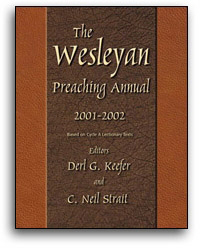
THE WESLEYAN PREACHING ANNUAL 2001--2002
WORSHIP HELPS
CALL TO WORSHIP (Unison)
"Those who bring thanksgiving as their sacrifice honor me; to those who go the right way I will show the salvation of God." (Psalm 50:23 NRSV)
OFFERING THOUGHT
Leader: Remember what Jesus said: It makes you more happy to give than to receive.
People: Then let us be happy in giving!
BENEDICTION
Let us give glory and receive strength from the one who loves us and whose blood washes our sins from our lives. He rules forever!

SERMON BRIEFS
Genuine Worship
Romans 12:1--8
Introduction
The Authorized Version (KJV) had an expression in verse 1 that is changed in all modern versions. It spoke of "reasonable service." The recent translations give the phrase as "spiritual worship." The term translated as "service" in the KJV is always (in the NT) used of service to God. Thus, it does signify "worship."
The Church today is caught up in what have been called "worship wars." Opinions differ over the style of music appropriate for worship. The debate often is confused and harsh, creating more heat than light. The nature of genuine worship has gotten lost in the conflict. Our passage provides us opportunity to ask and answer the question: "What is genuine worship?"
I. Genuine worship begins with surrender. (v. 1)
In the earlier chapters of Romans, Paul outlined the foundational truths of the gospel. Those truths proclaimed the reality of "God's mercy." It was because of God's mercy that Paul exhorted the Romans to decisive commitments. Through a series of imperatives he admonished them to respond to God's grace.
The primary command was that they "offer" themselves as "living sacrifices." Paul already exhorted them in this way earlier in the letter (6:12--13, 19). The term may also be expressed as "present, yield, surrender." He urged upon these Christians a profound commitment of their very "bodies" to God. Instead of the "dead sacrifices" of the OT, the Romans were to live as offerings utterly devoted to God.
We cannot genuinely worship until we become God's completely. We cannot be God's completely without yielding our daily living to God's will and design. Jesus taught us to pray to the Father, "Your kingdom come, your will be done, on earth as it is in heaven." Jesus called disciples to deny themselves and take up their crosses and follow him. Being God's completely is a matter of yielding the "everyday--ness" of our lives to God. Worship that flows from such surrender involves all of life. It makes everything we do and all that we are an act of worship.
II. Genuine worship means transformation of our inner self. (v. 2)
The surrender that begins genuine worship is towards a purpose. Its goal or aim is to bring transformation to the inner life of the worshipper. Paul followed his exhortation to surrender with two other related admonitions.
The first of these two commands was that the Romans should cease being conformed to the present age. One version has put it: "Stop allowing the world to squeeze you into its mold." The culture around us says, "Fit in; to get along you have to go along." Paul urges: "Stop living that way." Genuine worship that flows out from radical surrender to God cannot allow life to just go on in the way it always has.
The second command was that the Romans should be transformed by the renewing of their minds. Radical surrender to God will bring a radical newness internally. And that internal transformation will be expressed in outward lifestyle. The word translated as "transformed" is the term from which we get our English word metamorphosis - what happens when a caterpillar changes into a butterfly.
Genuine worship causes us to stop having the mindset of the world: "self, self, self." It produces a new mind in us: "God first, others second, and self last." Our thinking, attitudes, and motives are redirected, away from ourselves and towards God and others.
III. Genuine worship produces life like God's own life. (v. 2)
Paul was clear as to the ultimate, practical outcome of genuine worship. Yielding to God and being transformed by God's grace enables us to "discern" or "prove" God's will for us. Only by having our minds renewed are we able to truly see, for the first time, what God's will is. We learn that it is "good, acceptable, and perfect." We "discern" or learn this because we "prove" by the actions of our living that God's will is in truth "good, acceptable, and perfect."
Life like that is life like God's own life: "good, acceptable, and perfect." Genuine worship transforms us into persons of God--likeness. And that is what God wants for us all.
Conclusion
Everything we do can become genuine worship to God. All of our lives, all of our living, can be a sacrament of praise and adoration to God. Have you begun to worship God truly?
Hal A. Cauthron
Something Strange Happened In Caesar's Town
Matthew 16:13--20
Jesus has taken His disciples to Caesarea Philippi so that he can spend quality time teaching them without being interrupted. Caesarea Philippi was mainly a non--Jewish area so that Jesus would be able to avoid the instant rush and demands of the crowds.
This region was identified with various religions: It had been a center for Baal worship. Pan, the Greek god of nature also had shrines there. Additionally, a great temple of white marble built by Herod the Great to honor Caesar as a god (Caesarea means Caesar's town) loomed largely in the town's landscape.
It is to Caesar's town that Jesus goes with his disciples to give them advanced training. Here in this place with all of its pagan shrines an amazing discovery will occur because of a question that is asked. This question that is asked leads to:
I. An amazing confession (v. 15)
Here in Caesar's town Jesus asks a very penetrating question to his disciples: "Who do people say that the Son of Man is?" A lot more is involved than Jesus asking the results of a disciples tracking poll. However, this would really play well in today's media. I can see it already: reporters, camera crews, lights, crowds. The question is asked, and the camera moves from one person to another, focusing on their responses: "Some say you're a great teacher. Some say you're the prophet of today. Some say you're the leader with charisma."
Jesus isn't conducting an opinion poll. His question is very pointed and direct. He is not playing to any audience. Each of the disciples must contemplate his question, "Who do you say that I am?" Peter, never shy, never bashful, speaks, "You are the Christ, the Son of the living God!" (v. 16).
What a confession by Peter. To call Jesus messiah is to know that Jesus is the Savior, the one who rescues a world in danger. The entire Gospel of Matthew has been building up to Peter's response.
How does Peter know who Jesus is? It was a gift from God. Peter is able to make this confession because God came near to Peter through Jesus. This confession is the expression of a deep relationship. Because of this confession and relationship, Jesus blesses Peter. Peter has made a great discovery which issues forth in an amazing confession. From this confession our Lord makes:
II. An awesome commitment
To Peter, Jesus makes an awesome commitment: "Your name is 'Rock,' and on this 'rock' I will build my church" (vv. 17--18). Peter is the rock, the foundation stone upon which Jesus is going to establish His church. The picture is of Peter as the first foundation stone of the church. Since Peter was the first person to really grasp who Jesus was, he is the first stone, the foundation stone, the very beginning of the Church Jesus was founding. Everyone who makes the same discovery that Peter made becomes another stone in the Church of Jesus Christ. He is still building His church.
Jesus gave Peter an assurance when he made His awesome commitment to him. He promised Peter that the "gates of death will not overcome or prevail" against the church (v. 18). The gates of death symbolizes everything that opposes God's will. Yes, the church will encounter hostility and trouble, but hell does not hold the winning hand, and the powers of death will not have the final say. Why? Because Jesus will save and protect His people. From an awesome commitment, Jesus next informs Peter about:
III. An authentic community (v. 19)
The picture that we often see in cartoons of Saint Peter, keys in hand, standing guard at the gates of heaven, is a total misunderstanding of this passage. When Jesus speaks of the keys of the Kingdom, he is speaking of an authentic community. The keys are the symbol of that community's authority on earth. What the church does, its decisions, the stand it takes, the truth it expounds, all matter to God and form the basis of real community.
The church, as an authentic community, must faithfully call itself and the world to ethical responsibility (whatever you bind on earth) and proclaim God's free forgiveness (whatever you loose on earth). God then acts in and through the church. God will not abandon the church, but God will work to keep the church faithful and through this community of believers give faith to the world.
Everything begins with a personal confession of faith in Christ, which leads to a commitment from Christ to us, and results in each of us being a part of a community called the church.
Curtis Lewis
CALL TO WORSHIP (Unison)
"Those who bring thanksgiving as their sacrifice honor me; to those who go the right way I will show the salvation of God." (Psalm 50:23 NRSV)
OFFERING THOUGHT
Leader: Remember what Jesus said: It makes you more happy to give than to receive.
People: Then let us be happy in giving!
BENEDICTION
Let us give glory and receive strength from the one who loves us and whose blood washes our sins from our lives. He rules forever!
SERMON BRIEFS
Genuine Worship
Romans 12:1--8
Introduction
The Authorized Version (KJV) had an expression in verse 1 that is changed in all modern versions. It spoke of "reasonable service." The recent translations give the phrase as "spiritual worship." The term translated as "service" in the KJV is always (in the NT) used of service to God. Thus, it does signify "worship."
The Church today is caught up in what have been called "worship wars." Opinions differ over the style of music appropriate for worship. The debate often is confused and harsh, creating more heat than light. The nature of genuine worship has gotten lost in the conflict. Our passage provides us opportunity to ask and answer the question: "What is genuine worship?"
I. Genuine worship begins with surrender. (v. 1)
In the earlier chapters of Romans, Paul outlined the foundational truths of the gospel. Those truths proclaimed the reality of "God's mercy." It was because of God's mercy that Paul exhorted the Romans to decisive commitments. Through a series of imperatives he admonished them to respond to God's grace.
The primary command was that they "offer" themselves as "living sacrifices." Paul already exhorted them in this way earlier in the letter (6:12--13, 19). The term may also be expressed as "present, yield, surrender." He urged upon these Christians a profound commitment of their very "bodies" to God. Instead of the "dead sacrifices" of the OT, the Romans were to live as offerings utterly devoted to God.
We cannot genuinely worship until we become God's completely. We cannot be God's completely without yielding our daily living to God's will and design. Jesus taught us to pray to the Father, "Your kingdom come, your will be done, on earth as it is in heaven." Jesus called disciples to deny themselves and take up their crosses and follow him. Being God's completely is a matter of yielding the "everyday--ness" of our lives to God. Worship that flows from such surrender involves all of life. It makes everything we do and all that we are an act of worship.
II. Genuine worship means transformation of our inner self. (v. 2)
The surrender that begins genuine worship is towards a purpose. Its goal or aim is to bring transformation to the inner life of the worshipper. Paul followed his exhortation to surrender with two other related admonitions.
The first of these two commands was that the Romans should cease being conformed to the present age. One version has put it: "Stop allowing the world to squeeze you into its mold." The culture around us says, "Fit in; to get along you have to go along." Paul urges: "Stop living that way." Genuine worship that flows out from radical surrender to God cannot allow life to just go on in the way it always has.
The second command was that the Romans should be transformed by the renewing of their minds. Radical surrender to God will bring a radical newness internally. And that internal transformation will be expressed in outward lifestyle. The word translated as "transformed" is the term from which we get our English word metamorphosis - what happens when a caterpillar changes into a butterfly.
Genuine worship causes us to stop having the mindset of the world: "self, self, self." It produces a new mind in us: "God first, others second, and self last." Our thinking, attitudes, and motives are redirected, away from ourselves and towards God and others.
III. Genuine worship produces life like God's own life. (v. 2)
Paul was clear as to the ultimate, practical outcome of genuine worship. Yielding to God and being transformed by God's grace enables us to "discern" or "prove" God's will for us. Only by having our minds renewed are we able to truly see, for the first time, what God's will is. We learn that it is "good, acceptable, and perfect." We "discern" or learn this because we "prove" by the actions of our living that God's will is in truth "good, acceptable, and perfect."
Life like that is life like God's own life: "good, acceptable, and perfect." Genuine worship transforms us into persons of God--likeness. And that is what God wants for us all.
Conclusion
Everything we do can become genuine worship to God. All of our lives, all of our living, can be a sacrament of praise and adoration to God. Have you begun to worship God truly?
Hal A. Cauthron
Something Strange Happened In Caesar's Town
Matthew 16:13--20
Jesus has taken His disciples to Caesarea Philippi so that he can spend quality time teaching them without being interrupted. Caesarea Philippi was mainly a non--Jewish area so that Jesus would be able to avoid the instant rush and demands of the crowds.
This region was identified with various religions: It had been a center for Baal worship. Pan, the Greek god of nature also had shrines there. Additionally, a great temple of white marble built by Herod the Great to honor Caesar as a god (Caesarea means Caesar's town) loomed largely in the town's landscape.
It is to Caesar's town that Jesus goes with his disciples to give them advanced training. Here in this place with all of its pagan shrines an amazing discovery will occur because of a question that is asked. This question that is asked leads to:
I. An amazing confession (v. 15)
Here in Caesar's town Jesus asks a very penetrating question to his disciples: "Who do people say that the Son of Man is?" A lot more is involved than Jesus asking the results of a disciples tracking poll. However, this would really play well in today's media. I can see it already: reporters, camera crews, lights, crowds. The question is asked, and the camera moves from one person to another, focusing on their responses: "Some say you're a great teacher. Some say you're the prophet of today. Some say you're the leader with charisma."
Jesus isn't conducting an opinion poll. His question is very pointed and direct. He is not playing to any audience. Each of the disciples must contemplate his question, "Who do you say that I am?" Peter, never shy, never bashful, speaks, "You are the Christ, the Son of the living God!" (v. 16).
What a confession by Peter. To call Jesus messiah is to know that Jesus is the Savior, the one who rescues a world in danger. The entire Gospel of Matthew has been building up to Peter's response.
How does Peter know who Jesus is? It was a gift from God. Peter is able to make this confession because God came near to Peter through Jesus. This confession is the expression of a deep relationship. Because of this confession and relationship, Jesus blesses Peter. Peter has made a great discovery which issues forth in an amazing confession. From this confession our Lord makes:
II. An awesome commitment
To Peter, Jesus makes an awesome commitment: "Your name is 'Rock,' and on this 'rock' I will build my church" (vv. 17--18). Peter is the rock, the foundation stone upon which Jesus is going to establish His church. The picture is of Peter as the first foundation stone of the church. Since Peter was the first person to really grasp who Jesus was, he is the first stone, the foundation stone, the very beginning of the Church Jesus was founding. Everyone who makes the same discovery that Peter made becomes another stone in the Church of Jesus Christ. He is still building His church.
Jesus gave Peter an assurance when he made His awesome commitment to him. He promised Peter that the "gates of death will not overcome or prevail" against the church (v. 18). The gates of death symbolizes everything that opposes God's will. Yes, the church will encounter hostility and trouble, but hell does not hold the winning hand, and the powers of death will not have the final say. Why? Because Jesus will save and protect His people. From an awesome commitment, Jesus next informs Peter about:
III. An authentic community (v. 19)
The picture that we often see in cartoons of Saint Peter, keys in hand, standing guard at the gates of heaven, is a total misunderstanding of this passage. When Jesus speaks of the keys of the Kingdom, he is speaking of an authentic community. The keys are the symbol of that community's authority on earth. What the church does, its decisions, the stand it takes, the truth it expounds, all matter to God and form the basis of real community.
The church, as an authentic community, must faithfully call itself and the world to ethical responsibility (whatever you bind on earth) and proclaim God's free forgiveness (whatever you loose on earth). God then acts in and through the church. God will not abandon the church, but God will work to keep the church faithful and through this community of believers give faith to the world.
Everything begins with a personal confession of faith in Christ, which leads to a commitment from Christ to us, and results in each of us being a part of a community called the church.
Curtis Lewis