Benediction
Sermon
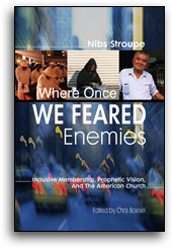
Where Once We Feared Enemies
Inclusive Membership, Prophetic Vision, And The American Church
This sermon, on the confrontation between the prophet Nathan and King David, and the sermon on Mary's confrontation with Jesus in the garden that opens the book, function together as thematic bookends of the collection as a whole. Hearing our names called by the risen Jesus is to come alive to the new reality of God's future amidst a world gripped by the power of death. Consequently, this new life open to the reality of God's future is fleshed out as a witness to God's justice in the face of the various social, political, and economic structures of power holding sway in our neighborhood, city, nation, and world. Stroupe is clear, however, that this call to witness heard in the call of the risen Jesus also entails a demand for confession on the part of the church because of its own long and continuing history of complicity with the principalities and powers of the world. The church must continually pray for discernment in judging when it is called to proclaim and when it is called to confess.

Truth Speaks To Power
2 Samuel 12
August 15, 1999
On a hot day, on Wednesday, August 28, 1963, more than 250,000 people gathered by the Lincoln Memorial in Washington, D.C. to celebrate the American vision of equality and to demand equal rights for black people in the United States. It was during this gathering that Martin Luther King, Jr., gave his most famous speech, "I Have A Dream." Less than three weeks later, on Sunday, September 15, 1963, white America answered. A bomb blew up Sixteenth Street Baptist Church in Birmingham, injuring many and killing four little girls, dressed in their Sunday best for church.
The cries went out across the nation: Why the children? Why harm children? We heard those cries again this week as another white person -- a white man -- shot up a Jewish day care center in Los Angeles. Why the children? Who kills children? It should be obvious by now. Our society is intertwined with, and rooted in, guns and violence, and children will not be deemed exempt from that identity. When we deny the humanity of others, when we believe in violence as the answer, it won't stop with adults. Our children will be killed in this kind of society. It's terrible.
Unfortunately, it's not new. I became an adult in an era of violence and killing -- four dead children in Birmingham. Two months after they were blown up, the President of the United States, John Kennedy, was assassinated. Scores of people were murdered in the Civil Rights Movement, and hundreds more were injured. In January, 1965, Malcolm X was assassinated, and in June, 1966, James Meredith was shot. Dr. King himself and Robert Kennedy were assassinated within two months of one another in 1968. It is a litany of the worship of guns and violence, whether it's 1848 or 1968 or 1999. What makes us think that our children will be exempt from the consequences of our worship? Indeed, we are teaching our children the catechism of violence, as we glorify it on television, in movies, and in video games.
Our biblical story for today reminds us of that difficult lesson. Bathsheba is exploited, Uriah is murdered, David is exposed, and the child dies. There are no exemptions. It reminds us of the difficult consequences that ensue when we deny the humanity of others and when we use violence to enforce that denial. We know this story. If you know anything at all about David, you know about a giant named Goliath and a beautiful woman named Bathsheba. David takes Bathsheba, the wife of another man, and uses her, and then he murders her husband Uriah to cover it up. We aren't prepared for this side of David.
We see David's raw power as king. It is a power that is unchecked. Jonathan is not around to tell David to cool it, to hold his power in check. Jonathan is dead, killed in war. David has no peer who will speak up to him. So his power is out of balance. He exploits Bathsheba as a woman and kills her husband to cover it up. He believes that he has gotten away with it. Bathsheba doesn't know about David's scheme. Uriah does not know that he carries his death sentence in the very letter that David tells him to deliver to Joab. Only Joab, David's army commander, has some hint as to what David is doing in this story.
The biblical story, however, tells us that God knows, and God sends a prophet to speak to David. Truth must speak to power. God sends the prophet Nathan to speak the truth to the powerful David. Nathan is not unknown to David. Back in chapter 7, Nathan came to the court to bless David's reign. When Nathan shows up this time, we don't know what David is thinking, but we do learn that Nathan has come this time for a different purpose -- not to bless David's reign, but to call it into question. Truth must speak to power.
Nathan has been around the king's court, though, and he doesn't just burst in and tell David that he has sinned grievously. Nathan knows that it is a dangerous situation. Instead, he tells David a story about a rich man and a poor man. The rich man abuses the poor man and his little lamb, and as David hears the story, his anger rises. After all, he used to be a shepherd boy himself. He has learned about taking care of sheep and lambs. His anger and indignation rise, and he becomes like many of us Christians in the church. He is judgmental and superior, and he is ready to crush this mean, dirty sinner. "Where is this man? He deserves to die! I'll get my elite bodyguard to torture him until he restores the poor man. Where is this man?" Nathan's strategy has worked. He has engaged David with this story and has brought David into the story. "Where is this man?" Then comes the shattering focal point of Nathan's story, "You are the man."
Truth speaks to power. It's a stunning and dangerous moment in biblical history. "You are the man." How will David react? Will he strike down Nathan as he struck down Uriah? As those white folks in Birmingham struck down the four little girls in Birmingham, as the white man struck down those children in the Jewish day care center this week? It's a dangerous moment when truth speaks out. We often think that the truth is wonderful, but when truth speaks out, it's dangerous. And this is a dangerous moment in biblical history. "You are the man."
To David's credit, he does not strike down Nathan. Rather, he shows the depths of his humanity, and this depth of humanity is one of the main reasons that Israel remembers him with such fondness. Not because he's good but because he's real. He's a human being. He doesn't try to evade Nathan or God or himself. He confesses. "I have sinned against the Lord." Interestingly enough, he doesn't say, "I have sinned against Bathsheba. I have sinned against Uriah." That reluctance will cost him dearly. Nathan tells him that his house will know violence for the rest of its existence. David does confess however, that he has abused his power. His confession is all the more remarkable because he is the king. He has absolute power. It's a model of public leadership that is desperately needed but rarely ever followed.
This week also marks the twenty-fifth anniversary of the resignation of Richard Nixon as president in 1974. It all began because Nixon would not confess his knowledge of the Watergate break-in. Had he admitted it straight up, he would have remained president of the United States. He could not bring himself to confess. We've seen that same story played out again in the last two years with President Bill Clinton. How much would we all have been spared if President Clinton had told us in January 1998, "I did have sexual relations with Monica Lewinski"? Clinton could not bring himself to confess, and the struggle stretched out over eighteen months. A lot of people are still disgusted with him and with Al Gore, the vice president. We may get George Bush and the dangerous Republican right wing in the White House because of Clinton's connection with Gore, because of Clinton's failure to be the kind of leader that we needed him to be, and because of Clinton's failure to confess his violation of the public trust.
David does confess, however. He redeems Israel with his confession, and it's because God sent a prophet to David to speak the truth to power. Truth must speak to power. That's one of the lessons of this difficult story in 2 Samuel. Nathan is sent by God to remind King David that the purpose of his kingship, that the purpose of having power, that the purpose of government is not to keep rich folk in power, but rather to establish justice. That's the reason God ordains government, not to establish order so much as to establish justice. Nathan is sent by God to remind David that even the king, the absolute power, is framed by justice. Especially in Israel, where Yahweh is the center, the king must be framed by justice.
Truth must speak to power. Power unchecked and unbalanced leads to incredible abuses, as we see in this story, as we see in the history of white supremacy that has so often been unchecked. It's why Presbyterians have great distrust of centralized power. It's why we don't have any bishops. It's why we prefer a system of checks and balances. I was reminded of this recently in a matter that came before our church's governing board, the Session. It was a matter that I handled badly. I tried to make an end run around the Session because I knew that they wouldn't approve what I wanted them to approve. The matter did come to light at the Session meeting, and the Session, of course, turned it down. One of the elders on the Session later told me that they did not want to be a "Yes" person for me on the Session. They preferred to be the elder that the congregation had elected them to be, and I needed to remember that. It was a painful but necessary reminder for me of why we Presbyterians greatly distrust centralized power.
Power needs a prophetic voice in order to govern well, in order to provide justice. There must be prophetic voices speaking to power. Power needs prophets. Power doesn't like prophets, but power needs prophets. It's why we must speak out on issues of guns and violence in our society. It's why we must march and cry out to powerful people about the need for decent health care for the poor. It's why we must stand against the theory of white supremacy that's held not only in the KKK and the Aryan Nations but also in the corporate boardrooms and the individual white bedrooms around this country. That's where the origins of white supremacy are. Its origins are not in the guy who shot up the day care center in Los Angeles. It's certainly there, but that's not where it comes from. It comes from the corporate boardrooms and the individual bedrooms throughout this society.
Truth must speak to power. It's why we must speak out against the exploitation of women like Bathsheba. She is not even named in the scripture we read today. She's called "the wife of Uriah," not even named. In the genealogy of Jesus in Matthew's Gospel, there are five women who are mentioned. Four of them are named, but the fifth, Bathsheba, is not named. There, too, she is called "the wife of Uriah." Bathsheba, seen as the property of men! In Nathan's story, which engages and convicts David, she is compared to an animal. We must speak out against the exploitation of women and against the theory of male supremacy, which relegates women to being the property of men. We must stand also against the homophobia and heterosexism that leads to the persecution of gay and lesbian people. These are the folks that Christians love to hate, the folks that we get so riled up about, like David got so upset about the rich man in Nathan's story. Then, scripture reminds us that we "are the man," and we must confess and speak up.
Truth must speak to power. It is our calling, our duty, as the people of God. We may be scared, as Nathan undoubtedly was, as he came to face David. Nathan was scared. He did not burst into David's presence with his prophetic voice. He had to draw a circle and gradually pull David in. We may choose a less direct method of confrontation, as Nathan did, but we must speak truth to power.
Of course, I am assuming that we have a glimpse of the truth that we can speak. I am bold to claim that we at Oakhurst do have a glimpse -- not the whole truth, by any means. We have many lessons yet to learn here at Oakhurst. We will continue to need prophets to speak to us here at Oakhurst, but we have learned some truth here. We've learned some truth that must be spoken to power. We've learned some truth here, not because we are good and righteous, but because we've shared our stories, and we have found out that the people we feared, those monsters we thought would destroy us because of different skin colors, different genders, different sexual orientations, different economic categories -- they really are our sisters and brothers, the folk for whom our hearts long. That's one of the gifts that Oakhurst has given to me and to many of us -- to learn that the monsters that I feared out there were really in here, inside me; that out there are sisters and brothers to whom I need to listen. We've heard about one another's pain here, and we've helped one another.
We've also seen firsthand here the destructive consequences of power unchecked, of power that doesn't hear prophets. We've seen husbands and fathers cut down by guns. We've heard about our sons and grandsons who get locked up because they're black. We've seen women in our midst who've been abused by men. We've held hands with people who are poor, who are exploited by society, and then tossed away. We know these stories. We've heard them. We've lived them. We are these stories.
We know firsthand the need to speak truth to power. Oh yes, we continue to need prophetic voices in our midst to speak to us here at Oakhurst. But we also need the courage to be prophetic voices in our community, as Nathan was to David. Truth must speak to power. That was Nathan's calling. It was Nathan's gift to David and to Israel and to us. David didn't hear Nathan's prophecy as a gift, but it was his gift to David. It is one of the reasons that Israel remembers David with such affection, because David was deepened by Nathan's prophecy. We continue to need to listen to one another, to hear Nathan's voice in our midst. We continue to need to seek discernment for those places where we must listen for that prophetic voice and where we must be that prophetic voice. May God give us the humility to listen for those voices. May God give us the courage to be those voices. The events of this week and this year cry out to us. Truth must speak to power. It is our duty, it is our calling, and it is our survival. Amen.
Truth Speaks To Power
2 Samuel 12
August 15, 1999
On a hot day, on Wednesday, August 28, 1963, more than 250,000 people gathered by the Lincoln Memorial in Washington, D.C. to celebrate the American vision of equality and to demand equal rights for black people in the United States. It was during this gathering that Martin Luther King, Jr., gave his most famous speech, "I Have A Dream." Less than three weeks later, on Sunday, September 15, 1963, white America answered. A bomb blew up Sixteenth Street Baptist Church in Birmingham, injuring many and killing four little girls, dressed in their Sunday best for church.
The cries went out across the nation: Why the children? Why harm children? We heard those cries again this week as another white person -- a white man -- shot up a Jewish day care center in Los Angeles. Why the children? Who kills children? It should be obvious by now. Our society is intertwined with, and rooted in, guns and violence, and children will not be deemed exempt from that identity. When we deny the humanity of others, when we believe in violence as the answer, it won't stop with adults. Our children will be killed in this kind of society. It's terrible.
Unfortunately, it's not new. I became an adult in an era of violence and killing -- four dead children in Birmingham. Two months after they were blown up, the President of the United States, John Kennedy, was assassinated. Scores of people were murdered in the Civil Rights Movement, and hundreds more were injured. In January, 1965, Malcolm X was assassinated, and in June, 1966, James Meredith was shot. Dr. King himself and Robert Kennedy were assassinated within two months of one another in 1968. It is a litany of the worship of guns and violence, whether it's 1848 or 1968 or 1999. What makes us think that our children will be exempt from the consequences of our worship? Indeed, we are teaching our children the catechism of violence, as we glorify it on television, in movies, and in video games.
Our biblical story for today reminds us of that difficult lesson. Bathsheba is exploited, Uriah is murdered, David is exposed, and the child dies. There are no exemptions. It reminds us of the difficult consequences that ensue when we deny the humanity of others and when we use violence to enforce that denial. We know this story. If you know anything at all about David, you know about a giant named Goliath and a beautiful woman named Bathsheba. David takes Bathsheba, the wife of another man, and uses her, and then he murders her husband Uriah to cover it up. We aren't prepared for this side of David.
We see David's raw power as king. It is a power that is unchecked. Jonathan is not around to tell David to cool it, to hold his power in check. Jonathan is dead, killed in war. David has no peer who will speak up to him. So his power is out of balance. He exploits Bathsheba as a woman and kills her husband to cover it up. He believes that he has gotten away with it. Bathsheba doesn't know about David's scheme. Uriah does not know that he carries his death sentence in the very letter that David tells him to deliver to Joab. Only Joab, David's army commander, has some hint as to what David is doing in this story.
The biblical story, however, tells us that God knows, and God sends a prophet to speak to David. Truth must speak to power. God sends the prophet Nathan to speak the truth to the powerful David. Nathan is not unknown to David. Back in chapter 7, Nathan came to the court to bless David's reign. When Nathan shows up this time, we don't know what David is thinking, but we do learn that Nathan has come this time for a different purpose -- not to bless David's reign, but to call it into question. Truth must speak to power.
Nathan has been around the king's court, though, and he doesn't just burst in and tell David that he has sinned grievously. Nathan knows that it is a dangerous situation. Instead, he tells David a story about a rich man and a poor man. The rich man abuses the poor man and his little lamb, and as David hears the story, his anger rises. After all, he used to be a shepherd boy himself. He has learned about taking care of sheep and lambs. His anger and indignation rise, and he becomes like many of us Christians in the church. He is judgmental and superior, and he is ready to crush this mean, dirty sinner. "Where is this man? He deserves to die! I'll get my elite bodyguard to torture him until he restores the poor man. Where is this man?" Nathan's strategy has worked. He has engaged David with this story and has brought David into the story. "Where is this man?" Then comes the shattering focal point of Nathan's story, "You are the man."
Truth speaks to power. It's a stunning and dangerous moment in biblical history. "You are the man." How will David react? Will he strike down Nathan as he struck down Uriah? As those white folks in Birmingham struck down the four little girls in Birmingham, as the white man struck down those children in the Jewish day care center this week? It's a dangerous moment when truth speaks out. We often think that the truth is wonderful, but when truth speaks out, it's dangerous. And this is a dangerous moment in biblical history. "You are the man."
To David's credit, he does not strike down Nathan. Rather, he shows the depths of his humanity, and this depth of humanity is one of the main reasons that Israel remembers him with such fondness. Not because he's good but because he's real. He's a human being. He doesn't try to evade Nathan or God or himself. He confesses. "I have sinned against the Lord." Interestingly enough, he doesn't say, "I have sinned against Bathsheba. I have sinned against Uriah." That reluctance will cost him dearly. Nathan tells him that his house will know violence for the rest of its existence. David does confess however, that he has abused his power. His confession is all the more remarkable because he is the king. He has absolute power. It's a model of public leadership that is desperately needed but rarely ever followed.
This week also marks the twenty-fifth anniversary of the resignation of Richard Nixon as president in 1974. It all began because Nixon would not confess his knowledge of the Watergate break-in. Had he admitted it straight up, he would have remained president of the United States. He could not bring himself to confess. We've seen that same story played out again in the last two years with President Bill Clinton. How much would we all have been spared if President Clinton had told us in January 1998, "I did have sexual relations with Monica Lewinski"? Clinton could not bring himself to confess, and the struggle stretched out over eighteen months. A lot of people are still disgusted with him and with Al Gore, the vice president. We may get George Bush and the dangerous Republican right wing in the White House because of Clinton's connection with Gore, because of Clinton's failure to be the kind of leader that we needed him to be, and because of Clinton's failure to confess his violation of the public trust.
David does confess, however. He redeems Israel with his confession, and it's because God sent a prophet to David to speak the truth to power. Truth must speak to power. That's one of the lessons of this difficult story in 2 Samuel. Nathan is sent by God to remind King David that the purpose of his kingship, that the purpose of having power, that the purpose of government is not to keep rich folk in power, but rather to establish justice. That's the reason God ordains government, not to establish order so much as to establish justice. Nathan is sent by God to remind David that even the king, the absolute power, is framed by justice. Especially in Israel, where Yahweh is the center, the king must be framed by justice.
Truth must speak to power. Power unchecked and unbalanced leads to incredible abuses, as we see in this story, as we see in the history of white supremacy that has so often been unchecked. It's why Presbyterians have great distrust of centralized power. It's why we don't have any bishops. It's why we prefer a system of checks and balances. I was reminded of this recently in a matter that came before our church's governing board, the Session. It was a matter that I handled badly. I tried to make an end run around the Session because I knew that they wouldn't approve what I wanted them to approve. The matter did come to light at the Session meeting, and the Session, of course, turned it down. One of the elders on the Session later told me that they did not want to be a "Yes" person for me on the Session. They preferred to be the elder that the congregation had elected them to be, and I needed to remember that. It was a painful but necessary reminder for me of why we Presbyterians greatly distrust centralized power.
Power needs a prophetic voice in order to govern well, in order to provide justice. There must be prophetic voices speaking to power. Power needs prophets. Power doesn't like prophets, but power needs prophets. It's why we must speak out on issues of guns and violence in our society. It's why we must march and cry out to powerful people about the need for decent health care for the poor. It's why we must stand against the theory of white supremacy that's held not only in the KKK and the Aryan Nations but also in the corporate boardrooms and the individual white bedrooms around this country. That's where the origins of white supremacy are. Its origins are not in the guy who shot up the day care center in Los Angeles. It's certainly there, but that's not where it comes from. It comes from the corporate boardrooms and the individual bedrooms throughout this society.
Truth must speak to power. It's why we must speak out against the exploitation of women like Bathsheba. She is not even named in the scripture we read today. She's called "the wife of Uriah," not even named. In the genealogy of Jesus in Matthew's Gospel, there are five women who are mentioned. Four of them are named, but the fifth, Bathsheba, is not named. There, too, she is called "the wife of Uriah." Bathsheba, seen as the property of men! In Nathan's story, which engages and convicts David, she is compared to an animal. We must speak out against the exploitation of women and against the theory of male supremacy, which relegates women to being the property of men. We must stand also against the homophobia and heterosexism that leads to the persecution of gay and lesbian people. These are the folks that Christians love to hate, the folks that we get so riled up about, like David got so upset about the rich man in Nathan's story. Then, scripture reminds us that we "are the man," and we must confess and speak up.
Truth must speak to power. It is our calling, our duty, as the people of God. We may be scared, as Nathan undoubtedly was, as he came to face David. Nathan was scared. He did not burst into David's presence with his prophetic voice. He had to draw a circle and gradually pull David in. We may choose a less direct method of confrontation, as Nathan did, but we must speak truth to power.
Of course, I am assuming that we have a glimpse of the truth that we can speak. I am bold to claim that we at Oakhurst do have a glimpse -- not the whole truth, by any means. We have many lessons yet to learn here at Oakhurst. We will continue to need prophets to speak to us here at Oakhurst, but we have learned some truth here. We've learned some truth that must be spoken to power. We've learned some truth here, not because we are good and righteous, but because we've shared our stories, and we have found out that the people we feared, those monsters we thought would destroy us because of different skin colors, different genders, different sexual orientations, different economic categories -- they really are our sisters and brothers, the folk for whom our hearts long. That's one of the gifts that Oakhurst has given to me and to many of us -- to learn that the monsters that I feared out there were really in here, inside me; that out there are sisters and brothers to whom I need to listen. We've heard about one another's pain here, and we've helped one another.
We've also seen firsthand here the destructive consequences of power unchecked, of power that doesn't hear prophets. We've seen husbands and fathers cut down by guns. We've heard about our sons and grandsons who get locked up because they're black. We've seen women in our midst who've been abused by men. We've held hands with people who are poor, who are exploited by society, and then tossed away. We know these stories. We've heard them. We've lived them. We are these stories.
We know firsthand the need to speak truth to power. Oh yes, we continue to need prophetic voices in our midst to speak to us here at Oakhurst. But we also need the courage to be prophetic voices in our community, as Nathan was to David. Truth must speak to power. That was Nathan's calling. It was Nathan's gift to David and to Israel and to us. David didn't hear Nathan's prophecy as a gift, but it was his gift to David. It is one of the reasons that Israel remembers David with such affection, because David was deepened by Nathan's prophecy. We continue to need to listen to one another, to hear Nathan's voice in our midst. We continue to need to seek discernment for those places where we must listen for that prophetic voice and where we must be that prophetic voice. May God give us the humility to listen for those voices. May God give us the courage to be those voices. The events of this week and this year cry out to us. Truth must speak to power. It is our duty, it is our calling, and it is our survival. Amen.