Sermon Illustrations For Trinity Sunday (2020)
Illustration
Genesis 1:1-2:4a
Creation is such a gift. Yet, we spend a lot of time arguing about whether the Genesis text is factually and literally true or simply a mythological interpretation of God’s creative power. I lean on the power or creativity of God and have never looked at the seven-day formula for creation as fact. What is more important for me is that God is the Creator. My view of God includes that God’s breath and words bring into being all that is. We are then blessed with the creation given to us, asking us to care for and hold that creation in our embrace, as God holds us in God’s embrace. This creative power of God infuses all that is, all that was, and all that will be. For that, I am truly grateful.
Bonnie B.
* * *
Genesis 1:1-2:4a
According to Jewish tradition, when God was about to create humanity, two factions rose up within his court of angels. One group was in favor of the creation of humans, while the other vehemently opposed it. The Angel of Kindness and the Angel of Truth squared up against each other. Kindness exclaimed, “Create them, for they will do acts of loving-kindness!” Truth, however, spat bitterly, “Do not create them, for they will be full of lies!” Similarly, Righteousness and Peace faced off. “Create them, for they will establish justice!” Righteousness declared. Peace rolled their eyes and said, “Do not create them, for they will be in constant strife!” One after another, the angels debated and feuded, each angel of virtue claiming that humans would lead either to their demise or triumph. But God, who had been silent for a while, suddenly spoke. “What are you arguing about?” He asked. “Humans have already been created.” He gestured towards his latest work, already walking around the surface of the Earth inspecting the plants and animals.
I love this story because, doubtlessly, all the angels are right––and also wrong. Humans do acts of loving-kindness, often sacrificing themselves for others. At the same time, humans lie and cheat. Humans have established systems of justice and morality, yet war is a regular human past time. Humans have as many flaws as virtues, and they are just as capable of hatred, violence, corruption, as they are of love, patience, and compassion. This story tells us that God was well aware of that before he made us. He knew that human beings would bring about both good and evil. Yet, he made us anyway.
What the angels failed to understand is that humans are never “only.” They are never only righteous, or only untruthful. They are not only just, or only quarrelsome. Rather, what makes humans different from angels––who are personifications of specific virtues, such as, kindness, truth, righteousness, and peace––is that we are all of these things. We contain kindness and its opposite, truth and its opposite, righteousness and its opposite, and peace and its opposite. Unlike the heavens where the angels could only contain one thing, humans contain multitudes, which may explain why “God saw all that He had made, and found it very good” (Genesis 1:31).
Story from the Midrash Genesis Rabbah 8:5.
M T.
* * *
Genesis 1:1--2:4a
The use of the plural pronoun to refer to God or the fact that the Hebrew term for God Elohim is plural opens the way to sermons on the Trinity. Illustrations for the Trinity include Martin Luther’s claim that, “The Father is mind; The Son, the intellect; and the Holy Spirit the will.” (Luther’s Works, Vol.1, p.50). He also spoke of Augustine’s idea of God as like the triune connection of mind, intellect, and will (Luther’s Works, Vol.1, p.60). In a hymn by ancient African theologian Marius Victorinus the Trinity is said to be one like water is found in the source of the river, the river itself, and its overflow, or the seed, tree, and fruit, are all one (The Fathers of the Church, Vo.69, pp.325,327).
Other images for making sense of the first creation story include noting how the light from which the creation reportedly begins suggests the energy transmitted by the Big Bang, light still being transmitted in the ever-inflating universe or parallel universes (see Brian Greene, The Hidden Reality, esp. pp.22-56). In a comment most compatible with the Theory of Relativity and its supposition that there is no time apart from the existence of the cosmos, John Wesley claimed that time began with creation (Commentary On the Bible, p.21).
Mark E.
* * *
2 Corinthians 13:11-13
Released in January 2020 at the Sundance movie festival was the documentary titled Crip Camp. The title comes from a camp for the handicap and the disabled that is located in upstate New York. Though the movie includes many individuals, it focuses on the life of Judith Heumann.
Heumann, who had polio as a baby and uses a wheelchair, has for decades been one of the leading figures of the disability rights movement. When the Brooklyn native, after graduating from college, was denied a teaching license by New York City’s board of education because her wheelchair was declared a fire hazard, she sued and won. In 1977, when the first federal civil rights legislation for disabled people stalled, she led a historic 28-day-long sit-in. The victory paved the way for 1990′s Americans With Disabilities Act.
The first viewing of the film in Park City, Utah, Heumann was astonished that so many people were still unaware of the number of individuals who are disabled. Heumann said in an interview, “At Sundance, I’m in a room with hundreds and hundreds of progressives who pride themselves on being progressives, who pride themselves on supporting diversity. And the number of people who say – and it’s not the first time I’ve heard this – ‘We didn’t know.’ ”
Ron L.
* * *
2 Corinthians 13:11-13
This may not seem to be the most theologically profound passage on which to preach, but there’s more going on here than you may realize. Paul’s letters seem to have been hand-carried by someone he knew, often from fellow Christians from the location where he’s writing. The connections were personal.
During the second half of the third Christian century, when the faith was still illegal, a man named Sotas was the overseer, or religious leader, of the Christians in the Egyptian town of Oxyrhynchus. Here are three examples of letters, two written by Sotas, one written to him, in which the credentials of Christians traveling from one city to another are guaranteed. They remind me of the greetings contained in Paul’s letters. These are my translations.
Greetings in the Lord, beloved brother Peter,
I, Sotas, greet you.
Our brother Herakles is to be welcomed according to custom, through whom I and the ones with me greet you and the ones with you. I pray for your health.
*
Greetings in the Lord, beloved brother Paul.
I, Sotas, greet you.
Our brothers and sisters Herona, Heriona, Philadelphous, Pekusin, and Na’arous, catechumens of the gathered, and Leona, catechumen in “the beginning of the gospel,” are to be welcomed as is fitting. They will greet your fellowship in the name of our fellowship.
I pray for your health in the Lord, beloved brother.
*
Greetings in the Lord, beloved Papa Sotas.
The elders of Herakleos send many greetings.
Our sister Taiown is coming to you. Receive her in peace. Also receive into your household Anos, who is a catechumen in Genesis, through whom we and the ones with us greet you and the brothers and sisters with you. We pray for your health in the Lord, beloved pap. 204.
(204 is the mathematical equivalent of “Amen.” Letters were used as numbers in ancient Greek, Latin, and Hebrew. The value of the letters for Amen add up to 204).
Some of us who live in rural areas know our mail carriers as neighbors and keep up with each other’s families. In urban or suburban areas mail carriers may rotate in and out of our area, but others will also be familiar faces. There’s a reminder here that communications, and our faith, are personal.
Frank R.
* * *
2 Corinthians 13:11-13
Division and strife in the church is not a new thing. Paul is writing to a church in Corinth that understood division. He’d already addressed those who thought highly of themselves and tried to minimize his influence. Now, as the letter closes, he urged his readers to be of one mind and to live in peace.
Unity and peace matter. I found this story that I think demonstrates this in a memorable and funny way. A family from New York decided to escape the city and raise cattle in the west. After they’d been there a short time, some friends visited and inquired about the ranch’s name. The would-be rancher replied, “I wanted to name it the Bar-J. My wife favored Suzy-Q. One of our sons wanted the Flying-W, and the other liked the Lazy-Y. So, we’re calling it the Bar-J-Suzy-Q-Flying-W-Lazy-Y Ranch.”
“I see,” they replied, “but where are all your cattle?”
The would-be rancher shook his head. “None survived the branding.”
Without working together and living in peace, survival can be tough. The remedy? If we will focus on Jesus — seek his will for our lives — adopt his attitude of service and sacrifice—the impossible can become possible.
Bill T.
* * *
Matthew 28:16-20
This scripture reading has our commission, our instructions to go forth and travel all the world, making disciples of all nations. How, in this day and age, do we do that? Most of us will not travel beyond our communities or nation, especially in this time of pandemic. But we are still called to make disciples. In days past, we made disciples by encouraging people to replace their cultural belief systems with our own Euro-Christian perspectives on all of culture. In this day and time, we are more inclined to share our love of God and how God has transformed our lives with people of other cultures, asking them to continue their cultural norms and include our belief systems with their own. It is not about annihilating culture but expanding culture. That is our commission. That is the call of Jesus — to share our faith. In this day, how are you sharing your faith and your transformation?
Bonnie B.
* * *
Matthew 28:16-20
In typical sermons and Bible studies, the main emphasis of this passage is Jesus’ command that the disciples, “Go therefore and make disciples of all nations” (Matt 28:19). This “Great Commission” is often seen as the starting point of what would one day be a great global religion. However, if we focus closely on the geographical details of this passage, another reading emerges.
The city of Galilee was the center of Jesus’s ministry. It was there he healed the blind and the lame, cured the woman with a flow of blood, and cast out demons. It was there that he preached his sermon on the mount and taught in parables. Galilee was––and still is––incredibly beautiful. It is a rural paradise lush with green fields dotted with red and yellow flowers. Overhead hawks circle in the sky as almond trees bloom white flowers like stars in the night sky.
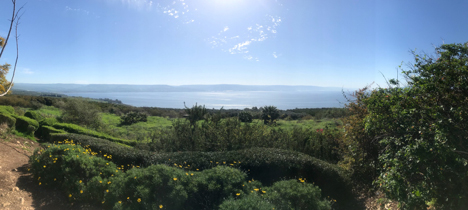
Overlooking the Sea of Galilee from the Mount of Beatitudes (Photo courtesy of M Adryael Tong. Used with permission.)
Before I visited Israel for the first time, I was most looking forward to visiting Jerusalem. But what truly took my breath away was Galilee. To this day the region is largely agricultural. Fishermen still fish in the sea. Shepherds still drive sheep across the rolling hills. It was an idyllic paradise where the rooster crows summon you to wake, and the crickets lull you to sleep. I guarantee it, if you visit the Galilee in the warm spring months just after Passover, you will never want to leave.
And yet, it was here, in this breathtaking landscape that Jesus said to his most faithful friends and students, “Go therefore and make disciples of all nations.” With those words, the disciples would know that they might never see this land again. After all, their Lord was sending them to cities and far-away places. They would be persecuted, tortured, and eventually killed.
The Scripture says, “Now the eleven disciples went to Galilee, to the mountain to which Jesus had directed them. When they saw him, they worshipped him; but some doubted” (28:16-17). Usually, we understand the “doubt” here as referring to doubting Thomas (John 20:24-29) who could not believe that Jesus had risen from the dead. But what if their doubt wasn’t about the resurrection, but rather their trepidation of having to leave this beautiful land that was their home?
When we see how beautiful the Galilee is, we can get a sense of just how hard Jesus’s request, that the disciples “Go therefore and make disciples of all nations,” must have been. As we celebrate their bravery and triumph in, indeed, making disciples of all nations, perhaps we might also think about what the apostles left behind, so that they could bring the good news to the world.
M T.
* * *
Matthew 28:16-20
Martin Luther spoke of the Trinity as an internal conversation in God, with the Father as speaker, the son as the word, and the spirit as the listener (Luther’s Works, Vol.24, pp.364-365). It is hardly surprising that such a God would welcome conversation among his creatures about the word, and so would encourage evangelism. John Calvin explained why the Trinity is intimately related to evangelism work:
There are good reasons why the Father, the Son, and the Holy Spirit, are expressly mentioned; for there is no other way in which the efficacy of baptism can be experienced than when we begin with the unmerited mercy of the Father, Who reconciles us to Himself by the only begotten Son; next, Christ comes forward with the sacrifice of His death; and at length the Holy Spirit is likewise added, by Whom He washes and regenerates us. (Calvin’s Commentaries, Vol.VII/1, p.382)
Evangelism is crucial to Luther too:
The noblest and greatest work and the most important service he [the Christian] can perform for God on earth is bringing other people, and especially those who are entrusted to us, to the knowledge of God by the Holy Gospel. (What Luther Says, p.958)
Mark E.
Creation is such a gift. Yet, we spend a lot of time arguing about whether the Genesis text is factually and literally true or simply a mythological interpretation of God’s creative power. I lean on the power or creativity of God and have never looked at the seven-day formula for creation as fact. What is more important for me is that God is the Creator. My view of God includes that God’s breath and words bring into being all that is. We are then blessed with the creation given to us, asking us to care for and hold that creation in our embrace, as God holds us in God’s embrace. This creative power of God infuses all that is, all that was, and all that will be. For that, I am truly grateful.
Bonnie B.
* * *
Genesis 1:1-2:4a
According to Jewish tradition, when God was about to create humanity, two factions rose up within his court of angels. One group was in favor of the creation of humans, while the other vehemently opposed it. The Angel of Kindness and the Angel of Truth squared up against each other. Kindness exclaimed, “Create them, for they will do acts of loving-kindness!” Truth, however, spat bitterly, “Do not create them, for they will be full of lies!” Similarly, Righteousness and Peace faced off. “Create them, for they will establish justice!” Righteousness declared. Peace rolled their eyes and said, “Do not create them, for they will be in constant strife!” One after another, the angels debated and feuded, each angel of virtue claiming that humans would lead either to their demise or triumph. But God, who had been silent for a while, suddenly spoke. “What are you arguing about?” He asked. “Humans have already been created.” He gestured towards his latest work, already walking around the surface of the Earth inspecting the plants and animals.
I love this story because, doubtlessly, all the angels are right––and also wrong. Humans do acts of loving-kindness, often sacrificing themselves for others. At the same time, humans lie and cheat. Humans have established systems of justice and morality, yet war is a regular human past time. Humans have as many flaws as virtues, and they are just as capable of hatred, violence, corruption, as they are of love, patience, and compassion. This story tells us that God was well aware of that before he made us. He knew that human beings would bring about both good and evil. Yet, he made us anyway.
What the angels failed to understand is that humans are never “only.” They are never only righteous, or only untruthful. They are not only just, or only quarrelsome. Rather, what makes humans different from angels––who are personifications of specific virtues, such as, kindness, truth, righteousness, and peace––is that we are all of these things. We contain kindness and its opposite, truth and its opposite, righteousness and its opposite, and peace and its opposite. Unlike the heavens where the angels could only contain one thing, humans contain multitudes, which may explain why “God saw all that He had made, and found it very good” (Genesis 1:31).
Story from the Midrash Genesis Rabbah 8:5.
M T.
* * *
Genesis 1:1--2:4a
The use of the plural pronoun to refer to God or the fact that the Hebrew term for God Elohim is plural opens the way to sermons on the Trinity. Illustrations for the Trinity include Martin Luther’s claim that, “The Father is mind; The Son, the intellect; and the Holy Spirit the will.” (Luther’s Works, Vol.1, p.50). He also spoke of Augustine’s idea of God as like the triune connection of mind, intellect, and will (Luther’s Works, Vol.1, p.60). In a hymn by ancient African theologian Marius Victorinus the Trinity is said to be one like water is found in the source of the river, the river itself, and its overflow, or the seed, tree, and fruit, are all one (The Fathers of the Church, Vo.69, pp.325,327).
Other images for making sense of the first creation story include noting how the light from which the creation reportedly begins suggests the energy transmitted by the Big Bang, light still being transmitted in the ever-inflating universe or parallel universes (see Brian Greene, The Hidden Reality, esp. pp.22-56). In a comment most compatible with the Theory of Relativity and its supposition that there is no time apart from the existence of the cosmos, John Wesley claimed that time began with creation (Commentary On the Bible, p.21).
Mark E.
* * *
2 Corinthians 13:11-13
Released in January 2020 at the Sundance movie festival was the documentary titled Crip Camp. The title comes from a camp for the handicap and the disabled that is located in upstate New York. Though the movie includes many individuals, it focuses on the life of Judith Heumann.
Heumann, who had polio as a baby and uses a wheelchair, has for decades been one of the leading figures of the disability rights movement. When the Brooklyn native, after graduating from college, was denied a teaching license by New York City’s board of education because her wheelchair was declared a fire hazard, she sued and won. In 1977, when the first federal civil rights legislation for disabled people stalled, she led a historic 28-day-long sit-in. The victory paved the way for 1990′s Americans With Disabilities Act.
The first viewing of the film in Park City, Utah, Heumann was astonished that so many people were still unaware of the number of individuals who are disabled. Heumann said in an interview, “At Sundance, I’m in a room with hundreds and hundreds of progressives who pride themselves on being progressives, who pride themselves on supporting diversity. And the number of people who say – and it’s not the first time I’ve heard this – ‘We didn’t know.’ ”
Ron L.
* * *
2 Corinthians 13:11-13
This may not seem to be the most theologically profound passage on which to preach, but there’s more going on here than you may realize. Paul’s letters seem to have been hand-carried by someone he knew, often from fellow Christians from the location where he’s writing. The connections were personal.
During the second half of the third Christian century, when the faith was still illegal, a man named Sotas was the overseer, or religious leader, of the Christians in the Egyptian town of Oxyrhynchus. Here are three examples of letters, two written by Sotas, one written to him, in which the credentials of Christians traveling from one city to another are guaranteed. They remind me of the greetings contained in Paul’s letters. These are my translations.
Greetings in the Lord, beloved brother Peter,
I, Sotas, greet you.
Our brother Herakles is to be welcomed according to custom, through whom I and the ones with me greet you and the ones with you. I pray for your health.
*
Greetings in the Lord, beloved brother Paul.
I, Sotas, greet you.
Our brothers and sisters Herona, Heriona, Philadelphous, Pekusin, and Na’arous, catechumens of the gathered, and Leona, catechumen in “the beginning of the gospel,” are to be welcomed as is fitting. They will greet your fellowship in the name of our fellowship.
I pray for your health in the Lord, beloved brother.
*
Greetings in the Lord, beloved Papa Sotas.
The elders of Herakleos send many greetings.
Our sister Taiown is coming to you. Receive her in peace. Also receive into your household Anos, who is a catechumen in Genesis, through whom we and the ones with us greet you and the brothers and sisters with you. We pray for your health in the Lord, beloved pap. 204.
(204 is the mathematical equivalent of “Amen.” Letters were used as numbers in ancient Greek, Latin, and Hebrew. The value of the letters for Amen add up to 204).
Some of us who live in rural areas know our mail carriers as neighbors and keep up with each other’s families. In urban or suburban areas mail carriers may rotate in and out of our area, but others will also be familiar faces. There’s a reminder here that communications, and our faith, are personal.
Frank R.
* * *
2 Corinthians 13:11-13
Division and strife in the church is not a new thing. Paul is writing to a church in Corinth that understood division. He’d already addressed those who thought highly of themselves and tried to minimize his influence. Now, as the letter closes, he urged his readers to be of one mind and to live in peace.
Unity and peace matter. I found this story that I think demonstrates this in a memorable and funny way. A family from New York decided to escape the city and raise cattle in the west. After they’d been there a short time, some friends visited and inquired about the ranch’s name. The would-be rancher replied, “I wanted to name it the Bar-J. My wife favored Suzy-Q. One of our sons wanted the Flying-W, and the other liked the Lazy-Y. So, we’re calling it the Bar-J-Suzy-Q-Flying-W-Lazy-Y Ranch.”
“I see,” they replied, “but where are all your cattle?”
The would-be rancher shook his head. “None survived the branding.”
Without working together and living in peace, survival can be tough. The remedy? If we will focus on Jesus — seek his will for our lives — adopt his attitude of service and sacrifice—the impossible can become possible.
Bill T.
* * *
Matthew 28:16-20
This scripture reading has our commission, our instructions to go forth and travel all the world, making disciples of all nations. How, in this day and age, do we do that? Most of us will not travel beyond our communities or nation, especially in this time of pandemic. But we are still called to make disciples. In days past, we made disciples by encouraging people to replace their cultural belief systems with our own Euro-Christian perspectives on all of culture. In this day and time, we are more inclined to share our love of God and how God has transformed our lives with people of other cultures, asking them to continue their cultural norms and include our belief systems with their own. It is not about annihilating culture but expanding culture. That is our commission. That is the call of Jesus — to share our faith. In this day, how are you sharing your faith and your transformation?
Bonnie B.
* * *
Matthew 28:16-20
In typical sermons and Bible studies, the main emphasis of this passage is Jesus’ command that the disciples, “Go therefore and make disciples of all nations” (Matt 28:19). This “Great Commission” is often seen as the starting point of what would one day be a great global religion. However, if we focus closely on the geographical details of this passage, another reading emerges.
The city of Galilee was the center of Jesus’s ministry. It was there he healed the blind and the lame, cured the woman with a flow of blood, and cast out demons. It was there that he preached his sermon on the mount and taught in parables. Galilee was––and still is––incredibly beautiful. It is a rural paradise lush with green fields dotted with red and yellow flowers. Overhead hawks circle in the sky as almond trees bloom white flowers like stars in the night sky.
Overlooking the Sea of Galilee from the Mount of Beatitudes (Photo courtesy of M Adryael Tong. Used with permission.)
Before I visited Israel for the first time, I was most looking forward to visiting Jerusalem. But what truly took my breath away was Galilee. To this day the region is largely agricultural. Fishermen still fish in the sea. Shepherds still drive sheep across the rolling hills. It was an idyllic paradise where the rooster crows summon you to wake, and the crickets lull you to sleep. I guarantee it, if you visit the Galilee in the warm spring months just after Passover, you will never want to leave.
And yet, it was here, in this breathtaking landscape that Jesus said to his most faithful friends and students, “Go therefore and make disciples of all nations.” With those words, the disciples would know that they might never see this land again. After all, their Lord was sending them to cities and far-away places. They would be persecuted, tortured, and eventually killed.
The Scripture says, “Now the eleven disciples went to Galilee, to the mountain to which Jesus had directed them. When they saw him, they worshipped him; but some doubted” (28:16-17). Usually, we understand the “doubt” here as referring to doubting Thomas (John 20:24-29) who could not believe that Jesus had risen from the dead. But what if their doubt wasn’t about the resurrection, but rather their trepidation of having to leave this beautiful land that was their home?
When we see how beautiful the Galilee is, we can get a sense of just how hard Jesus’s request, that the disciples “Go therefore and make disciples of all nations,” must have been. As we celebrate their bravery and triumph in, indeed, making disciples of all nations, perhaps we might also think about what the apostles left behind, so that they could bring the good news to the world.
M T.
* * *
Matthew 28:16-20
Martin Luther spoke of the Trinity as an internal conversation in God, with the Father as speaker, the son as the word, and the spirit as the listener (Luther’s Works, Vol.24, pp.364-365). It is hardly surprising that such a God would welcome conversation among his creatures about the word, and so would encourage evangelism. John Calvin explained why the Trinity is intimately related to evangelism work:
There are good reasons why the Father, the Son, and the Holy Spirit, are expressly mentioned; for there is no other way in which the efficacy of baptism can be experienced than when we begin with the unmerited mercy of the Father, Who reconciles us to Himself by the only begotten Son; next, Christ comes forward with the sacrifice of His death; and at length the Holy Spirit is likewise added, by Whom He washes and regenerates us. (Calvin’s Commentaries, Vol.VII/1, p.382)
Evangelism is crucial to Luther too:
The noblest and greatest work and the most important service he [the Christian] can perform for God on earth is bringing other people, and especially those who are entrusted to us, to the knowledge of God by the Holy Gospel. (What Luther Says, p.958)
Mark E.