
Some Guideline Questions
Stories
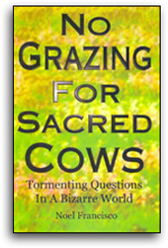
No Grazing For Sacred Cows
Tormenting Questions In A Bizarre World
Object:
Unbridled, unrestrained, blind ethnocentrism frightens me, Leon. It is almost unbelievable what some individuals, intoxicated with the tribalism of their religious fanaticism, ethnic loyalties, or national zeal will do to those who are considered their enemies. Recent events in the Balkans, Northern Ireland, and the Near East are among the examples of such extreme ethnocentrism to scourge humanity in the closing decades of this supposedly civilized century. If such unchecked ethnocentrism cannot soon be transformed to global benefits by our human race, I fear the future for our species is precarious, to say the least.
But the belief that there are no values or ethics that are universally applicable is almost as disturbing to me, Leon. Among some scholarly groups a kind of relativism has been accepted that dismisses any attempts to seek and understand standards of conduct and policy making that have some universal validity. This thinking has even been extended to the assertion that everything in human thought and belief is relative to the individual. Simply stated, there are those who claim that the only way of judging what is true, what is beautiful, what is good, is what is held as such for a particular individual. This leaves us humans prisoners of our own subjectivism, does it not? How can we then communicate meaningful, intelligent, understandable points of view to others? Such scholarship, I suspect, largely ignores the epistemological ramifications of such extreme relativism. Again the net effects of such an outlook can easily be that "anything goes." One has no way of judging or evaluating the thought and behavior of others.
For those who take the problems of contemporary humanity seriously though, there are some real difficulties in finding avenues of thought and action that avoid both the dangers of ethnocentrism and relativism. On our shrinking planet how are we to direct our thinking and behavior as we come in contact more and more with "strange bedfellows"? Who is right? Who is wrong? No wonder, is there, that many people today are confused and upset with all the conflicting voices that claim their religion, their national views, their belief system is the true one?
Broadening influences such as education, travel, and cross-cultural contacts can rather easily leave many individuals in a quandary. As old "security posts" of belief are shaken by such experiences, what can one believe today? This dilemma continues to trouble me, Leon. I don't believe there is any easy answer for resolving this philosophical, sociological, anthropological difficulty. Nevertheless, some kind of effort needs to be attempted to begin to resolve this intellectual problem that has all too many real results for the fate of humankind.
When situations arise, then, in which one is confronted with conflicting views of what is true, what is beautiful, what is good, these guideline questions would seem to be helpful. These questions I base upon the lectures of some of my most influential teachers at Drake and Duke Universities and upon reading I have done related to the subject.
How do views in question affect the unity of humans? Do they tend to divide or unify humans? Do the views tend to reach out and be more inclusive of others or are they exclusive in how they affect others?
Do the views attempt to take into consideration the accumulated knowledge of serious, dedicated thinkers from a wide range of different cultures or are they confined to the limited perspectives of individuals in only one or a few cultures?
Do the views possess creative potential for widening the scope of one's understanding of the cosmos or do they bind one into a stagnant mold?
Do the views reflect a respect for the dignity of human individuals or do they demean in obvious or subtle ways the human individual?
Do the views indicate an awareness of the integrated, sensitive ties of humans with other living creatures and with the ecosystem?
Do the views encourage the emancipation of the human spirit and intellect from conditions which may have been checking human creativity or upon close inspection do they suggest manipulation by "power-seekers"? How do the views impact upon vested interests?
Do the views recognize that human knowledge and understanding is ever-expanding, changing, and being revised? In this respect, do the views appear to have more of an underlying "ring" of humility or arrogance?
Granted, these questions are not, by any means, a comprehensive formulation of the guidelines which can be applied to beginning to resolve the dangers of ethnocentrism or cultural relativism, but could these not be a starting point? I would hope, Leon, that my own thinking can be refined and new insights can be gained on this subject.
But the belief that there are no values or ethics that are universally applicable is almost as disturbing to me, Leon. Among some scholarly groups a kind of relativism has been accepted that dismisses any attempts to seek and understand standards of conduct and policy making that have some universal validity. This thinking has even been extended to the assertion that everything in human thought and belief is relative to the individual. Simply stated, there are those who claim that the only way of judging what is true, what is beautiful, what is good, is what is held as such for a particular individual. This leaves us humans prisoners of our own subjectivism, does it not? How can we then communicate meaningful, intelligent, understandable points of view to others? Such scholarship, I suspect, largely ignores the epistemological ramifications of such extreme relativism. Again the net effects of such an outlook can easily be that "anything goes." One has no way of judging or evaluating the thought and behavior of others.
For those who take the problems of contemporary humanity seriously though, there are some real difficulties in finding avenues of thought and action that avoid both the dangers of ethnocentrism and relativism. On our shrinking planet how are we to direct our thinking and behavior as we come in contact more and more with "strange bedfellows"? Who is right? Who is wrong? No wonder, is there, that many people today are confused and upset with all the conflicting voices that claim their religion, their national views, their belief system is the true one?
Broadening influences such as education, travel, and cross-cultural contacts can rather easily leave many individuals in a quandary. As old "security posts" of belief are shaken by such experiences, what can one believe today? This dilemma continues to trouble me, Leon. I don't believe there is any easy answer for resolving this philosophical, sociological, anthropological difficulty. Nevertheless, some kind of effort needs to be attempted to begin to resolve this intellectual problem that has all too many real results for the fate of humankind.
When situations arise, then, in which one is confronted with conflicting views of what is true, what is beautiful, what is good, these guideline questions would seem to be helpful. These questions I base upon the lectures of some of my most influential teachers at Drake and Duke Universities and upon reading I have done related to the subject.
How do views in question affect the unity of humans? Do they tend to divide or unify humans? Do the views tend to reach out and be more inclusive of others or are they exclusive in how they affect others?
Do the views attempt to take into consideration the accumulated knowledge of serious, dedicated thinkers from a wide range of different cultures or are they confined to the limited perspectives of individuals in only one or a few cultures?
Do the views possess creative potential for widening the scope of one's understanding of the cosmos or do they bind one into a stagnant mold?
Do the views reflect a respect for the dignity of human individuals or do they demean in obvious or subtle ways the human individual?
Do the views indicate an awareness of the integrated, sensitive ties of humans with other living creatures and with the ecosystem?
Do the views encourage the emancipation of the human spirit and intellect from conditions which may have been checking human creativity or upon close inspection do they suggest manipulation by "power-seekers"? How do the views impact upon vested interests?
Do the views recognize that human knowledge and understanding is ever-expanding, changing, and being revised? In this respect, do the views appear to have more of an underlying "ring" of humility or arrogance?
Granted, these questions are not, by any means, a comprehensive formulation of the guidelines which can be applied to beginning to resolve the dangers of ethnocentrism or cultural relativism, but could these not be a starting point? I would hope, Leon, that my own thinking can be refined and new insights can be gained on this subject.
