
The Struggle To Honor Fathers
Self Help
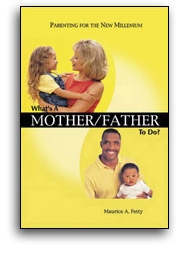
What's A Mother/Father To Do?
Parenting For The New Millennium
"But you say, 'If anyone tells his father or his mother, What you would have gained from me is given to God, he need not honor his father.' So, for the sake of your tradition, you have made void the word of God."
-- Matthew 15:5-6
The command to honor one's father has been in the Judeo-Christian tradition from the beginning. The first four of the Ten Commandments deal with one's religious obligation toward God. The last six deal with man's obligations to his fellow man. And the first of the last six has to do with children's obligation to their parents. "Honor your father and your mother," God instructed Moses, "that your days may be long in the land which the Lord your God gives you" (Exodus 20:12). So intense was the commandment that the later book of the covenant in Exodus said, "Whoever curses his father or his mother shall be put to death" (Exodus 21:17). The Judaic tradition was very clear. A basic religious obligation was that of honoring father and mother.
The Christian tradition, at least in its origins, was just as emphatic. Paul regularly wrote that children should honor their parents (Ephesians 6:1-4). And of course Jesus emphasized the basic religious duty of honoring, loving, respecting, and caring for one's parents. Not even a so-called religious act, such as the Corban vow mentioned in our text, should be allowed to interfere with showing reverence to parents, obeying them, and taking proper care of them. Christian theologians through the centuries advocated adherence to the great commandment: "Honor your father and your mother."
But today some people find it difficult to honor parents, especially fathers. Adolescent children characteristically think of their fathers as leftovers thawed out from the ice age. Young children may not have the foggiest notion what their father does for a living. And children grown and married may be hampered by geographic distance, even though they are now ready to honor father, because like Mark Twain, they have discovered that between the time they were sixteen and 21, their fathers had learned a lot.
Many fathers do not feel very much honor in their families, so we have set aside this day to call attention to a neglected person in our culture. We may find it a struggle to honor him because, as children, we shall have to set aside our own complaints for awhile. We shall have to think about our father's career for a moment instead of our own, about our father's dreams and desires and plans for the afternoon, in place of our own selfish interests.
And wives, for the moment, may need to lay aside the numerous women's magazines which increase circulation and make money largely by berating men and bemoaning woman's loathsome role in a so-called male chauvinist society. Women's libbers will need to turn off their microphones, put down their placards, and step down from the platform for a while and try to listen as we attempt to say a good word for men and fathers.
Besides, in today's struggle for rights, men must surely have a right or two. We have civil rights, minority rights, women's rights, gay rights, children's rights, grey rights (witness the Grey Panthers), and rights for most every conceivable kind of group. But lately, I have begun asking myself, from whom are they taking these rights? If they are demanding them, someone must have them. It occurs to me that the only group left from whom they are demanding rights is that minority group known as the white American, married, heterosexual, male, father, between the ages of thirty and 65!
I realize, of course, that some of you may be ready to point out that I might possibly fall into that category and therefore may not be expected to speak objectively. I readily admit to that possibility. But I am quick to point out that I have never noticed Helen Gurley Brown or Gloria Steinem overwhelmed with concerns about objectivity in speaking out in behalf of women. Men surely deserve as much subjectivity, partiality, and strident, emotional sexist defense as women!
So then, how might we proceed in our struggle to honor fathers?
I.
One way to honor fathers is to try to understand them.
Now that is not an unreasonable demand. Everyone wants to be understood. In fact, everyone demands to be understood. It is a right for women, children, minorities, even dogs and cats, to be understood. Some time ago we took our little dog to the veterinarian. He has a psychological problem, said the vet. Since there are, as yet, no dog psychiatrists, you will have to work it out yourselves, and try to understand him. (Our dog's problem, we determined, was loneliness. Too many children had left home for college!) So if dogs can demand to be understood, surely fathers can expect a bit of understanding.
This is a tough time for many men and fathers. Says Yale professor Kenneth Keniston, "Never before have men experienced such mass resignation before the forces of society, such a distance from the sources of power" (quoted in The New American Male, by Myron Brenton, p. 35). Numerous sociologists have written about our terrible sense of powerlessness. If in an earlier America on the frontier and in the small town, we often could influence the way things were, we are less able to do so in urbanized, industrialized, technologized, over-organized America. Even if we could locate the source of real power, it is questionable whether we could do much to influence it. Man complains about over-regulation, over-taxation, big government, and bureaucracies which harass the citizen in the name of protecting his liberty.
Even American presidents seem relatively powerless. They function a bit ceremoniously like constitutional monarchs while bureaucratic chieftains operate like prime ministers over their own domain, immune from the electorate. On our more pessimistic days we could describe presidential elections as national rituals wherein we enact our powerlessness -- the emasculation of the last American hero -- the President.
American men often are little more than production eunuchs -- powerless to effect real change. They feel it in corporations where increasingly decisions are by committee. They feel it in community organizations where they fear they will get a bad name if they don't go along with the prevailing view. After all, the up-and-coming banker, building his career, is not going to criticize anything like United Way.
Men also feel powerlessness in their own families. In earlier days, boys often worked alongside their fathers, learning not only a business or trade, but also a father's deep personality and his basic attitudes toward life. Now, many children hardly have any idea what their fathers do for a living. Therefore, one thing sons and daughters could do is insist on going to work with their fathers, striving to understand what they actually do. And perhaps we fathers could declare an annual sons and daughters day when our children make the rounds with us. After all, our work is not only our livelihood, but theirs. It is so much of our life.
Further, many fathers think their teaching and shaping role has been usurped by others. Schools have been presumptuous and pretentious about how much of life they could teach, believing, for example, that biological sex education addressed the far deeper and more complex issues of values, emotions, family feelings, traditions, and identity.
Youth magazines, records, movies, and television shows form a massive network of youth culture, based on the profit motive, presuming to instruct our young about life. Peer groups exert their pressure and respond en masse to fathers with derision and scorn. "What could fathers possibly know about such deep matters?" they ask. They have never had the problems and feelings we have.
Mothers get into the act also. Women complain about male-chauvinist pigs. But observe the bringing-up-father syndrome of many women who wear the pants and take pride in being the power behind the throne. Cartoons and magazine articles often have a down-with-daddy motif which suggests "pictorial sadism, verbal castration, or symbolic patricide" (Ibid., p. 141). Unmarried comic strip characters are usually virile and heroic, whereas the married ones are pictured as good-natured buffoons.
Consequently, fathers and husbands often feel displaced at home. They are off to the side of children and wife, feel isolated and alienated, and consequently withdraw or throw themselves into their work even more. Mothers and children build up a network of understanding that consciously or unconsciously excludes the father's influence.
And the changing role of women -- their independence, liberation, concern with career, their ambition to achieve and to excel on their own -- all these pose threats to husbands and fathers. Consequently, some men are confused over traditional masculine-feminine roles.
How can we honor fathers? By trying to understand the enormous pressures on them and their tensions and frustrations arising out of the massive social changes of today.
II.
A second way to honor fathers today is to love them.
And this, of course, is tougher than understanding, because when we love our fathers it usually means we have to give up some of our selfishness.
Many fathers have been criticized for not spending enough time with their children and families. They spend all their time at work and equate success with love. They seem to feel that if they provide their families with houses, cottages, boats, education, clothes, food, cars, vacations, and travel that that is loving them. But children and wives often rightfully complain they want more -- they want affection and time. And they are correct.
But wives and children will have to confess to their own greed in enjoying the things that Dad makes possible. Children often want more time, but they want the new moped, or car, too. They don't like to see Dad work such long hours, but they enjoy the new boat, the new cottage, and the European vacation. They claim they would like Dad to spend more time with them, but only when it fits in with their schedule. They want to honor Dad, but only on their terms. Dad may have his faults, but one way of honoring him is to love him, by acknowledging one's own selfishness, and taking the initiative to show affection and gratitude. If Dad thinks money and things are love, perhaps he will feel loved in return if we show appreciation.
Another way to honor Dad is to stop blaming him for all our faults. Many young people excuse their bad behavior or their maladjustment to life by blaming it on their fathers. No father is perfect. And if a child holds a grudge forever because he wasn't raised differently or because he felt deprived in some way, he will himself never become a man nor understand what it truly is to be a father. After all, we could all point the finger back to our ancestors and blame them for the mess we are in. But that is at least adolescent, if not childish. A way to honor Father is to give thanks for all the good he gave us, and accept responsibility to change the bad so we don't pass it on to our own children. If we honor our fathers that way, we will, as the commandment says, live longer.
Wives must also show some patience and understanding as they clamor for rapid change in the role of women in our society. After all many couples of today married with traditional understandings of masculine-feminine roles. Those understandings formed, in effect, unwritten contracts. If a wife wants to abandon the traditional child-rearing role, she should be as patient with her husband as she would expect her husband to be with her if he wanted to abandon the traditional bread-winning role. It is questionable whether women have the moral right to change traditional roles willy-nilly, overnight, without frustration and objection from men. In a day when people are pounding and tearing at each other, it would be an expression of love not to pound and tear at husbands who are having difficulty adjusting to their wife's liberation. After all, if she appears in pants, coat and tie, briefcase in hand on her way to her new executive office, what would she think of her husband in dress, high-heels, and make-up, off on his way to the club to play bridge? Fair is fair!
Finally, we need to honor our parents more by loving them in their old age. Our parents usually support us in our childhood. And as they live longer, it may become necessary for us to support them in their second childhood, as they become old, feeble, dependent, and even senile.
That's what Jesus was talking about in our text. Some people pledged money to the temple to get their name in print, but refused to help their needy, aged parents. I know few people today who give money to the church to the neglect of parents, but there are surely many who spend on houses, land, boats, pleasures, and ego organizations to the neglect of their parents. It ought not to be so, says Jesus. One of our highest religious obligations is to honor our parents -- especially our fathers on this day. It often is a struggle. But it is what makes life worth living, and living long.
Prayer
Eternal God, who has made the world in awesome beauty and terrifying majesty, we come before you to offer our praise and thanksgiving and to acknowledge you as Lord, and ourselves as your creatures, made in your image to do your will. Aware of your wholeness and holiness, we are more aware of our partiality and unholiness. Aware of your demand for righteousness and love, we are more conscious of our unrighteousness and indifference, even toward those of our own family. Forgive us wherein we fall short of your design for us, and be patient to start over again with us, to bring us to completion.
On this special day of honoring fathers, we are sometimes not sure we even should address you as Father, as though you were male only, embracing only a masculine point of view. But we know that all things have come to be through your power and creative word and that male and female, masculinity and femininity have arisen from your being. You have made us man and woman and have designed us for motherhood and fatherhood.
So bless especially on this day, the fathers of our church and land. Be close to fathers hurting and alone, who feel alienated by those they love most. Heal those fathers broken by death or divorce or loss of a child. Be near to fathers struggling with marriage and career, that they might be strong and keep their balance. Help fathers confused in mid-life crisis, wondering about identity and purpose. Be close to fathers who, wanting to understand and love their children, are unable to express love or to show understanding. Give them power to open up. Help young fathers with the newborn, fathers with the college-bound, and grandfathers in the sunset years that they may glow with wisdom and the assurance life has not been in vain.
Help fathers who fail in business and love, and restore them. Save powerful, successful fathers from pride and arrogance. Help them see the frailty of all life and their dependence upon you.
In these troublous days, bring new strength to the family, O Lord, that we may learn to honor one another and live long in the land in peace. We ask this in the name of Christ our Lord. Amen.
-- Matthew 15:5-6
The command to honor one's father has been in the Judeo-Christian tradition from the beginning. The first four of the Ten Commandments deal with one's religious obligation toward God. The last six deal with man's obligations to his fellow man. And the first of the last six has to do with children's obligation to their parents. "Honor your father and your mother," God instructed Moses, "that your days may be long in the land which the Lord your God gives you" (Exodus 20:12). So intense was the commandment that the later book of the covenant in Exodus said, "Whoever curses his father or his mother shall be put to death" (Exodus 21:17). The Judaic tradition was very clear. A basic religious obligation was that of honoring father and mother.
The Christian tradition, at least in its origins, was just as emphatic. Paul regularly wrote that children should honor their parents (Ephesians 6:1-4). And of course Jesus emphasized the basic religious duty of honoring, loving, respecting, and caring for one's parents. Not even a so-called religious act, such as the Corban vow mentioned in our text, should be allowed to interfere with showing reverence to parents, obeying them, and taking proper care of them. Christian theologians through the centuries advocated adherence to the great commandment: "Honor your father and your mother."
But today some people find it difficult to honor parents, especially fathers. Adolescent children characteristically think of their fathers as leftovers thawed out from the ice age. Young children may not have the foggiest notion what their father does for a living. And children grown and married may be hampered by geographic distance, even though they are now ready to honor father, because like Mark Twain, they have discovered that between the time they were sixteen and 21, their fathers had learned a lot.
Many fathers do not feel very much honor in their families, so we have set aside this day to call attention to a neglected person in our culture. We may find it a struggle to honor him because, as children, we shall have to set aside our own complaints for awhile. We shall have to think about our father's career for a moment instead of our own, about our father's dreams and desires and plans for the afternoon, in place of our own selfish interests.
And wives, for the moment, may need to lay aside the numerous women's magazines which increase circulation and make money largely by berating men and bemoaning woman's loathsome role in a so-called male chauvinist society. Women's libbers will need to turn off their microphones, put down their placards, and step down from the platform for a while and try to listen as we attempt to say a good word for men and fathers.
Besides, in today's struggle for rights, men must surely have a right or two. We have civil rights, minority rights, women's rights, gay rights, children's rights, grey rights (witness the Grey Panthers), and rights for most every conceivable kind of group. But lately, I have begun asking myself, from whom are they taking these rights? If they are demanding them, someone must have them. It occurs to me that the only group left from whom they are demanding rights is that minority group known as the white American, married, heterosexual, male, father, between the ages of thirty and 65!
I realize, of course, that some of you may be ready to point out that I might possibly fall into that category and therefore may not be expected to speak objectively. I readily admit to that possibility. But I am quick to point out that I have never noticed Helen Gurley Brown or Gloria Steinem overwhelmed with concerns about objectivity in speaking out in behalf of women. Men surely deserve as much subjectivity, partiality, and strident, emotional sexist defense as women!
So then, how might we proceed in our struggle to honor fathers?
I.
One way to honor fathers is to try to understand them.
Now that is not an unreasonable demand. Everyone wants to be understood. In fact, everyone demands to be understood. It is a right for women, children, minorities, even dogs and cats, to be understood. Some time ago we took our little dog to the veterinarian. He has a psychological problem, said the vet. Since there are, as yet, no dog psychiatrists, you will have to work it out yourselves, and try to understand him. (Our dog's problem, we determined, was loneliness. Too many children had left home for college!) So if dogs can demand to be understood, surely fathers can expect a bit of understanding.
This is a tough time for many men and fathers. Says Yale professor Kenneth Keniston, "Never before have men experienced such mass resignation before the forces of society, such a distance from the sources of power" (quoted in The New American Male, by Myron Brenton, p. 35). Numerous sociologists have written about our terrible sense of powerlessness. If in an earlier America on the frontier and in the small town, we often could influence the way things were, we are less able to do so in urbanized, industrialized, technologized, over-organized America. Even if we could locate the source of real power, it is questionable whether we could do much to influence it. Man complains about over-regulation, over-taxation, big government, and bureaucracies which harass the citizen in the name of protecting his liberty.
Even American presidents seem relatively powerless. They function a bit ceremoniously like constitutional monarchs while bureaucratic chieftains operate like prime ministers over their own domain, immune from the electorate. On our more pessimistic days we could describe presidential elections as national rituals wherein we enact our powerlessness -- the emasculation of the last American hero -- the President.
American men often are little more than production eunuchs -- powerless to effect real change. They feel it in corporations where increasingly decisions are by committee. They feel it in community organizations where they fear they will get a bad name if they don't go along with the prevailing view. After all, the up-and-coming banker, building his career, is not going to criticize anything like United Way.
Men also feel powerlessness in their own families. In earlier days, boys often worked alongside their fathers, learning not only a business or trade, but also a father's deep personality and his basic attitudes toward life. Now, many children hardly have any idea what their fathers do for a living. Therefore, one thing sons and daughters could do is insist on going to work with their fathers, striving to understand what they actually do. And perhaps we fathers could declare an annual sons and daughters day when our children make the rounds with us. After all, our work is not only our livelihood, but theirs. It is so much of our life.
Further, many fathers think their teaching and shaping role has been usurped by others. Schools have been presumptuous and pretentious about how much of life they could teach, believing, for example, that biological sex education addressed the far deeper and more complex issues of values, emotions, family feelings, traditions, and identity.
Youth magazines, records, movies, and television shows form a massive network of youth culture, based on the profit motive, presuming to instruct our young about life. Peer groups exert their pressure and respond en masse to fathers with derision and scorn. "What could fathers possibly know about such deep matters?" they ask. They have never had the problems and feelings we have.
Mothers get into the act also. Women complain about male-chauvinist pigs. But observe the bringing-up-father syndrome of many women who wear the pants and take pride in being the power behind the throne. Cartoons and magazine articles often have a down-with-daddy motif which suggests "pictorial sadism, verbal castration, or symbolic patricide" (Ibid., p. 141). Unmarried comic strip characters are usually virile and heroic, whereas the married ones are pictured as good-natured buffoons.
Consequently, fathers and husbands often feel displaced at home. They are off to the side of children and wife, feel isolated and alienated, and consequently withdraw or throw themselves into their work even more. Mothers and children build up a network of understanding that consciously or unconsciously excludes the father's influence.
And the changing role of women -- their independence, liberation, concern with career, their ambition to achieve and to excel on their own -- all these pose threats to husbands and fathers. Consequently, some men are confused over traditional masculine-feminine roles.
How can we honor fathers? By trying to understand the enormous pressures on them and their tensions and frustrations arising out of the massive social changes of today.
II.
A second way to honor fathers today is to love them.
And this, of course, is tougher than understanding, because when we love our fathers it usually means we have to give up some of our selfishness.
Many fathers have been criticized for not spending enough time with their children and families. They spend all their time at work and equate success with love. They seem to feel that if they provide their families with houses, cottages, boats, education, clothes, food, cars, vacations, and travel that that is loving them. But children and wives often rightfully complain they want more -- they want affection and time. And they are correct.
But wives and children will have to confess to their own greed in enjoying the things that Dad makes possible. Children often want more time, but they want the new moped, or car, too. They don't like to see Dad work such long hours, but they enjoy the new boat, the new cottage, and the European vacation. They claim they would like Dad to spend more time with them, but only when it fits in with their schedule. They want to honor Dad, but only on their terms. Dad may have his faults, but one way of honoring him is to love him, by acknowledging one's own selfishness, and taking the initiative to show affection and gratitude. If Dad thinks money and things are love, perhaps he will feel loved in return if we show appreciation.
Another way to honor Dad is to stop blaming him for all our faults. Many young people excuse their bad behavior or their maladjustment to life by blaming it on their fathers. No father is perfect. And if a child holds a grudge forever because he wasn't raised differently or because he felt deprived in some way, he will himself never become a man nor understand what it truly is to be a father. After all, we could all point the finger back to our ancestors and blame them for the mess we are in. But that is at least adolescent, if not childish. A way to honor Father is to give thanks for all the good he gave us, and accept responsibility to change the bad so we don't pass it on to our own children. If we honor our fathers that way, we will, as the commandment says, live longer.
Wives must also show some patience and understanding as they clamor for rapid change in the role of women in our society. After all many couples of today married with traditional understandings of masculine-feminine roles. Those understandings formed, in effect, unwritten contracts. If a wife wants to abandon the traditional child-rearing role, she should be as patient with her husband as she would expect her husband to be with her if he wanted to abandon the traditional bread-winning role. It is questionable whether women have the moral right to change traditional roles willy-nilly, overnight, without frustration and objection from men. In a day when people are pounding and tearing at each other, it would be an expression of love not to pound and tear at husbands who are having difficulty adjusting to their wife's liberation. After all, if she appears in pants, coat and tie, briefcase in hand on her way to her new executive office, what would she think of her husband in dress, high-heels, and make-up, off on his way to the club to play bridge? Fair is fair!
Finally, we need to honor our parents more by loving them in their old age. Our parents usually support us in our childhood. And as they live longer, it may become necessary for us to support them in their second childhood, as they become old, feeble, dependent, and even senile.
That's what Jesus was talking about in our text. Some people pledged money to the temple to get their name in print, but refused to help their needy, aged parents. I know few people today who give money to the church to the neglect of parents, but there are surely many who spend on houses, land, boats, pleasures, and ego organizations to the neglect of their parents. It ought not to be so, says Jesus. One of our highest religious obligations is to honor our parents -- especially our fathers on this day. It often is a struggle. But it is what makes life worth living, and living long.
Prayer
Eternal God, who has made the world in awesome beauty and terrifying majesty, we come before you to offer our praise and thanksgiving and to acknowledge you as Lord, and ourselves as your creatures, made in your image to do your will. Aware of your wholeness and holiness, we are more aware of our partiality and unholiness. Aware of your demand for righteousness and love, we are more conscious of our unrighteousness and indifference, even toward those of our own family. Forgive us wherein we fall short of your design for us, and be patient to start over again with us, to bring us to completion.
On this special day of honoring fathers, we are sometimes not sure we even should address you as Father, as though you were male only, embracing only a masculine point of view. But we know that all things have come to be through your power and creative word and that male and female, masculinity and femininity have arisen from your being. You have made us man and woman and have designed us for motherhood and fatherhood.
So bless especially on this day, the fathers of our church and land. Be close to fathers hurting and alone, who feel alienated by those they love most. Heal those fathers broken by death or divorce or loss of a child. Be near to fathers struggling with marriage and career, that they might be strong and keep their balance. Help fathers confused in mid-life crisis, wondering about identity and purpose. Be close to fathers who, wanting to understand and love their children, are unable to express love or to show understanding. Give them power to open up. Help young fathers with the newborn, fathers with the college-bound, and grandfathers in the sunset years that they may glow with wisdom and the assurance life has not been in vain.
Help fathers who fail in business and love, and restore them. Save powerful, successful fathers from pride and arrogance. Help them see the frailty of all life and their dependence upon you.
In these troublous days, bring new strength to the family, O Lord, that we may learn to honor one another and live long in the land in peace. We ask this in the name of Christ our Lord. Amen.
