
The Unprofitable Servant
Drama
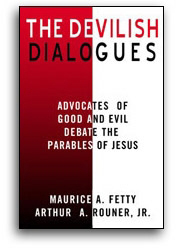
The Devilish Dialogues
Advocates Of Good And Evil Debate The Parables Of Jesus
The Devil's Advocate:
My dear friends, I consider it a great privilege to be able to address you on a topic very close to your heart and mine -- the topic of money and its use. Indeed, it is more than the topic of money --Êit is the topic of life itself, and how we should use it. I feel that it is a privilege to address you because I think many of you will be on my side. Heretofore, it has been my opinion that my opponent, The Lord's Advocate, has had the distinct advantage. It is to be remembered that I am having to make my case on his territory, right in the midst of his people.
Yet, I take particular delight in being able to address you because I am confident that many of you interpret this parable of the talents the same way as I interpret it. And quite frankly, nothing could delight me more than to see the Lord's Advocate embarrassed before his own troops.
You should be warned that he will attempt to exhort you to all sorts of foolish excesses. He will raise wild-eyed arguments and unprovable opinions. He will appeal to your romantic notions and sense of adventure. Note well the assault he will make on your calm reasonableness and your cool assessment of hard reality. So please allow me to forewarn you. I have your interests very much at heart, even if I have been given a rather unfortunate name. But do not let that deter you. Let me assure you that I have huge numbers of people who regularly argue for, believe in, and live out my position.
Of course, the majority of them are not in church. They are out for dinner or watching television or enjoying some other sort of diversion. Ah, yes, they are all mine. I love them. They know it's useless to bother with church. They already believe in my arguments.
But, of course, I am always glad to have the opportunity to do some recruiting. How wonderful it is! It is so deceitful and delightful because I can read your minds and hearts and I know some of you are secretly on my side already. Even though you are here, you wish you weren't. A perfectly marvelous attitude. So deceitful! Ah, well, it is his turn, so think about the television programs you will be watching when you get home.
The Lord's Advocate:
Well, I am glad to be here, too -- with the people who certainly should achieve the annual "we try harder" trophy, for effort.
Maybe you think you have the money-mad here tonight, Mr. Scratch, but you're so interested in the green stuff yourself that you may have misjudged the majority. I won't deny they're missing something on television. But maybe they'll really get it here tonight, much more than they might get at home. In fact, this may be a bigger boon right here.
And maybe they know it! Maybe that's why they're here. Because these types already suspect that the real values of life are not in color television or green-colored paper or any of the things they can buy. You may not find us so hung up over money as you think! Take it from here, friend!
II
The Devil's Advocate:
I would like to take the opportunity to point out a few facts about this parable. Notice first of all how unfair this fellow was. He didn't treat his employees the same. All men are created equal, you know. Yet he gave one man $5,000, the other $2,000, and the third only $1,000. Now I ask you, is that fair? Is he giving each man equal opportunity? Certainly not.
Yet I have heard my idealistic opponent fulminate regularly Sunday after Sunday that all men are created equal and that all men should be given equal opportunity. But look. Right here in one of Jesus' teachings you have preferential treatment. Some people are getting the advantage. Any idiot knows it's better to have $5,000 to invest rather than $1,000. You can do so much more with it. You have more freedom and confidence.
Let me point out another fact of this parable that is much overlooked. Note what the employer says to the employee who received only $1,000. "You wicked and slothful servant! You knew that I reap where I have not sowed and gather where I have not winnowed." Did you get that? The employer even admits that he is a hard and rapacious man. He'll grab whatever he can get wherever and whenever he has the opportunity. It doesn't bother him to muscle in on somebody else. So long as he can do it without too much resistance, he will. If a guy is sucker enough not to have the proper protection on his fortune, this fellow in Jesus' parable will abscond with it. He is an extortioner, a wheeler-dealer with no scruples, save one. And that is -- make money as fast as you can, any way that you can.
So you see who is criticized in this parable. It is the man who has scruples. Just imagine the methods used by those other two fellows who doubled their investment in the time their employer was away. Yet Jesus praises them and condemns the fellow who didn't invest his $1,000.
This leads me to mention the final fact about this story of unspeakable injustice. The $1,000 was taken away from the third man and given to the man who had been given $5,000. And since that man had doubled his investment he would now have a total of $11,000! I ask you, have you ever heard of such outrageous injustice? Yet Jesus uses this story.
So now let us see how our devious opponent will attempt to spin some sort of innocuous truth out of this one.
The Lord's Advocate:
Nothing devious -- just a question: Was he really so unjust? So unfair that one received $5,000 and another $2,000 and the third only $1,000? Indeed, all men are created equal: equal in every opportunity they need to make meaning out of life, equal in God's sight as his children to be loved.
But not all the same. Not all good, not all equal in ability, brain, and motivation. And the scripture says that the man of wealth divided his money among his servants "in proportion to their abilities." One of them deserved, by proven initiative and faithfulness, to be entrusted with $5,000. The man given $1,000 had measured up to no more risk than that.
And yet, he was not counted out. He was given a chance. He could prove himself with the little if he had the will, the daring, the faith.
And isn't that, after all, the key? Jesus told the story saying, "The Kingdom of God is like one man receiving $5,000 and another $2,000 and another $1,000. The Kingdom of God is a gift, an opportunity. And the man with a $5,000 faith is given a $5,000 opportunity." Each of us, the Lord was saying, is given a chance for great adventure with God. Every day the opportunity comes. It's come to us. It is coming to us tonight. Do we take it? That's what Jesus wants to know. That's what the story is about: about what we do with the Kingdom when it is handed to us.
Some grasp it as a golden chance: they use it, they let their light shine before men, they tell the world about their Christ, they "spread the blessing." And their $5,000 of faith becomes $10,000. And so with the $2,000 man with less.
But the man with the $1,000 faith really doesn't have the spirit. He is without the daring. Really without the trust -- and he immediately resorts to rationalization, to excuses for not doing anything with his faith-opportunity. All he does is blame God for not having given him more. He buries his chances. He doesn't bother to pray, to read the Bible, to know God. He does nothing. And he receives nothing. His faith is no greater when he's through.
But worse still, the kingdom is no greater. It has gained sway over no more lives under this man's hand. It has not been extended. And instead of simply not doing good, not making money, not increasing the world's faith, he has lost ground for the Kingdom. He has retreated, shrunk the reaches of his Lord's domain. He is an unprofitable servant and deserves to have taken away from him even what he had.
Harsh judgment perhaps, by the world's standards -- which are static. But by God's standards, which are dynamic and growing, he had lost the battle. He was defeated. And so he was plundered, and deserved to be. Complete fair play in the game God plays!
III
The Devil's Advocate:
Contrary to the misguided opinions of our opponent, the man who buried his money was pretty smart. Those fellows who invested were just lucky. What if there had been a recession in the market? What if there had been a depression? What if their President had slowed down the market by increasing interest rates? What if they had bought a bad stock at a bad time? What if the bottom had fallen out of the economy? Where would those $2,000 and $5,000 fellows be now? They would be broke and in the soup and bread line. And just think how many people would have liked to go out in their backyard to dig up a buried treasure of $1,000. That would be better in the long run than watching it sink into oblivion with the stock market.
Of course, we all know who Jesus was attacking. It was the scribes and Pharisees and other leaders of legalistic Judaism. He was angry at them for resisting his new teachings about religion. He claimed they were clutching their laws and rituals and religious teachings like the man clutched his $1,000. So he criticizes them for being so narrow and conservative. He wants them to be reckless and foolish by investing themselves in his religion. Jesus was reacting to opposition.
But I ask you, why should they change? Why should they give up a religion that had been with them over 1,300 years? It had taken nearly 900 years for their religious teachings and traditions to develop. They had beautiful worship facilities in the Temple in Jerusalem and in the synagogues throughout Palestine.
Of course, it is true that many of the more radical and fanatic types believed that a new messiah or king was coming. But there was certainly no reason to believe that Jesus was the one. After all, look where he came from --ÊNazareth of Galilee. What a despicable place! You might as well say he came from the hills of Tennessee or the prairies of the Dakotas! Nothing good can come from those places.
Besides, Jesus had the audacity to call those dear, devoted, religious men -- the Pharisees -- he had the audacity to call them sons-of-the-devil (a curious compliment, I must say), painted graves full of dead men's bones. How could he do that? These men had been in religious circles all their lives. They had been in Inter-Varsity Christian Fellowship, Campus Crusade for Christ, and the United Christian Campus Fellowship while in college. They had been active in seminary activities and received their Master of Divinity, the professional ministerial degree. Moreover, many had gone on to graduate school both at home and abroad and had received both master's and doctor's degrees. They were highly qualified.
One time when a farmer came to visit them, he asked the Doctors of Religion if God in fact loved man and cared about him. They pointed out that it depends a great deal on how you define God, love, and man. If you define God as the self-projected image of wish fulfillment, then "God" does indeed love man unless, of course, you define man as essentially self-hating because of guilt feelings aroused by society's demands upon man, demands which are idealized into absolute standards and reinforced by the concept of "God" who supports these standards. Of course, it was a little difficult for the farmer to grasp all that the first time around. So they advised him to read the complete works of Freud, Nietzsche, and Marx, along with those of Kierkegaard, Barth, Tillich, and Niebuhr.
A thoroughly efficient answer, wouldn't you say? Did they give him any foolish, simple-minded answer? Not at all! Did they delude him into thinking that religion was an easy thing, something you could get overnight? Not these boys! They were professionals from the word go. They were not going around spouting off easy answers to complex questions.
So how could they get excited about Jesus of Nazareth? Where had he gone to school? Who were his teachers? Where did he come from? His family was blue-collar class. He had published nothing in the leading professional journals. There were no books under his name. Most all the professional religious types knew nothing about him except that they violently disagreed with him.
So you see, they were protecting what they had. They were not going to risk their $1,000 of religion on something new and untried. Moses, Abraham, and the prophets they knew. But for this man Jesus, they neither knew from whence he had come or where he was going. So why risk their whole past on him?
The Lord's Advocate:
And it was a risk, you're right. Venture capital, it was, with a man's own heart -- and any one of us would do well to think twice before laying it on the line with an unknown like the Nazarene. The scribes and Pharisees were cautious, and they should be!
But how cautious? And for how long? If Jesus of Nazareth was God's man of the hour, bringing God's Kingdom in power, then the wise man is not only the cautious man. He's the man who has eyes to see and ears to hear! The man who can see the signs of the time, who can tell when history's hour has struck.
And you have the issue right: it was the time either to bury what you had and hang on in apprehensive hope, or to cast care to the wind, and "go big" in faith for a long-term, no hesitation investment! And the capital they were concerned with was faith.
And you are right -- the scribes and Pharisees did have something to defend: a long and great tradition, a good tradition, which had been precious to Abraham, Isaac, and Jacob. Not something you set aside in a moment! They could indeed have watched everything they cared about washed away forever with this Jesus if the risk was wrong and he was no Christ.
And, of course, his only proof was himself: the life he lived, the truth he taught, the love he gave, and finally the death he died. But, of course, they didn't really look at that, did they? They cast about for credentials. They made the mistake of religious men in every century: they judged by external appearances, by institutional forms, by predetermined procedures.
And by those standards, Jesus was a washout! Nazareth was nowhere! East Nothingsville! And isn't it strange what we take as standards -- college, seminary, proper ordination, official blessing from the right circles, getting published in the right journals, having your books widely acclaimed.
Jesus had none of these. All he had was himself: his heart, his hand, his hope to offer man. And, he had God.
A tough choice -- God or the right graduate degrees. And isn't it sad the scribes and Pharisees chose the degrees and not God. We sympathize with them. But they were wrong. They did miss their chance. And the whole people of Israel missed their chance because these men were wrong, because they didn't see, because they were blind. They gambled -- as they had every right to do --Êand they lost. It is one of the tragedies of the ages!
The only tragedy greater will be if we too are blind and do not have eyes to see that this man, in spite of coming from Nazareth, and having no academic credentials, is Christ the Lord, Son of God, and our Savior.
IV
The Devil's Advocate:
Let me remind you of what I said at the very beginning -- my opponent will try to allure you by false promises and emotional exhortations to adventure which can only lead to oblivion. Let me again appeal to your cool head, your balanced judgment, your hard reasonableness.
The first thing to remember is that you have to look skeptically at all religious reformers. Look at all these fly-by-night evangelists -- the Elmer Gantrys, the snake-handlers, the bright-eyed, innocent Campus Crusaders who have a simplistic answer to all the world's problems. They are like the souped-up, "Jesus-is-the-big-shot's-buddy" Christianity of Young Life. Campus Crusade and all the assorted self-appointed Bible teachers claim, "Jesus is the answer." But as one college sophomore put it, "What is the question?"
So I ask you, why not hold on to the religious instruction which you already have? Why abandon the professionals? Half these religious reformers running around are money-grabbing egomaniacs. They want you to give your heart to Jesus but your pocketbook to them. So why shouldn't you protect your $1,000 worth of religious treasure? Why should you throw it overboard for something unproven and untried? Why take a chance? Hang on to that which you have.
After all, that is the practice of religious denominations. Do you think they would give up what they have to go after something new? It is not very likely. Since Lutheranism is working for the Scandinavians and assorted Germans, why should they rethink it or abandon it for something else? Since Presbyterianism works for the Scotch, Catholicism for the Latins and Irish, and Angli-canism for the English, why risk all that for something new?
Since the Dutch liked to be Reformed, and
Since the Baptists like to be reborn, and
Since the Methodists like the Anglican outcaste, and
Since the Quakers like quietly to resist the draft, and
Since the Christian Scientists the doctors fear, and
Since the Congregationalists keep saying loud and clear,
"Remember the Mayflower," until they are small enough to get back on it, and
Since denominations, confident of their doctrine may not be,
You can be quite sure, they'd never give up bureaucracy.
So if religious leaders and denominations won't risk their old religious ideas on the new, why should you? I say, hide your religious convictions deep in your heart -- bury them there. Preserve them. Don't let anyone get at them. All this wild-eyed investing in novel religious ideas will cease. People who cast about so foolishly will only get foolish answers.
The scribes and Pharisees were right. They protected their investment. They held on to what they had. They were not deluded by the claims of Jesus. And I am sure that cool, conservative people such as yourselves will not be deluded either.
The Lord's Advocate:
I hope they will not be deluded. I hope they will protect their investment. What Christ wants to know is what is their investment? Is it in the past, in tradition, in custom, in denominations and their narrowed views, and their increasingly anachronistic bureaucracies -- or, is it in him, in Jesus Christ, the Son of Man, and Son of God?
I admit that a man who is trying to present Christ to the world does oversimplify. Sin is every man's sorrow, and it's the Christian's too. The glassy-eyed, spiritual scalp-takers who are only interested in adding up conversions are a distortion of true discipleship just as much as the denominational bureaucrats, and the professors in the theological cemeteries, and the silk-gowned establishment-defending ministers.
We all have our little prejudices, our little oversimplifications. And if the task of the Church is to "go into all the world and preach the gospel and heal the sick," then maybe we should at least be grateful that Campus Crusade and Inter-Varsity, and Young Life, and the Healing Order of St. Luke are doing it. At least they have a plan. At least they have a vision and are trying to fulfill it.
Are you "traditionalists" trying? Are you faith-buriers in the game, on the field, fighting the good fight? If you've got a better way to tell about Jesus, I'm sure Billy Graham would like to know it!
The trouble with the traditionalists is that they are like salesmen who never ask the customer to sign on the line! Your mainline church men are salesmen who are forever cultivating the prospect, but always afraid to "put the question." Maybe by putting the question you do offend a few. Maybe it will get too close for some people's comfort. Many a time the Master did exactly that! But somehow, somewhere, you've got to try. Even if you get yourself crucified.
Of course, you may win the crown of life. You may find a life, with Jesus, like nothing you've ever known before. You may just change the whole world.
Have your denominations, your traditions, if you want them. But have Christ first. Keep him at the heart: of your church, of your tradition, but most of all -- of your own life.
That's when your investment will pay off. That's when your gamble will win. That's when the Kingdom will come. The decision is yours to make -- tonight.
My dear friends, I consider it a great privilege to be able to address you on a topic very close to your heart and mine -- the topic of money and its use. Indeed, it is more than the topic of money --Êit is the topic of life itself, and how we should use it. I feel that it is a privilege to address you because I think many of you will be on my side. Heretofore, it has been my opinion that my opponent, The Lord's Advocate, has had the distinct advantage. It is to be remembered that I am having to make my case on his territory, right in the midst of his people.
Yet, I take particular delight in being able to address you because I am confident that many of you interpret this parable of the talents the same way as I interpret it. And quite frankly, nothing could delight me more than to see the Lord's Advocate embarrassed before his own troops.
You should be warned that he will attempt to exhort you to all sorts of foolish excesses. He will raise wild-eyed arguments and unprovable opinions. He will appeal to your romantic notions and sense of adventure. Note well the assault he will make on your calm reasonableness and your cool assessment of hard reality. So please allow me to forewarn you. I have your interests very much at heart, even if I have been given a rather unfortunate name. But do not let that deter you. Let me assure you that I have huge numbers of people who regularly argue for, believe in, and live out my position.
Of course, the majority of them are not in church. They are out for dinner or watching television or enjoying some other sort of diversion. Ah, yes, they are all mine. I love them. They know it's useless to bother with church. They already believe in my arguments.
But, of course, I am always glad to have the opportunity to do some recruiting. How wonderful it is! It is so deceitful and delightful because I can read your minds and hearts and I know some of you are secretly on my side already. Even though you are here, you wish you weren't. A perfectly marvelous attitude. So deceitful! Ah, well, it is his turn, so think about the television programs you will be watching when you get home.
The Lord's Advocate:
Well, I am glad to be here, too -- with the people who certainly should achieve the annual "we try harder" trophy, for effort.
Maybe you think you have the money-mad here tonight, Mr. Scratch, but you're so interested in the green stuff yourself that you may have misjudged the majority. I won't deny they're missing something on television. But maybe they'll really get it here tonight, much more than they might get at home. In fact, this may be a bigger boon right here.
And maybe they know it! Maybe that's why they're here. Because these types already suspect that the real values of life are not in color television or green-colored paper or any of the things they can buy. You may not find us so hung up over money as you think! Take it from here, friend!
II
The Devil's Advocate:
I would like to take the opportunity to point out a few facts about this parable. Notice first of all how unfair this fellow was. He didn't treat his employees the same. All men are created equal, you know. Yet he gave one man $5,000, the other $2,000, and the third only $1,000. Now I ask you, is that fair? Is he giving each man equal opportunity? Certainly not.
Yet I have heard my idealistic opponent fulminate regularly Sunday after Sunday that all men are created equal and that all men should be given equal opportunity. But look. Right here in one of Jesus' teachings you have preferential treatment. Some people are getting the advantage. Any idiot knows it's better to have $5,000 to invest rather than $1,000. You can do so much more with it. You have more freedom and confidence.
Let me point out another fact of this parable that is much overlooked. Note what the employer says to the employee who received only $1,000. "You wicked and slothful servant! You knew that I reap where I have not sowed and gather where I have not winnowed." Did you get that? The employer even admits that he is a hard and rapacious man. He'll grab whatever he can get wherever and whenever he has the opportunity. It doesn't bother him to muscle in on somebody else. So long as he can do it without too much resistance, he will. If a guy is sucker enough not to have the proper protection on his fortune, this fellow in Jesus' parable will abscond with it. He is an extortioner, a wheeler-dealer with no scruples, save one. And that is -- make money as fast as you can, any way that you can.
So you see who is criticized in this parable. It is the man who has scruples. Just imagine the methods used by those other two fellows who doubled their investment in the time their employer was away. Yet Jesus praises them and condemns the fellow who didn't invest his $1,000.
This leads me to mention the final fact about this story of unspeakable injustice. The $1,000 was taken away from the third man and given to the man who had been given $5,000. And since that man had doubled his investment he would now have a total of $11,000! I ask you, have you ever heard of such outrageous injustice? Yet Jesus uses this story.
So now let us see how our devious opponent will attempt to spin some sort of innocuous truth out of this one.
The Lord's Advocate:
Nothing devious -- just a question: Was he really so unjust? So unfair that one received $5,000 and another $2,000 and the third only $1,000? Indeed, all men are created equal: equal in every opportunity they need to make meaning out of life, equal in God's sight as his children to be loved.
But not all the same. Not all good, not all equal in ability, brain, and motivation. And the scripture says that the man of wealth divided his money among his servants "in proportion to their abilities." One of them deserved, by proven initiative and faithfulness, to be entrusted with $5,000. The man given $1,000 had measured up to no more risk than that.
And yet, he was not counted out. He was given a chance. He could prove himself with the little if he had the will, the daring, the faith.
And isn't that, after all, the key? Jesus told the story saying, "The Kingdom of God is like one man receiving $5,000 and another $2,000 and another $1,000. The Kingdom of God is a gift, an opportunity. And the man with a $5,000 faith is given a $5,000 opportunity." Each of us, the Lord was saying, is given a chance for great adventure with God. Every day the opportunity comes. It's come to us. It is coming to us tonight. Do we take it? That's what Jesus wants to know. That's what the story is about: about what we do with the Kingdom when it is handed to us.
Some grasp it as a golden chance: they use it, they let their light shine before men, they tell the world about their Christ, they "spread the blessing." And their $5,000 of faith becomes $10,000. And so with the $2,000 man with less.
But the man with the $1,000 faith really doesn't have the spirit. He is without the daring. Really without the trust -- and he immediately resorts to rationalization, to excuses for not doing anything with his faith-opportunity. All he does is blame God for not having given him more. He buries his chances. He doesn't bother to pray, to read the Bible, to know God. He does nothing. And he receives nothing. His faith is no greater when he's through.
But worse still, the kingdom is no greater. It has gained sway over no more lives under this man's hand. It has not been extended. And instead of simply not doing good, not making money, not increasing the world's faith, he has lost ground for the Kingdom. He has retreated, shrunk the reaches of his Lord's domain. He is an unprofitable servant and deserves to have taken away from him even what he had.
Harsh judgment perhaps, by the world's standards -- which are static. But by God's standards, which are dynamic and growing, he had lost the battle. He was defeated. And so he was plundered, and deserved to be. Complete fair play in the game God plays!
III
The Devil's Advocate:
Contrary to the misguided opinions of our opponent, the man who buried his money was pretty smart. Those fellows who invested were just lucky. What if there had been a recession in the market? What if there had been a depression? What if their President had slowed down the market by increasing interest rates? What if they had bought a bad stock at a bad time? What if the bottom had fallen out of the economy? Where would those $2,000 and $5,000 fellows be now? They would be broke and in the soup and bread line. And just think how many people would have liked to go out in their backyard to dig up a buried treasure of $1,000. That would be better in the long run than watching it sink into oblivion with the stock market.
Of course, we all know who Jesus was attacking. It was the scribes and Pharisees and other leaders of legalistic Judaism. He was angry at them for resisting his new teachings about religion. He claimed they were clutching their laws and rituals and religious teachings like the man clutched his $1,000. So he criticizes them for being so narrow and conservative. He wants them to be reckless and foolish by investing themselves in his religion. Jesus was reacting to opposition.
But I ask you, why should they change? Why should they give up a religion that had been with them over 1,300 years? It had taken nearly 900 years for their religious teachings and traditions to develop. They had beautiful worship facilities in the Temple in Jerusalem and in the synagogues throughout Palestine.
Of course, it is true that many of the more radical and fanatic types believed that a new messiah or king was coming. But there was certainly no reason to believe that Jesus was the one. After all, look where he came from --ÊNazareth of Galilee. What a despicable place! You might as well say he came from the hills of Tennessee or the prairies of the Dakotas! Nothing good can come from those places.
Besides, Jesus had the audacity to call those dear, devoted, religious men -- the Pharisees -- he had the audacity to call them sons-of-the-devil (a curious compliment, I must say), painted graves full of dead men's bones. How could he do that? These men had been in religious circles all their lives. They had been in Inter-Varsity Christian Fellowship, Campus Crusade for Christ, and the United Christian Campus Fellowship while in college. They had been active in seminary activities and received their Master of Divinity, the professional ministerial degree. Moreover, many had gone on to graduate school both at home and abroad and had received both master's and doctor's degrees. They were highly qualified.
One time when a farmer came to visit them, he asked the Doctors of Religion if God in fact loved man and cared about him. They pointed out that it depends a great deal on how you define God, love, and man. If you define God as the self-projected image of wish fulfillment, then "God" does indeed love man unless, of course, you define man as essentially self-hating because of guilt feelings aroused by society's demands upon man, demands which are idealized into absolute standards and reinforced by the concept of "God" who supports these standards. Of course, it was a little difficult for the farmer to grasp all that the first time around. So they advised him to read the complete works of Freud, Nietzsche, and Marx, along with those of Kierkegaard, Barth, Tillich, and Niebuhr.
A thoroughly efficient answer, wouldn't you say? Did they give him any foolish, simple-minded answer? Not at all! Did they delude him into thinking that religion was an easy thing, something you could get overnight? Not these boys! They were professionals from the word go. They were not going around spouting off easy answers to complex questions.
So how could they get excited about Jesus of Nazareth? Where had he gone to school? Who were his teachers? Where did he come from? His family was blue-collar class. He had published nothing in the leading professional journals. There were no books under his name. Most all the professional religious types knew nothing about him except that they violently disagreed with him.
So you see, they were protecting what they had. They were not going to risk their $1,000 of religion on something new and untried. Moses, Abraham, and the prophets they knew. But for this man Jesus, they neither knew from whence he had come or where he was going. So why risk their whole past on him?
The Lord's Advocate:
And it was a risk, you're right. Venture capital, it was, with a man's own heart -- and any one of us would do well to think twice before laying it on the line with an unknown like the Nazarene. The scribes and Pharisees were cautious, and they should be!
But how cautious? And for how long? If Jesus of Nazareth was God's man of the hour, bringing God's Kingdom in power, then the wise man is not only the cautious man. He's the man who has eyes to see and ears to hear! The man who can see the signs of the time, who can tell when history's hour has struck.
And you have the issue right: it was the time either to bury what you had and hang on in apprehensive hope, or to cast care to the wind, and "go big" in faith for a long-term, no hesitation investment! And the capital they were concerned with was faith.
And you are right -- the scribes and Pharisees did have something to defend: a long and great tradition, a good tradition, which had been precious to Abraham, Isaac, and Jacob. Not something you set aside in a moment! They could indeed have watched everything they cared about washed away forever with this Jesus if the risk was wrong and he was no Christ.
And, of course, his only proof was himself: the life he lived, the truth he taught, the love he gave, and finally the death he died. But, of course, they didn't really look at that, did they? They cast about for credentials. They made the mistake of religious men in every century: they judged by external appearances, by institutional forms, by predetermined procedures.
And by those standards, Jesus was a washout! Nazareth was nowhere! East Nothingsville! And isn't it strange what we take as standards -- college, seminary, proper ordination, official blessing from the right circles, getting published in the right journals, having your books widely acclaimed.
Jesus had none of these. All he had was himself: his heart, his hand, his hope to offer man. And, he had God.
A tough choice -- God or the right graduate degrees. And isn't it sad the scribes and Pharisees chose the degrees and not God. We sympathize with them. But they were wrong. They did miss their chance. And the whole people of Israel missed their chance because these men were wrong, because they didn't see, because they were blind. They gambled -- as they had every right to do --Êand they lost. It is one of the tragedies of the ages!
The only tragedy greater will be if we too are blind and do not have eyes to see that this man, in spite of coming from Nazareth, and having no academic credentials, is Christ the Lord, Son of God, and our Savior.
IV
The Devil's Advocate:
Let me remind you of what I said at the very beginning -- my opponent will try to allure you by false promises and emotional exhortations to adventure which can only lead to oblivion. Let me again appeal to your cool head, your balanced judgment, your hard reasonableness.
The first thing to remember is that you have to look skeptically at all religious reformers. Look at all these fly-by-night evangelists -- the Elmer Gantrys, the snake-handlers, the bright-eyed, innocent Campus Crusaders who have a simplistic answer to all the world's problems. They are like the souped-up, "Jesus-is-the-big-shot's-buddy" Christianity of Young Life. Campus Crusade and all the assorted self-appointed Bible teachers claim, "Jesus is the answer." But as one college sophomore put it, "What is the question?"
So I ask you, why not hold on to the religious instruction which you already have? Why abandon the professionals? Half these religious reformers running around are money-grabbing egomaniacs. They want you to give your heart to Jesus but your pocketbook to them. So why shouldn't you protect your $1,000 worth of religious treasure? Why should you throw it overboard for something unproven and untried? Why take a chance? Hang on to that which you have.
After all, that is the practice of religious denominations. Do you think they would give up what they have to go after something new? It is not very likely. Since Lutheranism is working for the Scandinavians and assorted Germans, why should they rethink it or abandon it for something else? Since Presbyterianism works for the Scotch, Catholicism for the Latins and Irish, and Angli-canism for the English, why risk all that for something new?
Since the Dutch liked to be Reformed, and
Since the Baptists like to be reborn, and
Since the Methodists like the Anglican outcaste, and
Since the Quakers like quietly to resist the draft, and
Since the Christian Scientists the doctors fear, and
Since the Congregationalists keep saying loud and clear,
"Remember the Mayflower," until they are small enough to get back on it, and
Since denominations, confident of their doctrine may not be,
You can be quite sure, they'd never give up bureaucracy.
So if religious leaders and denominations won't risk their old religious ideas on the new, why should you? I say, hide your religious convictions deep in your heart -- bury them there. Preserve them. Don't let anyone get at them. All this wild-eyed investing in novel religious ideas will cease. People who cast about so foolishly will only get foolish answers.
The scribes and Pharisees were right. They protected their investment. They held on to what they had. They were not deluded by the claims of Jesus. And I am sure that cool, conservative people such as yourselves will not be deluded either.
The Lord's Advocate:
I hope they will not be deluded. I hope they will protect their investment. What Christ wants to know is what is their investment? Is it in the past, in tradition, in custom, in denominations and their narrowed views, and their increasingly anachronistic bureaucracies -- or, is it in him, in Jesus Christ, the Son of Man, and Son of God?
I admit that a man who is trying to present Christ to the world does oversimplify. Sin is every man's sorrow, and it's the Christian's too. The glassy-eyed, spiritual scalp-takers who are only interested in adding up conversions are a distortion of true discipleship just as much as the denominational bureaucrats, and the professors in the theological cemeteries, and the silk-gowned establishment-defending ministers.
We all have our little prejudices, our little oversimplifications. And if the task of the Church is to "go into all the world and preach the gospel and heal the sick," then maybe we should at least be grateful that Campus Crusade and Inter-Varsity, and Young Life, and the Healing Order of St. Luke are doing it. At least they have a plan. At least they have a vision and are trying to fulfill it.
Are you "traditionalists" trying? Are you faith-buriers in the game, on the field, fighting the good fight? If you've got a better way to tell about Jesus, I'm sure Billy Graham would like to know it!
The trouble with the traditionalists is that they are like salesmen who never ask the customer to sign on the line! Your mainline church men are salesmen who are forever cultivating the prospect, but always afraid to "put the question." Maybe by putting the question you do offend a few. Maybe it will get too close for some people's comfort. Many a time the Master did exactly that! But somehow, somewhere, you've got to try. Even if you get yourself crucified.
Of course, you may win the crown of life. You may find a life, with Jesus, like nothing you've ever known before. You may just change the whole world.
Have your denominations, your traditions, if you want them. But have Christ first. Keep him at the heart: of your church, of your tradition, but most of all -- of your own life.
That's when your investment will pay off. That's when your gamble will win. That's when the Kingdom will come. The decision is yours to make -- tonight.
