
What If Your Minister Misleads You?
Preaching
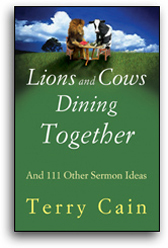
Lions And Cows Dining Together
And 111 Other Sermon Ideas
Object:
Purpose Statement: How do we recognize the truth or know we can trust the sermons we hear since we can never know everything perfectly?
Within Christianity alone, there are a great many brands and flavors. Most churches or denominations make a point of proclaiming biblical truth and God's will. Yet they disagree on numerous issues, even issues of serious contradiction. The only logical conclusion to postulate is that not every one is right. We may even have a sneaky suspicion that all of them are wrong on some doctrines or ideas since we do not have a perfect understanding. Jesus warned us against false prophets (Matthew 24:4, 5, 24). Not every one who claims to be Christian or even called by God to the ministry will know the whole of God's truth and nothing but the truth (see sermon A-1, "Shaking Wolves Out Of Cherry Trees"). Paul also warns us there are false teachers claiming to be able to speak God's truth (2 Corinthians 11:12-15). Are we being misled at times and how will we know?
a. No one has a corner on the truth. Contrary to what some churches and preachers say, we are all still struggling to find the answers. There are theological issues, social problems, and just plain facts that we find difficult knowing for sure what to believe. For example: churches disagree on whether one needs to be baptized to be saved. Each of us should be wary of those who claim to be the true church with the unadulterated gospel.
b. Ultimately, we are the final say. As much as we would like someone to tell us the right doctrine in order that we might memorize it and never have to think again, it can't be done. It is up to us to sort through the debris and confusion for a sound set of principles and theology that serves us. As Paul said, we must work out our salvation and faith, he could have added, "theology" (Philippians 2:12). We must find the beliefs that answer our questions, give us assurance, and provide moral direction. It becomes our own personal struggle. Recognizing that no one church has all "the truth," we choose which church best fits our own individual beliefs and spiritual needs.
c. Challenge everything. We must question and challenge (take with a grain of salt) everything. No matter how impressive the authority may be, we should never blindly accept what we read or hear, but examine it for validity, looking for inconsistencies and errors. The most respectable pastor could be wrong.
d. Run an authenticity test. Ask some salient and practical questions. Does the idea or belief appeal to our selfish interest, or can we find substance and meaning in it despite the fact we may not like it, or despite the fact that it may make us uncomfortable? Second, does it hurt anyone -- others or ourselves? Third, are we hearing or reading this with an open mind or are we stuck on some prejudice or biases? Fourth, is it consistent and reasonable?
e. Let Jesus arbitrate it. Finally, we must add one more critical test. Is the doctrine or theology consistent with the life and teachings of Jesus?
Within Christianity alone, there are a great many brands and flavors. Most churches or denominations make a point of proclaiming biblical truth and God's will. Yet they disagree on numerous issues, even issues of serious contradiction. The only logical conclusion to postulate is that not every one is right. We may even have a sneaky suspicion that all of them are wrong on some doctrines or ideas since we do not have a perfect understanding. Jesus warned us against false prophets (Matthew 24:4, 5, 24). Not every one who claims to be Christian or even called by God to the ministry will know the whole of God's truth and nothing but the truth (see sermon A-1, "Shaking Wolves Out Of Cherry Trees"). Paul also warns us there are false teachers claiming to be able to speak God's truth (2 Corinthians 11:12-15). Are we being misled at times and how will we know?
a. No one has a corner on the truth. Contrary to what some churches and preachers say, we are all still struggling to find the answers. There are theological issues, social problems, and just plain facts that we find difficult knowing for sure what to believe. For example: churches disagree on whether one needs to be baptized to be saved. Each of us should be wary of those who claim to be the true church with the unadulterated gospel.
b. Ultimately, we are the final say. As much as we would like someone to tell us the right doctrine in order that we might memorize it and never have to think again, it can't be done. It is up to us to sort through the debris and confusion for a sound set of principles and theology that serves us. As Paul said, we must work out our salvation and faith, he could have added, "theology" (Philippians 2:12). We must find the beliefs that answer our questions, give us assurance, and provide moral direction. It becomes our own personal struggle. Recognizing that no one church has all "the truth," we choose which church best fits our own individual beliefs and spiritual needs.
c. Challenge everything. We must question and challenge (take with a grain of salt) everything. No matter how impressive the authority may be, we should never blindly accept what we read or hear, but examine it for validity, looking for inconsistencies and errors. The most respectable pastor could be wrong.
d. Run an authenticity test. Ask some salient and practical questions. Does the idea or belief appeal to our selfish interest, or can we find substance and meaning in it despite the fact we may not like it, or despite the fact that it may make us uncomfortable? Second, does it hurt anyone -- others or ourselves? Third, are we hearing or reading this with an open mind or are we stuck on some prejudice or biases? Fourth, is it consistent and reasonable?
e. Let Jesus arbitrate it. Finally, we must add one more critical test. Is the doctrine or theology consistent with the life and teachings of Jesus?
