
"Forgive Us Our DebtsÓ
Sermon
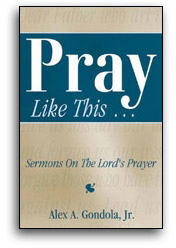
PRAY LIKE THIS ...
Sermons On The Lord's Prayer
"Forgive us our debts as we forgive our debtors." I don't know about you, but I find the second part of that petition much harder than the first. I find it relatively easy to ask God for forgiveness. I need God's forgiveness every day, just like I need my daily bread. But I sometimes have trouble forgiving others. What about you? Do you sometimes find it hard to forgive?
Have you ever found yourself reliving a painful incident again and again, as if you were watching a videotape in your head over and over? Have you ever fantasized, yearned for, or plotted revenge? Ever reveled in revenge? Have you ever let a wound fester, picking at it again and again so it never heals completely? Or am I the only one?
Consider this story. After the Civil War, Robert E. Lee, the former Confederate Commander, visited Kentucky. Lee stopped at a local woman's farm. She brought Robert E. Lee to her front yard and pointed out what was left of a once magnificent old tree. The woman cried bitterly because Union artillery fire had destroyed its trunk and branches.
The woman expected Robert E. Lee to join her in condemning "those damn Yankees." But after a brief silence, Lee simply said, "Cut it down, my dear madam, and forget it." Good advice: I know - we all know - there are some things we should just "cut down and forget."
But when people hurt us and the wounds are deep, how can we forgive them? Jesus tells us to forgive. But he doesn't say how to forgive. So maybe many of us, myself included, need a refresher course in forgiveness. I'd like to offer one, based on my personal reading over the last week. Let's call it "Forgiveness 101 - The Four Foundations To Forgiving."
The first foundation to forgiveness is - if we're ever going to forgive - we really have to want to. It can be tempting, even comfortable, to hold onto a grudge, can't it? Like a character in Robert Burns' poem, "Tam o' Shanter," we may nurse our "wrath to keep it warm." Frederick William I, King of Prussia was on his deathbed. His pastor encouraged William to forgive his enemies if he wanted to go to heaven. Frederick thought immediately of his despised brother--in--law, King George II of England. Frederick told his wife reluctantly, "In that case, write to your brother and tell him I forgive him. But," he continued, "be sure not to do it until after my death" (The Little, Brown Book of Anecdotes, Clifton Fadiman, editor, Little Brown, p. 223). Frederick didn't really want to forgive!
But harboring hurts and building up bitterness is toxic to us, isn't it? Booker T. Washington was right when he said, "I will not permit any man to narrow and degrade my soul by making me hate him." Another wise person, Hannah Moore, wrote, "If I had an enemy whom I wanted to punish, I would teach him to hate someone." Or, as Buddha put it, holding onto anger is like grabbing a hot coal in our hand with the intention of throwing it at someone. We're the ones who end up being burned.
There's a Russian folk tale about a mean man who went to hell. He found himself waist deep in a lake of fire. The tortured man begged the avenging angel for relief. The angel asked the mean man if he could remember doing even one merciful thing in his lifetime. The tortured man thought and thought - and finally remembered once giving an onion to a hungry beggar.
So the angel held out an onion and told the man to grab it. He did. Then the angel began to pull the man out of Hell. Several of his fellow sufferers saw what was happening and clung to the man's legs, hoping to escape with him. But he began to kick and struggle, shouting, "It's my onion! It's my onion." The onion fell apart, and the man fell back into the lake of fire. The first foundation of forgiveness is clinging to it: really wanting to forgive someone, if not for his or her sake, then at least for ours.
According to what I've read, forgiveness foundation two is "be realistic." Being realistic has two parts. One is acknowledging our hurt. Sometimes we are hurt but deny it. We can be like the woman who said, "I'm so glad I got religion. I've got an uncle I used to hate so much I vowed I would never go to his funeral. But, now I'd be happy to go to his funeral anytime!" Do you think that woman ever really acknowledged her anger toward her uncle?
"Forgiveness," as someone once put it, "is no duck's back." Few of us get hurt and it just rolls off us. It's okay to acknowledge to ourselves and others, "That hurt! I'm hurt." But we also must guard against taking some injury and blowing it way out of proportion. As Walter Wangerin, Jr., put it, we can "dump a thousand grievances into a single pot of sin" (As For Me and My House, Thomas Nelson, p. 97).
Say someone slights us. We can see that slight as an isolated incident. Or it can become the magnet that collects every slight we have ever received since childhood. Then, remembering all those past hurts, we can blow up at the person who has hurt us in the present. If we are to forgive, we need to be realistic: acknowledging the offense, but keeping it in perspective.
Forgiveness foundation three: surrender your right to get even. This is hard. For when we are wronged, every bone in our body cries out, "That's not fair!" Ever bump a little child accidentally? Almost instantaneously the child wells up with anger or tears or both. When we're hurt, the little child inside us cries out for justice. We want the scales balanced. And we may well deserve justice. It can be hard to let go of that. But it seems we have to, if we're going to forgive.
Does that mean we shouldn't confront people or hold them accountable for hurting us? No. Sometimes, if the relationship is strong enough, it's quite appropriate, even healthy, to confront the people who hurt us, telling them specifically how they hurt us and how we feel about it. But if we do so, we must do so carefully, with humility, gentleness, and love. It might help to remember the point of this little poem:
Has God deserted heaven
And left it up to you,
To judge if this or that is right
And what each one should do?
I think (God's) still in business
And knows when to wield the rod,
So when you're judging others,
Just remember, you're not - God.
(Quoted by Charles L. Allen in God's Psychiatry, Spire Books, p. 116)
You and I are not God. Although we're sinned against, we're also sinners. Can we remember that every day we need forgiveness ourselves?
Abraham Lincoln once received a letter from a man begging for a pardon. Lincoln was surprised there were no character references or letters of recommendation with the request. "Has this man no friends?" Lincoln asked his assistant. "No, Sir, he hasn't," the assistant responded. "Then I will be his friend," Abe said, and signed the pardon (reported by David L. Williamson in The Library of Distinctive Sermons, volume 5, Questars Publishers, pp. 259--60).
Before we lash out at another, can we remember that God has been our friend in those moments when we've been friendless? Can we remember that God has pardoned us for our sins that sent Christ to the Cross?
On the Cross, Jesus surrendered his right to get even. He could have called on twelve legions of angels to defend him (Matthew 26:53). But he didn't. Even on the cross, with nails in his hands and feet, he forgave his enemies: "Father, forgive them; for they know not what they do" (Luke 23:34 RSV).
But you and I are among those Christ has forgiven! Can't we, then, who have been loved to death (his death) by Jesus, forgive someone else for Christ's sake? Can't we surrender our right to get even? And if and when we do confront someone, can we do it in a spirit of humility, gentleness, and love?
As I understand it, the first three foundations of forgiveness are 1) really wanting to forgive; 2) being realistic about the hurt; and 3) surrendering our right to get even. The final foundation of forgiveness is "move on."
Preacher John Claypool gives us another Kentucky tree story. It seems there was a large orchard on his grandfather's farm. One day a powerful thunderstorm blew through that orchard. It blew down a pear tree that had been around for many years.
Claypool's grandfather really grieved the loss of that pear tree. He had climbed it as a boy and eaten its fruit all his life. A neighbor came over and said, "Doc, I'm really sorry to see your pear tree blown down."
"I'm sorry, too," his grandfather responded. "It was a real part of my past."
The neighbor said, "What are you going to do?"
Claypool's grandfather thought for a long moment. Then he said, "I'm going to pick the fruit and burn what's left."
John Claypool comments, "That's such a wise way of working with the past. We do need to pick its fruit. We need to learn its lessons ... But having learned what the past can teach us, we need to pick the fruit, burn what's left, and go on" ("The Future and Forgetting," Preaching Today Tape Number 109).
Lewis Smedes speaks of the beautiful fruits of forgiveness. By working through the foundations for forgiveness, over time "you begin to revise your feelings. The person who hurt you gradually rejoins the human race ... (You) recognize that the person who hurt you is a failed, a flawed, a fallible human being not much different from you ...."
Smedes continues, "The first time you feel you can think of the person that hurt you and just wish or pray that something good could happen to that person - maybe the good is the good that he'll never do it to anybody else - when you reach that point, you know you are on your way" to forgiveness ("Forgiveness, Doubt, Love" in Wrestling with Angels, Zondervan Publishing House).
Forgiveness may be difficult. But forgiveness can be fruitful.
Let us pray: God, help us to forgive our debtors as you already have forgiven our debts. Give us the grace we need to move on in the process of forgiveness. We ask in the name of Jesus Christ. Amen.
Have you ever found yourself reliving a painful incident again and again, as if you were watching a videotape in your head over and over? Have you ever fantasized, yearned for, or plotted revenge? Ever reveled in revenge? Have you ever let a wound fester, picking at it again and again so it never heals completely? Or am I the only one?
Consider this story. After the Civil War, Robert E. Lee, the former Confederate Commander, visited Kentucky. Lee stopped at a local woman's farm. She brought Robert E. Lee to her front yard and pointed out what was left of a once magnificent old tree. The woman cried bitterly because Union artillery fire had destroyed its trunk and branches.
The woman expected Robert E. Lee to join her in condemning "those damn Yankees." But after a brief silence, Lee simply said, "Cut it down, my dear madam, and forget it." Good advice: I know - we all know - there are some things we should just "cut down and forget."
But when people hurt us and the wounds are deep, how can we forgive them? Jesus tells us to forgive. But he doesn't say how to forgive. So maybe many of us, myself included, need a refresher course in forgiveness. I'd like to offer one, based on my personal reading over the last week. Let's call it "Forgiveness 101 - The Four Foundations To Forgiving."
The first foundation to forgiveness is - if we're ever going to forgive - we really have to want to. It can be tempting, even comfortable, to hold onto a grudge, can't it? Like a character in Robert Burns' poem, "Tam o' Shanter," we may nurse our "wrath to keep it warm." Frederick William I, King of Prussia was on his deathbed. His pastor encouraged William to forgive his enemies if he wanted to go to heaven. Frederick thought immediately of his despised brother--in--law, King George II of England. Frederick told his wife reluctantly, "In that case, write to your brother and tell him I forgive him. But," he continued, "be sure not to do it until after my death" (The Little, Brown Book of Anecdotes, Clifton Fadiman, editor, Little Brown, p. 223). Frederick didn't really want to forgive!
But harboring hurts and building up bitterness is toxic to us, isn't it? Booker T. Washington was right when he said, "I will not permit any man to narrow and degrade my soul by making me hate him." Another wise person, Hannah Moore, wrote, "If I had an enemy whom I wanted to punish, I would teach him to hate someone." Or, as Buddha put it, holding onto anger is like grabbing a hot coal in our hand with the intention of throwing it at someone. We're the ones who end up being burned.
There's a Russian folk tale about a mean man who went to hell. He found himself waist deep in a lake of fire. The tortured man begged the avenging angel for relief. The angel asked the mean man if he could remember doing even one merciful thing in his lifetime. The tortured man thought and thought - and finally remembered once giving an onion to a hungry beggar.
So the angel held out an onion and told the man to grab it. He did. Then the angel began to pull the man out of Hell. Several of his fellow sufferers saw what was happening and clung to the man's legs, hoping to escape with him. But he began to kick and struggle, shouting, "It's my onion! It's my onion." The onion fell apart, and the man fell back into the lake of fire. The first foundation of forgiveness is clinging to it: really wanting to forgive someone, if not for his or her sake, then at least for ours.
According to what I've read, forgiveness foundation two is "be realistic." Being realistic has two parts. One is acknowledging our hurt. Sometimes we are hurt but deny it. We can be like the woman who said, "I'm so glad I got religion. I've got an uncle I used to hate so much I vowed I would never go to his funeral. But, now I'd be happy to go to his funeral anytime!" Do you think that woman ever really acknowledged her anger toward her uncle?
"Forgiveness," as someone once put it, "is no duck's back." Few of us get hurt and it just rolls off us. It's okay to acknowledge to ourselves and others, "That hurt! I'm hurt." But we also must guard against taking some injury and blowing it way out of proportion. As Walter Wangerin, Jr., put it, we can "dump a thousand grievances into a single pot of sin" (As For Me and My House, Thomas Nelson, p. 97).
Say someone slights us. We can see that slight as an isolated incident. Or it can become the magnet that collects every slight we have ever received since childhood. Then, remembering all those past hurts, we can blow up at the person who has hurt us in the present. If we are to forgive, we need to be realistic: acknowledging the offense, but keeping it in perspective.
Forgiveness foundation three: surrender your right to get even. This is hard. For when we are wronged, every bone in our body cries out, "That's not fair!" Ever bump a little child accidentally? Almost instantaneously the child wells up with anger or tears or both. When we're hurt, the little child inside us cries out for justice. We want the scales balanced. And we may well deserve justice. It can be hard to let go of that. But it seems we have to, if we're going to forgive.
Does that mean we shouldn't confront people or hold them accountable for hurting us? No. Sometimes, if the relationship is strong enough, it's quite appropriate, even healthy, to confront the people who hurt us, telling them specifically how they hurt us and how we feel about it. But if we do so, we must do so carefully, with humility, gentleness, and love. It might help to remember the point of this little poem:
Has God deserted heaven
And left it up to you,
To judge if this or that is right
And what each one should do?
I think (God's) still in business
And knows when to wield the rod,
So when you're judging others,
Just remember, you're not - God.
(Quoted by Charles L. Allen in God's Psychiatry, Spire Books, p. 116)
You and I are not God. Although we're sinned against, we're also sinners. Can we remember that every day we need forgiveness ourselves?
Abraham Lincoln once received a letter from a man begging for a pardon. Lincoln was surprised there were no character references or letters of recommendation with the request. "Has this man no friends?" Lincoln asked his assistant. "No, Sir, he hasn't," the assistant responded. "Then I will be his friend," Abe said, and signed the pardon (reported by David L. Williamson in The Library of Distinctive Sermons, volume 5, Questars Publishers, pp. 259--60).
Before we lash out at another, can we remember that God has been our friend in those moments when we've been friendless? Can we remember that God has pardoned us for our sins that sent Christ to the Cross?
On the Cross, Jesus surrendered his right to get even. He could have called on twelve legions of angels to defend him (Matthew 26:53). But he didn't. Even on the cross, with nails in his hands and feet, he forgave his enemies: "Father, forgive them; for they know not what they do" (Luke 23:34 RSV).
But you and I are among those Christ has forgiven! Can't we, then, who have been loved to death (his death) by Jesus, forgive someone else for Christ's sake? Can't we surrender our right to get even? And if and when we do confront someone, can we do it in a spirit of humility, gentleness, and love?
As I understand it, the first three foundations of forgiveness are 1) really wanting to forgive; 2) being realistic about the hurt; and 3) surrendering our right to get even. The final foundation of forgiveness is "move on."
Preacher John Claypool gives us another Kentucky tree story. It seems there was a large orchard on his grandfather's farm. One day a powerful thunderstorm blew through that orchard. It blew down a pear tree that had been around for many years.
Claypool's grandfather really grieved the loss of that pear tree. He had climbed it as a boy and eaten its fruit all his life. A neighbor came over and said, "Doc, I'm really sorry to see your pear tree blown down."
"I'm sorry, too," his grandfather responded. "It was a real part of my past."
The neighbor said, "What are you going to do?"
Claypool's grandfather thought for a long moment. Then he said, "I'm going to pick the fruit and burn what's left."
John Claypool comments, "That's such a wise way of working with the past. We do need to pick its fruit. We need to learn its lessons ... But having learned what the past can teach us, we need to pick the fruit, burn what's left, and go on" ("The Future and Forgetting," Preaching Today Tape Number 109).
Lewis Smedes speaks of the beautiful fruits of forgiveness. By working through the foundations for forgiveness, over time "you begin to revise your feelings. The person who hurt you gradually rejoins the human race ... (You) recognize that the person who hurt you is a failed, a flawed, a fallible human being not much different from you ...."
Smedes continues, "The first time you feel you can think of the person that hurt you and just wish or pray that something good could happen to that person - maybe the good is the good that he'll never do it to anybody else - when you reach that point, you know you are on your way" to forgiveness ("Forgiveness, Doubt, Love" in Wrestling with Angels, Zondervan Publishing House).
Forgiveness may be difficult. But forgiveness can be fruitful.
Let us pray: God, help us to forgive our debtors as you already have forgiven our debts. Give us the grace we need to move on in the process of forgiveness. We ask in the name of Jesus Christ. Amen.
