
God's 'No'
Sermon
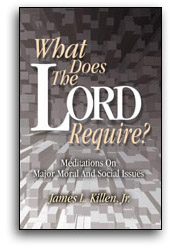
WHAT DOES THE LORD REQUIRE?
Meditations On Major Moral And Social Issues
We modern Christians like to think of ourselves as people who practice a positive religion, one that puts the emphasis on the "Thou shalts" rather than on the "Thou shalt nots," especially the one that says, "Thou shalt love." We think that a life that is shaped primarily by a bunch of "no--nos" would be stifling and joyless. We think that life ought rather to be shaped by hearing and believing the great "Yes" that God speaks in love to us and to every person. That is a good way to think about the Christian faith. But yet - but yet - there is still a great "No" that is part of God's interaction with us, and we need to hear it and to heed it because to ignore it is to put ourselves and the whole creation in serious jeopardy.
That great "No" is God's response to everything that is contrary to God's loving purpose for us. God wants for us, and for the whole creation, life at its very best. We were created to live up to the very highest possible level of humanity and to maintain God's creation in beauty and justice and goodness. God's "Yes" rests upon everything that builds up and moves the creation toward the fulfillment of that purpose. But God's "No" must rest upon everything that is hurtful or destructive to us or to the rest of God's creation.
This "No" that we are talking about is not just some moralistic little prohibition. It is a great convulsion, choked with divine anguish. It is like something that originates in the most distant part of the universe. It rushes toward us giving the galaxies a spin as it comes. When it strikes, it makes the mountains quake. And, if our humanity is not dead, it reverberates in our own minds and echoes back as a "No" that is our own. It is the horrified reaction of one who loves to all that destroys what is loved. And even when it is translated into laws written on stone by the very hand of God, it loses something in translation.
What kind of thing could evoke that kind of response from God? The most conspicuous example we can think of is war. Many of you have been to war and you know what it is like. The rest of us can only imagine what it is like on the basis of what we have heard. Our imagining tells us that it must be horrible. It turns beautiful countrysides into desolation and cities into rubble. It destroys the infrastructures that both God and humans have created to sustain life. It regards God's most beautiful and precious creations, human beings, as disposable. It piles their lifeless bodies up like cordwood, having undone the miracle of the creation of life. It attacks the humanity of all who are involved in it. It doesn't matter whether it is a primitive conflict fought with handheld machetes or a sophisticated modern warfare in which deadly missiles are aimed at populated areas by people sitting at computer consoles so far away that they can't see the destruction they cause. The effect is the same.
Some parts of the Bible say some very bewildering things about God being involved in warfare. But if God really is the loving God whom we know through Jesus Christ, there cannot be any war that does not break the heart of God.
Now please understand that nothing we are saying is intended as an attack on those brave people whose names are carved on that black marble wall in Washington - or on the thousands of red granite monuments on courthouse lawns all across this country. They are victims of the tragedy as surely as are little girls burned by napalm. Soldiers are somebody's children, too. They are victims, too. Those who are required to die are victims of one kind and those who are required to kill are victims of another kind - and some of you sitting here know what that means.
Can anything be more horrible than war? Can't we all see clearly that God's "No" rests upon it? And yet, we have so clothed our wars with the noble trappings of patriotism that we often fail to hear the "No." We do that to make it possible for us to endure what tragic history sometimes makes necessary. But we do that at great risk. When we silence the "No" we may begin to think of war as an acceptable way of accomplishing national objectives. Some, who wage crusades and jihads, even go to war in the name of religion. In the Middle East, in Northern Ireland, in Bosnia, and in other places, we have even seen people go to war to oppress and destroy and rape and kill in the name of the Christian religion. How can anyone who knows anything about Jesus do that? When God sees that, God's response must certainly be a great, heartbroken, "No, no, no." And we put the whole creation in jeopardy when we refuse to hear it.
One certain pastor led his congregation in praying their way through the war in the Persian Gulf. A number of members of his congregation had family members or loved ones serving in or near the action. As a church family, they prayed their way through that terrible time. Generally, they made the assumption that their country's involvement there was a tragic necessity, something made necessary by criminal aggression. But when the war was over, the pastor was chagrined to see that the victory celebration suggested that some were making political capital out of the tragedy. He felt that he had to say something from the pulpit about celebrating the end of a tragedy in the same way one might celebrate a high school football championship. He knew that some would not like it. And some didn't. But after the worship service, two men, who were older than the pastor, came around separately and privately and said, "Preacher, I am glad you said that. These people don't seem to realize that we killed thousands of people over there." Both of those men had flown bombers during the Second World War. One had been a pilot and one had been a bombardier. They were brave men who did what they felt they had to do in the midst of a tragic time in the world's history. But they still dared to let themselves hear God's "No" resting upon the whole war - and they didn't pretend that it was right or good - and they didn't let themselves forget how bad it was.
Where does this divine "No" come from? It comes from the same place as the divine "Yes." It is the other side of the divine "Yes." It is not just a legalistic prohibition. It is like the awful "No" that rises in the heart of a parent who drives past a traffic accident and realizes that the small car that has just been crushed by an eighteen--wheeler is the one they bought for their children to drive.
Fortunately, very few parents actually have to experience that - but every parent imagines it. And, kids, in case you are wondering, that kind of imagining is the origin of most of those troublesome restrictions your parents impose on you while you are growing up. It may help to know that your parents make up all of those "thou shalt nots" because they love you and they want to keep you alive and on the right track toward a healthy and happy life.
In just the same way, those divine "Thou shalt nots" arise out of God's "Yes" to all that is good for us. Commandments like "Thou shalt not kill," "Thou shalt not steal," "Thou shalt not commit adultery," and the rest come from the aching heart of God who loves us and knows what can happen to us. The things they prohibit are things that could wreck our lives.
But this was not supposed to be a sermon on war. That is just one conspicuous example of the kind of thing that evokes a great "No" from God. What are some other examples?
Famine must be as repulsive to God as war. This world is able to produce enough food to feed its whole population. Yet, time and time again, political oppression, or greed, or short--sightedness plunge whole parts of the world into famines that cause little children to grow up mentally retarded because of malnutrition and that threatens adults with the slow, agonizing death of starvation. Till yet, when we see their emaciated faces looking at us from the covers of news magazines, we hear God's "No" echoing back from deep within ourselves and we send aid. But there is danger that we could slip into "compassion fatigue" and that our selfishness could make us stop hearing the "No."
Let's face another of the knotty problems of our day. How does all of this apply to abortion? That issue is really much more complex than the most vocal protagonists on either side of the argument want to admit. It is foolish to say that an unborn child is just tissue that can be disposed of if it is troublesome. It is a person. Just ask any mother who is going through a wanted pregnancy. To that mother, the fetus is a person and the mother loves it and wants for it to be born into a loving family and to grow up into a healthy, happy, productive person. We can believe that God feels that way about every unborn child. Yes, there are some tragic human situations that may make the termination of a pregnancy the lesser of two evils. But nothing can make it really right. And whenever a person, either born or unborn, dies short of human fulfillment, no matter what the reason, that is the occasion for great grief in the heart of God. Anyone who is having to make a decision about an abortion needs to take that into consideration. Not to do so is to lose part of our humanity.
God's "No" rests on many different human situations. It probably rests upon some things that we don't think about, things that our culture has taught us to think of as acceptable. It rests on things like young people having everything they need to make life wholesome and good but trashing it all in the pursuit of some attractive pleasure. God's "No" rests on things like families having all of the advantages that should enable them to build strong, loving family relationships but letting that slip away as one of the casualties of their pursuit of material prosperity. When we see that sort of thing happening, we should hear God sobbing. We will all be wise to stay sensitive to the sadness of God.
Well then, what are we to make of all of that? It really doesn't translate into any simple rules for living. It is still true that life shaped by "Thou shalt nots" alone will be a stale and joyless existence. It is true that the big question must always be, "What does love require?" And it isn't enough just to say, "Always do what is right and never do what is wrong." Life won't let us live that way. Life is always dancing us into situations in which we are forced to decide which is the lesser of two evils. And it is not always easy to know what love requires. Time and again, decisiveness will require us to choose between options that are all at least partially wrong.
But in those times, we ought not to tell ourselves that what we are doing is right or good. We ought always to let ourselves hear God's "No" when it comes through. We will be wise always to let it be part of the conversation that shapes our decisions. And when we find God's "No" resting upon our actions, we can let it send us looking for God's forgiving grace - and for God's saving work - and for God's guidance to show us a better way. At the very least, continuing to hear God's "No" can keep our humanity alive even in the most compromised of life situations. It is important to know that, because God's "No," like God's "Yes," is a gift of love.1
____________
1. This sermon was originally published in Pulpit Digest, March--April, 1998, David Albert Farmer, Editor (Inver Grove Heights, Minnesota: Logos Productions Inc.).
That great "No" is God's response to everything that is contrary to God's loving purpose for us. God wants for us, and for the whole creation, life at its very best. We were created to live up to the very highest possible level of humanity and to maintain God's creation in beauty and justice and goodness. God's "Yes" rests upon everything that builds up and moves the creation toward the fulfillment of that purpose. But God's "No" must rest upon everything that is hurtful or destructive to us or to the rest of God's creation.
This "No" that we are talking about is not just some moralistic little prohibition. It is a great convulsion, choked with divine anguish. It is like something that originates in the most distant part of the universe. It rushes toward us giving the galaxies a spin as it comes. When it strikes, it makes the mountains quake. And, if our humanity is not dead, it reverberates in our own minds and echoes back as a "No" that is our own. It is the horrified reaction of one who loves to all that destroys what is loved. And even when it is translated into laws written on stone by the very hand of God, it loses something in translation.
What kind of thing could evoke that kind of response from God? The most conspicuous example we can think of is war. Many of you have been to war and you know what it is like. The rest of us can only imagine what it is like on the basis of what we have heard. Our imagining tells us that it must be horrible. It turns beautiful countrysides into desolation and cities into rubble. It destroys the infrastructures that both God and humans have created to sustain life. It regards God's most beautiful and precious creations, human beings, as disposable. It piles their lifeless bodies up like cordwood, having undone the miracle of the creation of life. It attacks the humanity of all who are involved in it. It doesn't matter whether it is a primitive conflict fought with handheld machetes or a sophisticated modern warfare in which deadly missiles are aimed at populated areas by people sitting at computer consoles so far away that they can't see the destruction they cause. The effect is the same.
Some parts of the Bible say some very bewildering things about God being involved in warfare. But if God really is the loving God whom we know through Jesus Christ, there cannot be any war that does not break the heart of God.
Now please understand that nothing we are saying is intended as an attack on those brave people whose names are carved on that black marble wall in Washington - or on the thousands of red granite monuments on courthouse lawns all across this country. They are victims of the tragedy as surely as are little girls burned by napalm. Soldiers are somebody's children, too. They are victims, too. Those who are required to die are victims of one kind and those who are required to kill are victims of another kind - and some of you sitting here know what that means.
Can anything be more horrible than war? Can't we all see clearly that God's "No" rests upon it? And yet, we have so clothed our wars with the noble trappings of patriotism that we often fail to hear the "No." We do that to make it possible for us to endure what tragic history sometimes makes necessary. But we do that at great risk. When we silence the "No" we may begin to think of war as an acceptable way of accomplishing national objectives. Some, who wage crusades and jihads, even go to war in the name of religion. In the Middle East, in Northern Ireland, in Bosnia, and in other places, we have even seen people go to war to oppress and destroy and rape and kill in the name of the Christian religion. How can anyone who knows anything about Jesus do that? When God sees that, God's response must certainly be a great, heartbroken, "No, no, no." And we put the whole creation in jeopardy when we refuse to hear it.
One certain pastor led his congregation in praying their way through the war in the Persian Gulf. A number of members of his congregation had family members or loved ones serving in or near the action. As a church family, they prayed their way through that terrible time. Generally, they made the assumption that their country's involvement there was a tragic necessity, something made necessary by criminal aggression. But when the war was over, the pastor was chagrined to see that the victory celebration suggested that some were making political capital out of the tragedy. He felt that he had to say something from the pulpit about celebrating the end of a tragedy in the same way one might celebrate a high school football championship. He knew that some would not like it. And some didn't. But after the worship service, two men, who were older than the pastor, came around separately and privately and said, "Preacher, I am glad you said that. These people don't seem to realize that we killed thousands of people over there." Both of those men had flown bombers during the Second World War. One had been a pilot and one had been a bombardier. They were brave men who did what they felt they had to do in the midst of a tragic time in the world's history. But they still dared to let themselves hear God's "No" resting upon the whole war - and they didn't pretend that it was right or good - and they didn't let themselves forget how bad it was.
Where does this divine "No" come from? It comes from the same place as the divine "Yes." It is the other side of the divine "Yes." It is not just a legalistic prohibition. It is like the awful "No" that rises in the heart of a parent who drives past a traffic accident and realizes that the small car that has just been crushed by an eighteen--wheeler is the one they bought for their children to drive.
Fortunately, very few parents actually have to experience that - but every parent imagines it. And, kids, in case you are wondering, that kind of imagining is the origin of most of those troublesome restrictions your parents impose on you while you are growing up. It may help to know that your parents make up all of those "thou shalt nots" because they love you and they want to keep you alive and on the right track toward a healthy and happy life.
In just the same way, those divine "Thou shalt nots" arise out of God's "Yes" to all that is good for us. Commandments like "Thou shalt not kill," "Thou shalt not steal," "Thou shalt not commit adultery," and the rest come from the aching heart of God who loves us and knows what can happen to us. The things they prohibit are things that could wreck our lives.
But this was not supposed to be a sermon on war. That is just one conspicuous example of the kind of thing that evokes a great "No" from God. What are some other examples?
Famine must be as repulsive to God as war. This world is able to produce enough food to feed its whole population. Yet, time and time again, political oppression, or greed, or short--sightedness plunge whole parts of the world into famines that cause little children to grow up mentally retarded because of malnutrition and that threatens adults with the slow, agonizing death of starvation. Till yet, when we see their emaciated faces looking at us from the covers of news magazines, we hear God's "No" echoing back from deep within ourselves and we send aid. But there is danger that we could slip into "compassion fatigue" and that our selfishness could make us stop hearing the "No."
Let's face another of the knotty problems of our day. How does all of this apply to abortion? That issue is really much more complex than the most vocal protagonists on either side of the argument want to admit. It is foolish to say that an unborn child is just tissue that can be disposed of if it is troublesome. It is a person. Just ask any mother who is going through a wanted pregnancy. To that mother, the fetus is a person and the mother loves it and wants for it to be born into a loving family and to grow up into a healthy, happy, productive person. We can believe that God feels that way about every unborn child. Yes, there are some tragic human situations that may make the termination of a pregnancy the lesser of two evils. But nothing can make it really right. And whenever a person, either born or unborn, dies short of human fulfillment, no matter what the reason, that is the occasion for great grief in the heart of God. Anyone who is having to make a decision about an abortion needs to take that into consideration. Not to do so is to lose part of our humanity.
God's "No" rests on many different human situations. It probably rests upon some things that we don't think about, things that our culture has taught us to think of as acceptable. It rests on things like young people having everything they need to make life wholesome and good but trashing it all in the pursuit of some attractive pleasure. God's "No" rests on things like families having all of the advantages that should enable them to build strong, loving family relationships but letting that slip away as one of the casualties of their pursuit of material prosperity. When we see that sort of thing happening, we should hear God sobbing. We will all be wise to stay sensitive to the sadness of God.
Well then, what are we to make of all of that? It really doesn't translate into any simple rules for living. It is still true that life shaped by "Thou shalt nots" alone will be a stale and joyless existence. It is true that the big question must always be, "What does love require?" And it isn't enough just to say, "Always do what is right and never do what is wrong." Life won't let us live that way. Life is always dancing us into situations in which we are forced to decide which is the lesser of two evils. And it is not always easy to know what love requires. Time and again, decisiveness will require us to choose between options that are all at least partially wrong.
But in those times, we ought not to tell ourselves that what we are doing is right or good. We ought always to let ourselves hear God's "No" when it comes through. We will be wise always to let it be part of the conversation that shapes our decisions. And when we find God's "No" resting upon our actions, we can let it send us looking for God's forgiving grace - and for God's saving work - and for God's guidance to show us a better way. At the very least, continuing to hear God's "No" can keep our humanity alive even in the most compromised of life situations. It is important to know that, because God's "No," like God's "Yes," is a gift of love.1
____________
1. This sermon was originally published in Pulpit Digest, March--April, 1998, David Albert Farmer, Editor (Inver Grove Heights, Minnesota: Logos Productions Inc.).
